
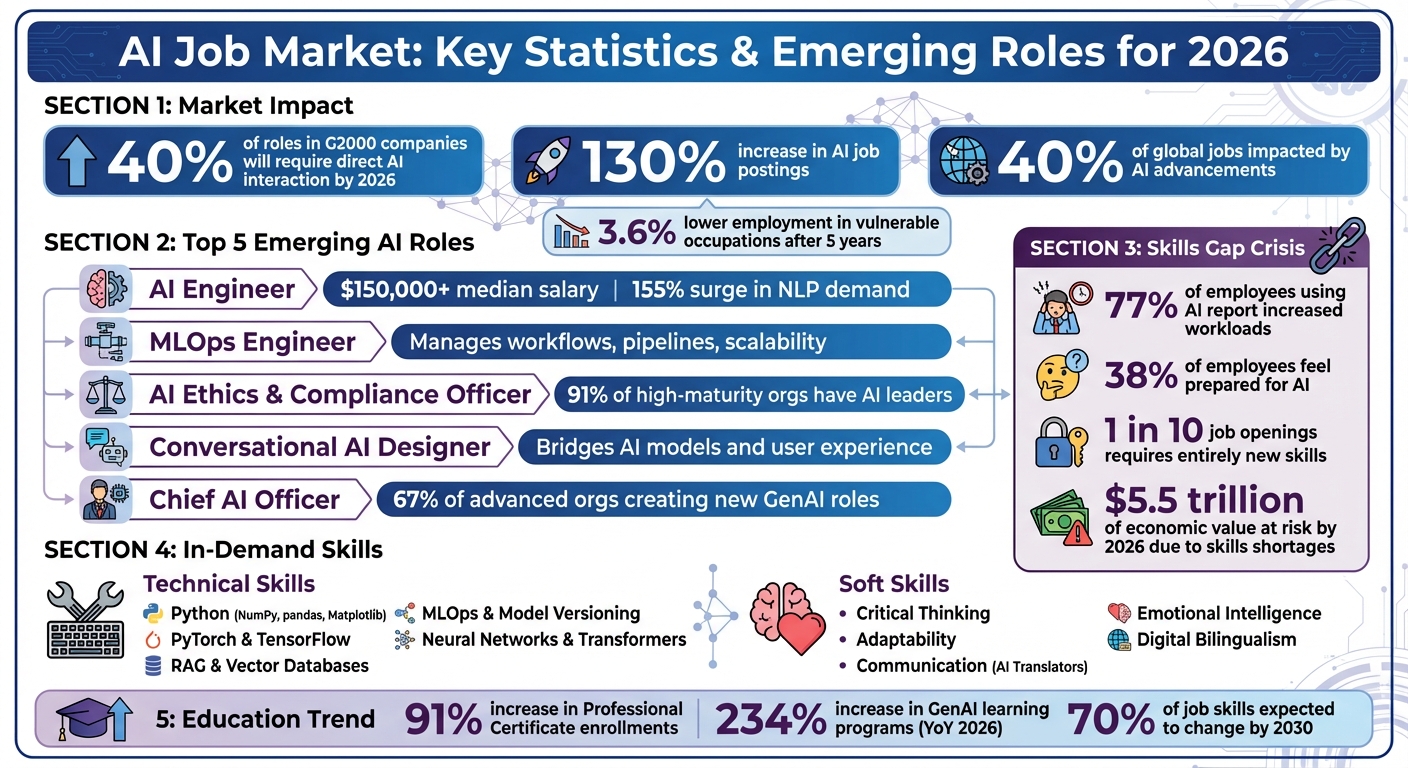
Artificial intelligence is reshaping the job market faster than ever. By 2026, nearly 40% of roles in large companies will require direct interaction with AI, while the demand for AI expertise has surged by 130%. However, as AI automates repetitive tasks, entry-level positions are disappearing, creating a growing skills gap.
Key takeaways:
- New Roles: Positions like AI Engineers, MLOps Engineers, AI Ethics Officers, Conversational AI Designers, and Chief AI Officers are gaining traction.
- Skills in Demand: Python, machine learning frameworks (e.g., PyTorch, TensorFlow), and tools like vector databases are critical. Soft skills like critical thinking and communication are equally important.
- Challenges: Traditional education systems lag behind, leaving workers unprepared for AI-driven roles. Many organizations report employees struggling to use AI tools effectively.
If you're looking to thrive in this AI-driven era, focus on blending technical expertise with human judgment, and leverage platforms like Acedit for tailored skill-building and career preparation.
AI Job Market Statistics and Emerging Roles 2026
LinkedIn CEO: The Fastest-Growing Jobs in the AI Era - How to Prepare
sbb-itb-20a3bee
The Problem: Skills Gap in AI Jobs
AI is advancing at a breakneck pace, but the workforce isn't keeping up. 40% of global jobs are now impacted by AI advancements, yet traditional education systems are struggling to adapt. This mismatch is especially visible in the shrinking pool of entry-level jobs.
A major issue is the vanishing of entry-level opportunities. Tasks like data gathering, note-taking, and basic report writing - once stepping stones for beginners - are now automated. This shift means roles that used to provide on-the-job learning are disappearing. For example, even entry-level positions in cybersecurity now ask for at least four years of experience. In areas where AI skills are in high demand, employment in vulnerable occupations is 3.6% lower after five years - a trend that disproportionately affects young workers.
"Today's students need cognitive, creative, and technical skills that complement AI and help them use it rather than compete with it."
– Kristalina Georgieva, Managing Director, IMF
Traditional education isn't keeping pace with these changes. Many programs still focus on teaching functional and technical skills that AI can now handle, while neglecting essential human skills like emotional intelligence and ethical reasoning. Meanwhile, one in 10 job openings in advanced economies requires at least one entirely new skill, yet most educational systems haven't started addressing these needs. Adding to the problem, 77% of employees using AI tools report increased workloads. Instead of boosting productivity, the lack of proper training leaves workers struggling to use these tools effectively.
This creates a troubling cycle. Overdependence on AI can lead to skills atrophy - a decline in critical thinking, writing, and analytical abilities. Workers who skip foundational experiences are thrown into advanced tasks without mastering the basics, leaving them ill-prepared to verify AI outputs or make sound decisions. Bridging these skill gaps is essential to prepare for the future of work in an AI-driven world.
New AI Job Roles Expected in 2026
Generative AI tools are evolving at lightning speed, and with that comes a growing need to scale AI systems effectively while ensuring they operate within ethical and legal boundaries. Job postings referencing AI have jumped by over 130%, and 67% of advanced organizations are now creating entirely new roles tailored to Generative AI.
This shift is creating a noticeable skills gap. By 2026, around 40% of roles in G2000 companies will involve direct interaction with AI agents. Below are five roles shaping the future of work in this space.
AI Engineer
AI Engineers are at the forefront, building and implementing systems that drive everything from predictive analytics to automated customer service. This role is experiencing explosive growth, fueled by the widespread use of generative AI and automation.
Unlike traditional data scientists, AI Engineers focus on creating production-ready AI systems. They work with tools like LangChain and PyTorch, implement Retrieval-Augmented Generation (RAG) systems, and integrate AI seamlessly into existing environments via APIs.
"The most in-demand skills that employers are prioritizing include hands-on programming in Python, familiarity with modern machine learning libraries such as PyTorch and TensorFlow, and the skills required for deploying and managing models in a production environment."
– Ali Gohar, Chief Human Resources Officer, Software Finder
Demand for specialists in Natural Language Processing (NLP) has surged by 155%, with job vacancy rates hitting 15% - double the national average. AI Engineers with these sought-after skills can earn median salaries exceeding $150,000.
MLOps Engineer
MLOps Engineers play a critical role in keeping AI systems reliable and efficient. After models are built, these professionals manage workflows, data pipelines, and ensure scalability without driving up costs or risks.
This role leans heavily on the operational side of AI, covering everything from model versioning and cost optimization to accuracy monitoring and governance. Skills once considered advanced are now baseline expectations for AI-related positions. In industries like healthcare and finance, MLOps Engineers are crucial for creating stable and trustworthy AI infrastructures.
AI Ethics and Compliance Officer
As AI becomes more prevalent, concerns about fairness, bias, and legal accountability are growing. AI Ethics and Compliance Officers are the gatekeepers who ensure systems align with ethical standards and comply with regulations like the EU AI Act.
These professionals audit AI systems for bias, assess risks in high-stakes scenarios, and develop frameworks for responsible AI use. For example, in May 2025, Moderna combined its technology and HR teams under Tracey Franklin to integrate AI with human workflows while maintaining ethical oversight.
"By 2026, building trust in AI is predicted to be organizations' #1 challenge."
– ODSC Team
With only 32% of Americans currently trusting AI and mentions of "Responsible AI" appearing in nearly 1% of all AI job posts across 22 countries by 2025, this role is becoming indispensable for avoiding legal, financial, and reputational risks.
Conversational AI Designer
Conversational AI Designers focus on creating user-friendly interfaces for AI-powered chatbots and virtual assistants. Their goal is to ensure these systems provide accurate, contextually relevant, and brand-consistent responses.
These designers bridge the gap between AI models and user experience. They also leverage Context Engineering - grounding AI responses in company-specific data to minimize hallucinations or irrelevant answers.
Chief AI Officer
The Chief AI Officer (CAIO) is a high-level executive tasked with steering AI adoption across an organization. This role involves aligning AI initiatives with business goals, ensuring a solid return on investment, and managing the large-scale changes AI requires.
A staggering 91% of high-maturity organizations already have a dedicated AI leader. For instance, in September 2025, RTX Chief Digital Officer Vince Campisi introduced a "three M's" governance strategy - map, measure, and monitor - to oversee AI deployment while maintaining essential human oversight.
The CAIO must balance deep technical knowledge with strategic business acumen. In January 2025, Coca-Cola's CIO Neeraj Tolmare demonstrated this by implementing modular architectures and agile team structures to localize AI solutions across global markets.
"We've moved beyond retrofitting AI into existing roles. Now we're seeing signs of companies building them for a native AI Era."
– Marinela Profi, Global AI Strategy Lead, SAS
With skills shortages in AI projected to put up to $5.5 trillion of global economic value at risk by 2026, having strong leadership at the helm is more important than ever.
Skills Needed for AI Jobs
Breaking into AI roles today requires a blend of advanced technical know-how, strong interpersonal abilities, and familiarity with cutting-edge tools. What used to be specialized expertise is now becoming the baseline for anyone aiming to excel in this field. Here's a closer look at the skills you'll need to stay ahead.
Technical Skills
Start with mastering Python - including libraries like NumPy, pandas, and Matplotlib - to handle data analysis and visualization effectively. Beyond Python, dive into Neural Networks and the Transformer architecture, especially the self-attention mechanism that powers large language models (LLMs).
A key area to understand is Retrieval-Augmented Generation (RAG), which connects LLMs to live external data sources, enabling real-time, context-rich outputs for enterprise AI tasks. You'll also need experience with vector databases like Weaviate or Pinecone, which are used for semantic searches.
The rise of Agentic AI - systems capable of executing complex workflows and making autonomous decisions - has further expanded the demand for AI expertise. In fact, nearly 40 AI-related skills have seen a dramatic surge in demand, with some doubling in popularity within a year.
"The message to tech professionals is clear: learn what this technology can do… or get left behind."
– Dice Staff
MLOps is another crucial focus area. Skills in model versioning, drift monitoring, and scaling through platforms like MLflow and Kubeflow are essential. As AI systems face greater scrutiny, expertise in bias mitigation, explainability (XAI), and Reinforcement Learning from Human Feedback (RLHF) is becoming indispensable.
While technical expertise forms the backbone of AI roles, soft skills are just as critical for long-term success.
Soft Skills
In the fast-evolving AI landscape, adaptability has become indispensable. Technology shifts so quickly that being flexible often matters more than mastering any single tool or skill.
Critical thinking is equally important. As AI takes on more routine tasks, your role will increasingly involve questioning its outputs, making ethical decisions, and providing the human judgment that machines lack.
Strong communication skills are also in high demand. The emergence of "AI Translators" - professionals who bridge the gap between technical teams and non-technical stakeholders - highlights a major skills gap in many organizations. Currently, only 38% of businesses feel their employees are fully prepared to work with AI, even though more than half use it for daily decision-making.
"Digital bilingualism: the ability to fluently navigate both human judgment and machine logic."
– The Conversation
Lastly, emotional intelligence plays a vital role in managing hybrid human-AI teams and handling complex customer interactions that AI can't resolve. Over 70% of the skills employers seek today are relevant across both automatable and non-automatable roles.
Tools and Platforms
Knowing the right tools is just as important as understanding the concepts. PyTorch and TensorFlow remain the top frameworks for building AI solutions. Familiarity with specific LLMs, such as OpenAI's GPT-4.1 and Anthropic's Claude Sonnet 4, is increasingly valuable for integrating AI into business workflows.
For Agentic AI, you'll need to grasp technologies like Model Context Protocol (MCP) servers, intelligent function-calling systems, and secure tool integration platforms that enable AI to carry out complex tasks. Additionally, cloud platforms like AWS and Azure are essential for deploying and scaling AI applications.
Don't overlook traditional tools like Excel, which are often used to validate AI-driven analyses. Advanced knowledge of formulas can be surprisingly useful. Skills in ontologies and knowledge graphs are also becoming critical for specialized roles like knowledge engineers.
"While AI-specific skills are important, it's equally important to take a step back and make sure that our technical teams have solid foundations in domains like cloud engineering, cybersecurity, data management, and dev ops."
– Liz Bryson, Head of the Digital Learning Institute, Sanofi
The demand for AI skills is reflected in education trends. Professional Certificate enrollments have jumped 91%, and GenAI learning programs have seen a 234% increase in participation year-over-year as of 2026.
Next, we'll explore how Acedit can help you build these essential skills with tailored support.
How to Build AI Skills with Acedit
Breaking into AI roles isn’t just about mastering technical know-how - it’s also about showing you can apply those skills effectively in interviews. Yet, only 38% of employees feel fully prepared for the challenge. Acedit steps in to bridge this gap by offering practical tools and strategies to help you stand out.
Real-Time Interview Coaching
Once you’ve nailed down the technical skills, the next step is proving you can apply them under pressure. Acedit’s Chrome extension is designed to do just that. During live interviews, it listens to questions in real time and suggests AI-generated responses. This is particularly useful for tackling tough topics like machine learning pipelines, bias mitigation strategies, or model deployment challenges - areas where clarity and precision are key. The tool also helps you practice turning complex machine outputs into clear, actionable insights that resonate with human decision-makers.
"The future won't just reward the most technical workers, but those who can turn intelligence – human or artificial – into real-world value." – Malte Mueller, Researcher, Drexel University
With AI job postings surging by 108% between December 2022 and December 2024, competition is fiercer than ever. Real-time coaching equips you to explain complex ideas clearly, even in high-pressure situations, giving you a critical edge.
Customized Preparation for AI Roles
Acedit also tailors its interview prep to match specific, emerging AI roles. Whether you’re aiming for an MLOps Engineer position that demands expertise in Kubernetes and data pipelines or an AI Ethics Officer role focused on compliance and risk management, Acedit creates realistic Q&A scenarios to help you prepare. With 67% of mature organizations creating new roles for generative AI, preparing for these cutting-edge positions is more important than ever.
The platform’s interview simulations address the growing expectations placed on candidates, requiring you to showcase strategic thinking from the outset. But preparation doesn’t stop at interviews - building a strong professional profile is just as crucial.
Complete Career Support
Acedit goes beyond interview prep by helping you craft a standout professional presence. Its AI-driven cover letter tool ensures your achievements are backed by measurable outcomes, while the LinkedIn profile integration highlights the technical and interpersonal skills recruiters are actively seeking. Since only 27% of recruiters feel comfortable with applicants using AI tools, it’s vital to present a polished, authentic profile that reflects your unique strengths.
The demand for AI skills in the tech industry has grown by a staggering 407% over the two years leading up to late 2024. Acedit’s approach tackles every stage of the job search, from crafting compelling applications to acing final interviews. By focusing on both technical expertise and effective communication, the platform ensures you’re ready to succeed in today’s competitive AI job market.
Conclusion
The rise of AI is reshaping the professional landscape, creating roles and opportunities that didn’t exist just a few years ago. With 67% of mature organizations developing new positions specifically for generative AI, the message is clear: those who combine technical expertise with distinctly human skills will thrive in this evolving environment. Whether your goal is to become an MLOps Engineer or an AI Ethics Officer, your success will hinge on balancing machine-driven insights with human judgment.
The challenge is significant but not insurmountable. With 70% of job skills expected to change by 2030 and only 38% of employees feeling prepared for AI's impact, the readiness gap is real. However, by honing skills that blend human intuition with AI capabilities, you can position yourself as a key player in AI-driven teams and workflows.
"The speed of technological change will make adaptability the ultimate human superpower." – Lareina Yee and Anu Madgavkar, McKinsey Global Institute
To stand out, focus on building AI literacy alongside critical human abilities like empathy, strategic thinking, and ethical decision-making. Gain practical experience through pilot projects and refine your ability to communicate effectively under pressure.
Platforms like Acedit can help you navigate this shift. Offering real-time interview coaching and AI interview preparation vs traditional methods for emerging AI roles, Acedit equips you with the tools to excel in an AI-driven job market. By committing to this transformation, you’ll not only keep pace with change but also secure your place in the AI-powered future.
FAQs
Which AI role should I target first based on my background?
The ideal AI role for you will depend on your unique skills and interests. If you have a technical background in data or engineering, roles like AI Prompt Engineer or Synthetic Data Engineer are highly sought after. For those with expertise in user experience or communication, positions such as AI-Powered UX Designer or Conversational UX Designer might be a perfect fit. Meanwhile, professionals with a focus on ethics could explore opportunities as an AI Ethics Officer or AI Compliance Analyst.
What portfolio projects best prove I can build AI systems in production?
When it comes to showcasing your AI production skills, the most impressive portfolio projects are end-to-end implementations that deliver measurable outcomes. Think along the lines of deploying generative AI applications, building chatbots, creating AI agents, or developing full-stack AI products with applications that solve real-world problems. The key is to demonstrate practical solutions and clear, tangible results that underline your expertise.
How can I stay employable as entry-level tasks are automated?
To keep your career secure as automation grows, focus on developing skills that work well alongside AI. These include critical thinking, problem-solving, and emotional intelligence - abilities that machines can't easily replicate. Learn how to work with AI tools, interpret their outputs, and make informed decisions based on those results. Staying competitive also means committing to continuous learning and keeping up with the latest advancements in technology. This proactive approach will help you navigate and thrive in an ever-changing job market.