
The workplace is changing faster than ever, driven by AI transforming jobs and creating new opportunities. To stay ahead, you need to focus on AI literacy, collaboration with AI tools, and human-centric skills that machines can't replicate. Here's a quick breakdown:
- AI's Impact on Jobs: 40% of tasks could be automated by 2028, with hybrid roles like AI translators and digital coaches on the rise.
- Skills in Demand: AI literacy, data analysis, prompt engineering, and governance expertise are critical.
- Human Skills Matter: Ethical reasoning, emotional intelligence, and problem-solving are irreplaceable.
- New Roles Emerging: Jobs like AI Ethics Officers and Agent Orchestrators are gaining traction, offering salaries up to $170,000 annually.
- Practical Training: Platforms like Acedit help build these skills through hands-on simulations and real-time feedback.
The key takeaway? Combine technical knowledge with judgment and communication to thrive in an AI-driven world.
Job Titles Are Going Away With AI. These 7 Skills Will Replace Them.
sbb-itb-20a3bee
Technical Skills for AI-Driven Workplaces
You don’t need to be a data scientist or software engineer to thrive in an AI-driven workplace. What matters is understanding how AI systems operate, their strengths and weaknesses, and how to work with them effectively. Surprisingly, only 1 in 50 enterprise AI investments delivers meaningful ROI, often due to insufficient workforce training.
The challenge isn’t the technology - it’s the people. Companies with structured AI training programs achieve adoption rates three to four times higher than those relying on self-directed learning. Success doesn’t hinge on being the most tech-savvy person in the room; it’s about viewing AI as a tool to enhance your judgment, not replace it. This foundational knowledge opens the door to a deeper understanding of how AI works and where its limitations lie.
Understanding AI and Machine Learning
You don’t need coding skills to use AI effectively, but you do need to understand its boundaries. AI systems can sometimes "hallucinate", confidently presenting incorrect information as fact. They can also reflect biases present in their training data and struggle with tasks requiring creativity, ethical reasoning, or accountability.
AI literacy begins with knowing when to trust the machine and when to step in. Think of AI as a junior assistant - quick and capable, but requiring oversight. Your role is to identify potential errors, verify outputs, and take responsibility for decisions. This shift from hands-on execution to oversight is what sets apart AI-aware professionals from those who are truly fluent in the technology.
Governance is just as important as technical skills. Professionals who understand concepts like bias detection, data privacy, and audit trails for AI decisions are increasingly in demand. With regulations like the EU AI Act now in play, knowing how to assess AI risks and maintain transparency is no longer optional - it’s a must.
Data Analysis and Interpretation
Data skills aren’t just about crunching numbers - they’re about interpreting what those numbers mean and communicating insights effectively. While AI can process data at lightning speed, it can’t determine which trends matter or how to act on them.
Take IBM’s HR department as an example. Between 2017 and 2024, they introduced an AI assistant called "AskHR." By 2024, it had handled 11.5 million interactions with a 94% containment rate, meaning only 6% of queries required human input. Managers completed HR tasks 75% faster, resulting in $3.5 billion in productivity savings for IBM.
"AI takes away the drudgery of work, allowing us to do those uniquely human, higher-value tasks that only we can do." - Nickle LaMoreaux, Senior Vice President and CHRO, IBM
The real value comes from blending technical skills with communication. Tools like Excel Copilot or Julius AI can analyze data or summarize reports, but the key is explaining the findings in plain language that drives decisions. Start with fundamental skills like SQL for database queries, basic statistics to separate trends from noise, and data cleaning for reliability. Then, focus on visualization tools like Tableau or Power BI to turn raw numbers into visuals that resonate with stakeholders.
Working with AI Tools and Prompt Engineering
Interacting with AI effectively goes beyond data analysis - it requires mastering prompt engineering. This skill connects human intent with machine execution. It’s not just about asking questions; it’s about crafting inputs with clear instructions, relevant context, examples (few-shot prompting), and constraints to deliver accurate results. Between 2023 and 2025, LinkedIn reported a 434% increase in job postings mentioning prompt engineering, and companies that excel in it saw up to 340% higher ROI on AI investments.
For instance, instead of vaguely asking AI to "summarize this report", specifying the format, tone, length, and key points can drastically improve the output.
Amazon’s AI agent, Amazon Q, is a great example. Between 2024 and 2025, advanced prompt engineering helped the project achieve a 36% faster upgrade process, cut time per application by 42%, and modernize legacy systems four times faster than manual methods. Similarly, Unity optimized prompts for Zendesk’s AI-powered support agents, deflecting 8,000 tickets and saving $1.3 million in operational costs.
"The skill that matters most for building with LLMs is not writing better prompts - it's context engineering. The LLM is the CPU, the context window is RAM, and your job is to be the operating system." - Andrej Karpathy
By 2026, prompt engineering had evolved into context engineering - structuring the full informational framework, including system prompts, retrieved documents, memory, and connected tools. Treat prompts like code: use version control, build test sets to evaluate performance, and iterate based on results. Keep inputs clean to avoid vulnerabilities like prompt injection, the top weakness in large language models.
Blending technical knowledge with thoughtful oversight ensures AI tools are used effectively in today’s fast-changing workplaces.
Human Skills That AI Cannot Replace
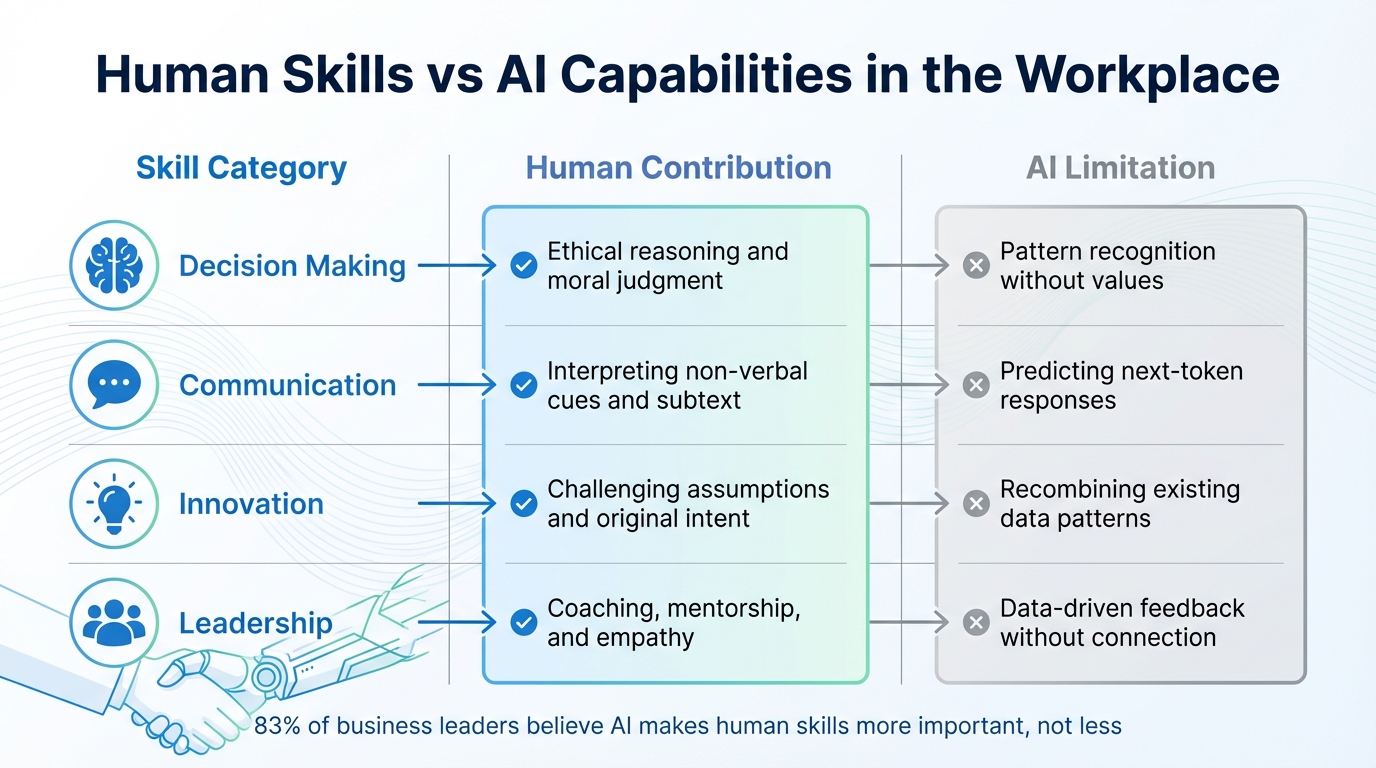
Human Skills vs AI Capabilities in the Workplace
Technical skills might help you work alongside AI, but it's human skills that set you apart. These are the qualities that allow you to lead, think creatively, and make sound decisions. While AI excels at data processing and pattern recognition, it lacks the judgment, empathy, and nuanced thinking that humans bring to the table. In fact, 83% of business leaders believe AI makes human skills more important, not less. As AI takes on repetitive tasks, the demand for ethical reasoning, emotional intelligence, and adaptability is only growing.
This shift is reshaping hiring practices. Companies are focusing less on resumes packed with keywords and more on evidence of skills like creative problem-solving and ethical decision-making. By 2027, over 40% of core job skills are expected to change. This doesn't mean human roles will vanish - it means they'll evolve. Skills like communication, trust-building, and navigating uncertainty are what make humans irreplaceable. The table below highlights key areas where humans have the edge over AI:
| Skill Category | Human Contribution | AI Limitation |
|---|---|---|
| Decision Making | Ethical reasoning and moral judgment | Pattern recognition without values |
| Communication | Interpreting non-verbal cues and subtext | Predicting next-token responses |
| Innovation | Challenging assumptions and original intent | Recombining existing data patterns |
| Leadership | Coaching, mentorship, and empathy | Data-driven feedback without connection |
Flexibility and Continuous Learning
AI is evolving at a breakneck pace, and staying relevant isn't about mastering every new tool - it’s about adapting without burning out. Over the last two years, demand for advanced AI skills has increased sevenfold, but the "AI tools trap" - constantly chasing updates - can lead to burnout. One in five professionals report symptoms like mental fatigue and cognitive impairment.
The key is to work smarter, not harder. Focus on building a mindset grounded in curiosity, responsibility, and human-centered thinking. A simple way to stay adaptable? Spend 15 minutes each week experimenting with a new AI feature in a specific context. This micro-learning approach helps you stay updated without the overwhelm.
Take the example of Healx, a biotechnology company. In February 2026, Healx used its AI platform to identify existing drugs that could treat rare diseases. However, it was human experts who decided which treatments to move forward with. This collaboration has already advanced seven treatments into research and development. The takeaway? AI can suggest possibilities, but humans determine which ones matter.
"AI is not a replacement for judgment. Knowing where to apply it, and where not to, is now a critical leadership skill." - Karim Lakhani, Professor, Harvard Business School
As professionals, resilience is just as important as adaptability when navigating challenges AI cannot solve.
Problem-Solving and Resilience
AI can process enormous amounts of data, but it struggles with ambiguity. When information is incomplete, when ethical dilemmas arise, or when there’s no clear answer, human judgment becomes essential. This is where resilience comes into play - not just bouncing back from setbacks, but staying focused when AI outputs fall short.
Resilience is a skill you can develop. The "Awareness–Pause–Reframe" technique is a simple but effective tool: first, notice physical signs of stress (Awareness). Then, step back to avoid reacting impulsively (Pause). Finally, shift your mindset from "Why is this happening?" to "What can I learn?" (Reframe). This approach helps you stay calm and effective, even when AI-driven recommendations face pushback.
Leaders with strong emotional intelligence - a cornerstone of resilience - see employee retention rates nearly 30 points higher than those without it. In workplaces increasingly shaped by AI, your ability to coach, mentor, and build trust becomes a competitive edge that machines simply can’t replicate.
Communicating AI Results to Others
AI can generate insights, but it can’t explain why they matter or how they fit into the bigger picture. That’s where your communication skills come in. Translating technical outputs into actionable insights for diverse audiences - whether executives, non-technical teams, or clients - requires a human touch.
Start by practicing active listening. Pay attention to what’s unsaid - hesitation, tone, body language - to address concerns about AI data. When presenting findings, frame them as questions rather than conclusions. For example, instead of saying, "The AI recommends this strategy", try, "Based on these patterns, what can we learn about our customers?" This approach invites collaboration and reduces resistance.
Position AI as a partner, not a replacement. Emphasize how it supports human decision-making rather than overshadowing it. This framing helps ease anxieties and encourages engagement, especially in organizations new to AI. Your role is to bridge the gap, making AI findings understandable and actionable for everyone involved.
New Roles and Changing Skill Requirements
AI is transforming the workplace, not by simply replacing jobs but by reshaping them. According to the World Economic Forum, by 2030, the global workforce will gain 170 million new roles while 92 million will be displaced, resulting in a net increase of 78 million jobs. This isn't just about survival - it's about adaptation. The real question is not whether your job will remain but how it will evolve.
New AI-Focused Job Positions
Emerging careers are now centered on managing and optimizing AI systems. For example, Agent Orchestrators oversee and design workflows involving multiple AI agents, while AI Ethics Officers ensure that AI outputs align with ethical and legal standards. Another key role, AI Evaluation Specialists, focuses on testing the accuracy of AI outputs and maintaining quality control.
These specialized roles come with lucrative paychecks. AI Ethics Auditors can earn between $90,000 and $150,000 annually, while MLOps Specialists command salaries ranging from $100,000 to $170,000. Workers with AI expertise are also seeing a significant boost in earnings - 56% more than their peers in similar roles without AI skills, compared to a 25% premium just a year ago. A notable example of this shift is DBS Group in Singapore, which announced in February 2025 that it would reduce around 4,000 temporary and contract roles over three years but create 1,000 new AI-related positions during the same period.
The rise of agentic AI, which involves autonomous systems capable of planning and executing complex workflows, is accelerating this shift. Currently, 62% of organizations are actively testing or scaling these systems. This trend is driving the demand for roles in AI Orchestration, where professionals manage, verify, and strategically deploy AI systems. The focus is moving from task execution to task orchestration, fundamentally redefining the nature of work.
How Traditional Roles Are Evolving
AI is also reshaping traditional jobs, creating AI-augmented versions that add new layers of value. Routine tasks are increasingly at risk of automation, while roles requiring critical judgment and advanced skills are becoming indispensable. The key to staying relevant lies in acquiring these new skills.
Take marketing, for instance. Professionals are transitioning from producing large volumes of content to focusing on Answer Engine Optimization (AEO). Similarly, product managers are evolving from drafting detailed specifications to building evaluation frameworks and developing a deeper understanding of AI decision-making.
Recent examples underline this shift. In July 2025, the Commonwealth Bank of Australia reduced certain roles as it integrated AI into frontline and back-office tasks. Klarna followed suit, cutting its workforce by 40% by leveraging AI for customer support and content creation. Remarkably, Klarna replaced its global marketing agency with AI tools, slashing content production costs by 90%. These cases highlight a clear trend: automation is taking over routine tasks, while roles that require strategic thinking and decision-making are gaining prominence.
"AI is changing the content of work faster than it is changing job titles." - Snowflake
The financial benefits of adapting are clear. Job postings requiring at least one new skill pay about 3% more, while those demanding four or more new skills offer up to 15% higher salaries in the UK and 8.5% more in the US. The takeaway? Build your skills, and your paycheck will follow.
Using Acedit to Build Workplace Skills
As AI reshapes workplace demands, practical training is more important than ever. Acedit steps in as a tool designed to help individuals build the skills needed for AI-driven environments. These skills don’t appear overnight - they require practice, real-world application, and the ability to adapt under pressure. AI interview preparation platform provides a hands-on way to develop these in-demand capabilities.
Developing AI Skills with Real-Time Coaching
Acedit turns theoretical knowledge into actionable practice. With features like question detection and response suggestions, the platform helps users master prompt engineering and AI literacy - skills that 70% of employers now prioritize alongside analytical thinking.
Instead of encouraging rote memorization, Acedit focuses on teaching users how to craft precise prompts for tailored outputs. For instance, if you’re preparing for a data analyst role and ask, “How would you use AI to interpret sales data?” the platform not only provides a customized response but also teaches you how to refine your prompts. This mirrors real-world AI skills, such as integrating OpenAI APIs. Users report an 88% improvement in response quality and a 94% boost in confidence.
Acedit’s Chrome extension works seamlessly during video calls on platforms like Zoom, Microsoft Teams, and Google Meet. It provides instant suggestions, helping users improve their tech adaptability and digital fluency - skills that are increasingly important in today’s job market.
Building Flexibility Through Practice Interviews
Success in AI-driven environments often depends on staying calm under pressure. Acedit’s unlimited AI-driven interview simulations offer a safe way to build this kind of resilience. The platform exposes users to diverse and unpredictable scenarios, helping them adapt to challenges on the fly.
The simulator uses adaptive AI questioning that evolves based on your responses, closely mimicking a live interview. One moment you might face a straightforward behavioral question, and the next, you could be tackling a complex AI ethics scenario. Regular users of these simulations have a 78% job offer success rate and report feeling 3.2 times more confident in real interviews. Additionally, 89% of users see measurable improvement after just three sessions.
"Being able to prepare for interviews with real-time AI feedback was a game changer and made me feel confident for my interview." - William Johnson
Acedit also tailors role-specific questions based on your resume and target position, ensuring you practice for situations you’re likely to encounter. Whether preparing for a traditional role or a new AI-focused position, these simulations help users critically evaluate AI outputs and switch between tools with ease. This adaptability is crucial for roles that require translating technical insights into actionable strategies.
Improving Analysis and Communication Skills
Clear communication of AI-driven insights can set candidates apart. Acedit hones these skills by generating customized Q&A scenarios and offering STAR (Situation, Task, Action, Result) methodology examples, helping users structure complex information logically.
For example, if you’re preparing for a business analyst interview, Acedit might generate a question about analyzing AI-driven sales patterns. The platform provides STAR-based examples, improving your ability to spot trends, make decisions, and communicate findings effectively. It achieves a 92% relevance score for personalized scenarios by analyzing your LinkedIn profile and resume.
Acedit also emphasizes the importance of using clear, non-technical language. This helps users translate machine learning outcomes into practical business insights, bridging communication gaps and fostering collaboration - skills that remain essential even as AI advances. Users report a 2.8x improvement in response quality.
For those looking to deepen their skills, Acedit offers Premium ($45 one-time) and Premium Plus ($75 one-time) plans. These unlock unlimited practice Q&As and advanced AI response suggestions, allowing users to refine their analytical and communication skills until they feel second nature. With over 15,000 practice questions completed and a 4.8/5 user rating, Acedit has proven effective in helping professionals confidently articulate complex AI concepts.
Conclusion
The workplace is evolving at an incredible pace. By 2030, workers will need to realign their skills to meet the demands of an AI-driven world, as professionals with AI expertise are already earning 56% more than their peers. Thriving in this environment requires more than just technical know-how - it’s about blending machine capabilities with human judgment. As the YouGotJobs Research Team aptly puts it:
"The key question is not 'will AI take my job' but 'can my job be fully described in a prompt?' If the answer is yes, that role is at risk".
This shift highlights the importance of mastering both AI tools and the critical thinking skills that machines can’t replicate. Professionals who excel in managing AI outputs and applying nuanced judgment are becoming indispensable. With roles that emphasize human-AI collaboration growing each year, the demand for this hybrid skill set is only increasing.
Developing these abilities takes more than theory - it requires hands-on practice. Platforms like Acedit offer opportunities to sharpen these skills through unlimited interview simulations, real-time coaching, and personalized Q&A tools. Whether you're aiming for a competitive AI-focused role or transitioning into a new career path, consistent practice builds both the technical skills and the confidence employers are looking for.
Success stories highlight the value of this approach. For instance, professionals who reduce report generation time by 40% with AI or translate complex datasets into actionable strategies demonstrate the kind of real-world impact that stands out. With only 6% of companies fully trusting AI without human oversight, there’s a growing need for individuals who can bridge the gap between raw data and informed decisions.
This balance between technology and human insight is the foundation of AI-driven transformation. The gap between those who embrace AI collaboration and those who don’t is growing wider every month. Early adopters who hone these skills now are positioning themselves to thrive in the future workplace.
FAQs
How can I tell if my job is at risk of AI automation?
Jobs that involve repetitive, rule-based tasks - like data entry or creating routine reports - are at a higher risk of being automated by AI. On the other hand, roles that rely on human abilities such as strategic thinking, creativity, or emotional intelligence are less likely to be replaced. To gauge your own vulnerability, it's important to keep up with AI advancements, prioritize developing technical skills, and regularly review your responsibilities to make sure they match the changing needs of an AI-driven work environment.
What are the fastest AI skills to learn without coding?
If you're looking to step into the world of AI without diving into programming, start with these skills:
- AI Literacy: This involves grasping the basics of how AI systems work, their capabilities, and their limitations. It’s about understanding the role AI plays in various industries and how it impacts decision-making.
- Data Literacy: Being able to interpret and work with data is essential. This includes understanding data trends, visualizations, and how AI uses data to make predictions or decisions.
- Prompt Engineering: Crafting effective prompts is key to getting the most out of AI tools. Whether you're using chatbots or AI-driven platforms, knowing how to communicate clearly with these systems can make a huge difference.
Beyond these, you can explore AI-powered platforms for tasks like content creation or interview preparation. These tools are designed to be user-friendly and require no coding expertise. Developing these skills can make you more competitive in workplaces that are increasingly integrating AI into their operations.
How do I use AI at work without trusting it too much?
To use AI responsibly, focus on building AI literacy and ensuring human oversight remains a priority. It's crucial to recognize when AI outputs can be trusted and when human judgment needs to take the lead. Practical strategies include setting clear policies, organizing trust calibration sessions, and using frameworks like the "AI plus one" rule, which emphasizes collaboration between AI and humans.
Watch out for automation bias, where people might over-rely on AI without questioning its outputs. Regular training and education can help maintain a balance between leveraging AI and applying critical, human evaluation.