
Virtual interviews can feel impersonal without face-to-face interaction. To stand out, you need a structured approach combined with emotional depth. Here's how:
- STAR Method: Use this framework - Situation, Task, Action, Result - to structure your answers. It keeps responses clear and focused, helping interviewers assess your skills effectively.
- Emotional Appeals: Add ethos (credibility), pathos (emotional connection), and logos (logic). This makes your answers relatable and memorable.
- Virtual Delivery: Maintain eye contact with the camera, use vocal variety, and align facial expressions with your story.
For example, when discussing a challenge, briefly set the context (Situation), explain your role (Task), highlight your actions (Action), and share measurable outcomes (Result). Add emotional elements like empathy or enthusiasm to engage the interviewer.
Tools like Acedit can enhance your preparation by suggesting STAR-based responses and analyzing your delivery. With practice, you can master the art of crafting impactful virtual interview answers.
Interview Tips From a MarketStar Recruiter | Hiring Process, STAR Method, and Virtual Interview Tips
Understanding the STAR Method and Emotional Appeals
To effectively combine structure with persuasion, it’s crucial to grasp what each framework brings to the table. The STAR method offers a structured way to articulate your story, while emotional appeals - ethos, pathos, and logos - infuse a human element that makes your responses stick. Together, they elevate your answers from a simple rundown of events to a compelling narrative that highlights both your abilities and your personality.
What is the STAR Method?
The STAR method is a four-step approach designed to help you answer behavioral interview questions with clarity and focus. Here’s how it works:
- Situation: Set the stage by describing the context or challenge you encountered.
- Task: Define the specific responsibility or goal you were tasked with in that situation.
- Action: Detail the steps you took to address the task and resolve the issue.
- Result: Share the measurable outcome and the lessons you learned.
This method is especially useful in virtual interviews, where maintaining clarity and focus is more challenging. With nonverbal cues harder to interpret on a screen, a well-structured STAR response ensures your interviewer can easily follow your story and note your impact in real time. In fact, behavioral interviews are widely used by U.S. employers, making STAR a powerful tool to leave a lasting impression.
When crafting your STAR response, each part serves a distinct purpose. Keep the Situation brief to provide just enough context. Use the Task to show accountability and ownership of your role. The Action section is your chance to highlight your problem-solving skills and decision-making process. Finally, the Result ties everything together with tangible outcomes - think metrics like increased revenue, improved efficiency, or enhanced customer satisfaction.
Emotional Appeals: Ethos, Pathos, and Logos
Emotional appeals are rhetorical tools that add depth and persuasiveness to your message. Each plays a unique role:
- Ethos: Establishes your credibility and character by demonstrating integrity, reliability, and relevant experience.
- Pathos: Creates an emotional connection by showing empathy, enthusiasm, and alignment with the company’s values.
- Logos: Focuses on logical reasoning and data-driven results to validate your approach.
In interviews, these appeals work best when combined. A strong response might showcase your experience (ethos), follow a logical sequence supported by data (logos), and weave in emotional elements (pathos) to make your answer engaging and relatable. Studies in communication and psychology back this approach, showing that blending emotional resonance with clear evidence often makes messages more persuasive.
Building ethos involves highlighting moments where you earned trust or demonstrated responsibility - like leading a project or receiving positive feedback. To tap into pathos, focus on the human side of your story, such as understanding your team’s frustrations or improving customer experiences. For logos, emphasize your decision-making process with data and measurable results. Together, these elements enhance your STAR responses, making them more impactful.
Why Combine STAR and Emotional Appeals?
The STAR method provides the structure, but combining it with ethos, pathos, and logos transforms your response into a well-rounded narrative that showcases both your skills and your character. This is especially important in virtual interviews, where limited nonverbal cues make it harder to build rapport. A response that’s clear, organized, and engaging can set you apart.
For example, imagine you’re describing how you resolved a conflict in a remote team. A basic STAR answer might explain the issue and the resolution. But adding emotional appeals could elevate your response: you might mention being selected to lead the resolution (ethos), acknowledge your teammates’ frustrations (pathos), and share a concrete result, like a 22% boost in collaboration scores after your intervention (logos).
U.S. interviewers often look for a mix of technical know-how and soft skills like communication, teamwork, and adaptability. Answers that are too data-heavy can feel impersonal, while overly emotional ones might lack substance. Blending these elements within the STAR framework strikes the right balance - making your response relatable, credible, and backed by evidence. This approach is particularly effective in virtual settings, where engaging language and vocal warmth help overcome the challenges of reduced physical presence.
Using STAR with Emotional Appeals in Virtual Interviews
Virtual interviews can feel a bit impersonal compared to in-person meetings. Without nonverbal cues like handshakes or the energy of the room, your words, tone, and delivery take center stage. To stand out, you need to infuse emotional depth into your STAR responses and deliver them effectively through the camera.
Adding Emotional Elements to Each STAR Component
The STAR framework naturally lends itself to incorporating emotional appeals, making your responses more engaging and memorable.
In the Situation step, set the stage by explaining the stakes and who was impacted. Instead of simply stating, "Our team faced a deadline", you could say, "Our team was under a tight 48-hour deadline for a client presentation, and the pressure was mounting during our daily standups." This not only establishes context but also hints at the emotional weight of the challenge. Keep it concise - just a sentence or two to outline the scenario and its importance.
When you move to the Task, highlight your personal investment in the goal. Statements like "I knew it was my responsibility to keep the project on track" or "I felt strongly about preserving our client relationship" show your sense of ownership and intrinsic motivation. U.S. interviewers often value initiative and genuine care for outcomes, so this is your chance to demonstrate both your commitment and your drive.
The Action step is where you can showcase emotional intelligence alongside your problem-solving skills. For example, instead of just detailing what you did, you might say, "I initiated an emergency Zoom call to address concerns and proposed a revised workflow", or "I stayed calm and reassured the client with regular updates to maintain their confidence." Pairing emotions like empathy or composure with specific actions shows how your feelings guided effective decisions.
Finally, in the Result, balance measurable outcomes with the human impact. For instance, share key metrics - whether it’s meeting a deadline, boosting engagement, or hitting a revenue target - while also highlighting the emotional payoff, such as positive client feedback or improved team morale. This approach demonstrates both your ability to achieve results and your capacity to build trust and collaboration.
Once your STAR story is enriched with emotional depth, focus on delivering it effectively on camera.
Virtual Interview Delivery Techniques
Delivering your STAR response in a virtual setting requires intentionality to overcome the limitations of the digital medium. Since body language is less visible, you’ll need to rely on other cues to connect with your interviewer.
Eye contact is crucial, even on video. Look directly at the camera, especially when expressing confidence, empathy, or enthusiasm, to simulate genuine eye contact. Position your camera at eye level to maintain an engaged and professional appearance.
Your voice becomes a powerful tool in virtual interviews. Slow down slightly when introducing a high-stakes situation or sharing an important result - this gives your interviewer time to absorb the details and emphasizes the significance of your points. Adjust your tone to match the moment: lower it to convey seriousness during challenges and raise it to show enthusiasm when discussing actions and outcomes. This vocal variety ensures your story’s emotional arc comes through clearly, even if video quality isn’t perfect.
Facial expressions should align naturally with your narrative. If you’re describing a stressful moment, let a hint of concern show; when sharing a success, smile authentically. These subtle expressions help bridge the emotional gap created by the screen. Make sure your lighting is good so your expressions are easy to see.
Pacing and pauses also play a key role. Speak at a deliberate pace and use brief pauses to emphasize important points. For example, after stating a strong result like, "We increased customer engagement by 22%", pausing for a moment can underscore the impact of that achievement.
Sample STAR Responses with Emotional Appeals
Here’s how these techniques come together in real-world examples.
Example 1: Resolving Conflict in a Remote Team
Situation: "Last year, two members of my remote marketing team had a disagreement over campaign priorities that began affecting our Slack communication and project timelines. The tension was making the rest of the team uncomfortable."
Task: "As the team lead, I felt it was my responsibility to address the issue quickly to protect our collaboration and morale."
Action: "I scheduled individual video calls with each person to listen to their concerns without judgment. Then, I brought them together on a Zoom call to facilitate a discussion focused on our shared goals. I encouraged them to acknowledge each other’s perspectives and proposed piloting both ideas on a smaller scale for 30 days."
Result: "Both team members agreed to the plan, and within two weeks, our Slack communication noticeably improved. After the pilot, we combined the best elements of both approaches, which led to a 22% increase in engagement on our next campaign. More importantly, my colleagues appreciated feeling heard, and our team’s collaboration scores improved in the next quarterly survey."
Example 2: Handling a Technical Failure in a Virtual Client Meeting
Situation: "In March 2024, I was leading a product demo for a potential client worth $200,000 in annual revenue. Five minutes before the webinar was set to start, our primary video platform crashed."
Task: "I was responsible for delivering the demo, and I knew the client had set aside time specifically for this meeting. Losing this opportunity could have jeopardized the deal."
Action: "I stayed calm and immediately activated our backup plan - sending the client a Google Meet link via email and text within minutes. I explained the situation and reassured them that we were ready to proceed. Meanwhile, I had a colleague troubleshoot the original platform in case it became usable again."
Result: "The client joined the backup link promptly, and the demo went smoothly. Afterwards, they expressed how impressed they were by our quick adaptation and professionalism under pressure. Three weeks later, we closed the deal, and I felt relieved and proud to have safeguarded the relationship."
sbb-itb-20a3bee
Adjusting Emotional Appeals for Different Audiences and Industries
Interviewers expect responses that match their priorities, and the emotional tone of your STAR answers should shift depending on the person interviewing you and the industry you're targeting. While the STAR framework remains your foundation, the way you present your story should align with the interviewer's focus. For instance, a technical panel at a fintech company will prioritize different aspects than an HR recruiter at a nonprofit.
Customizing Answers for Different Interview Audiences
Your STAR responses should reflect the goals and concerns of the person interviewing you.
HR recruiters are often focused on how well you'll fit into the company culture and your soft skills. They want to see if you’re dependable, collaborative, and aligned with their values. For these interviews, emphasize ethos (credibility) and use moderate pathos (emotion) to highlight teamwork and conflict resolution. Avoid diving too deeply into technical details. For example, you could say, "After introducing weekly check-ins, our team felt more connected, and our project completion rate improved."
Hiring managers are more interested in the tangible impact of your work. They want to see measurable results and problem-solving abilities. Combine logos (logic and data) with a touch of pathos to show how your efforts benefited the team. A strong response might be, "I restructured our workflow, cutting project turnaround time by 30% and saving $15,000 in our quarterly budget."
Technical panels focus on your technical expertise and approach to solving problems. They value precision and logos, so keep emotion to a minimum and focus on the data and processes behind your decisions. A suitable example could be, "I identified a bottleneck in our API response time, refactored the database queries, and reduced latency from 800ms to 200ms, which improved user retention by 12%."
A 2024 survey revealed that 78% of hiring managers use behavioral questions in virtual interviews and expect STAR-style answers. Additionally, candidates who tailor their answers to fit the audience - whether HR or a technical panel - are 35% more likely to move to the next interview stage.
| Interviewer Type | Primary Focus | Emotional Appeal Strategy | STAR Emphasis |
|---|---|---|---|
| HR / Recruiter | Culture fit, soft skills, reliability | Ethos (credibility), moderate pathos (teamwork) | Relatable stories with clear results |
| Hiring Manager | Business impact, problem-solving, leadership | Logos (metrics, ROI), moderate pathos (team impact) | Measurable outcomes and strong results |
| Technical Panel | Technical skills, process, precision | Logos (data, technical details), minimal pathos | Detailed actions and technical decisions |
Pay attention to cues during the interview to fine-tune your approach. If the interviewer focuses on metrics or outcomes, prioritize logos by emphasizing concrete results. If they ask about ethical choices or role ownership, lean into ethos. Nonverbal signals like nodding or note-taking usually indicate engagement, while rushed transitions or distracted behavior might mean your story is too long or overly emotional. In those cases, streamline the Situation and Task, and focus on the Action and Result with clear, measurable outcomes.
Industry-Specific Adjustments to Emotional Appeals
Different industries have distinct cultures and expectations, requiring further adaptation of your STAR responses. The same story can be adjusted to reflect the emotional tone and focus that resonates most with the industry.
In finance, law, and healthcare, emotional appeals should be restrained and fact-based. These industries prioritize precision, compliance, and risk management. Use logos by focusing on metrics and compliance, and only incorporate moderate pathos when it directly supports client trust, patient safety, or stakeholder confidence. Research shows that moderate emotional appeal increases likability by 22%, but excessive emotion can reduce perceived competence by 18% in these fields. For example, a nurse applying for a leadership role might emphasize empathy and collaboration when speaking to HR but focus on reduced infection rates and compliance metrics in a clinical panel.
In technology and engineering, the emphasis is on innovation, scalability, and problem-solving. Interviewers in these fields typically prefer data-driven answers over emotional ones. For example, a software engineer might describe a system outage differently depending on the audience: for HR, they could highlight teamwork and customer impact, while for the technical panel, they’d detail root-cause analysis and uptime metrics.
Nonprofit and social impact organizations value empathy, mission alignment, and community impact. These settings call for more pathos to convey passion and purpose, balanced with measurable outcomes. For instance, instead of simply stating, "We served 500 families," you could say, "Seeing families gain stable housing after months of uncertainty reminded me why this work matters and motivated our team to expand the program to three more neighborhoods."
Creative industries and tech startups often appreciate storytelling and enthusiasm. They value imaginative thinking and mission-driven energy. Use pathos to express passion and connect with their vision, while still grounding your story in results such as user growth or product adoption.
| Industry | Typical Emotional Tone | Story Focus | STAR Result Emphasis |
|---|---|---|---|
| Finance / Law | Restrained, professional, fact-based | Risk, compliance, ROI, efficiency | Hard numbers, cost savings, risk reduction |
| Healthcare / Education | Empathetic, mission-driven | Patient/student impact, safety, trust | Improved outcomes, satisfaction, retention |
| Tech / Engineering | Logical, results-oriented | Innovation, scalability, problem-solving | Metrics, uptime, performance gains |
| Nonprofit / Social Impact | Passionate, values-driven | Mission, community impact, equity | Lives changed, reach, engagement, sustainability |
In virtual interviews, small adjustments in tone - warmer for HR, more neutral for technical panels - can influence how your emotional appeals are received. Since nonverbal cues are limited online, your choice of words, pacing, and vocal tone take on greater importance. Practice these elements so your STAR stories feel natural and align with the expectations of different audiences.
Start with a balanced approach: keep the Situation and Task concise, introduce moderate emotion in the Action phase, and finish with clear, measurable results. Stay flexible by watching for cues that suggest when to lean into pathos or focus more on logos. This adaptability ensures your STAR responses stay effective without losing their structure.
Tools like Acedit can help you refine your STAR responses for different audiences. By recording mock interviews and reviewing your delivery, you can ensure your answers are concise, data-driven, and emotionally aligned with the interviewer’s focus. Acedit offers real-time feedback and simulated sessions to help you fine-tune your approach for diverse industries and interview scenarios. Practice these strategies to confidently tailor your STAR stories for any context.
Using Acedit to Master STAR-Based Emotional Storytelling
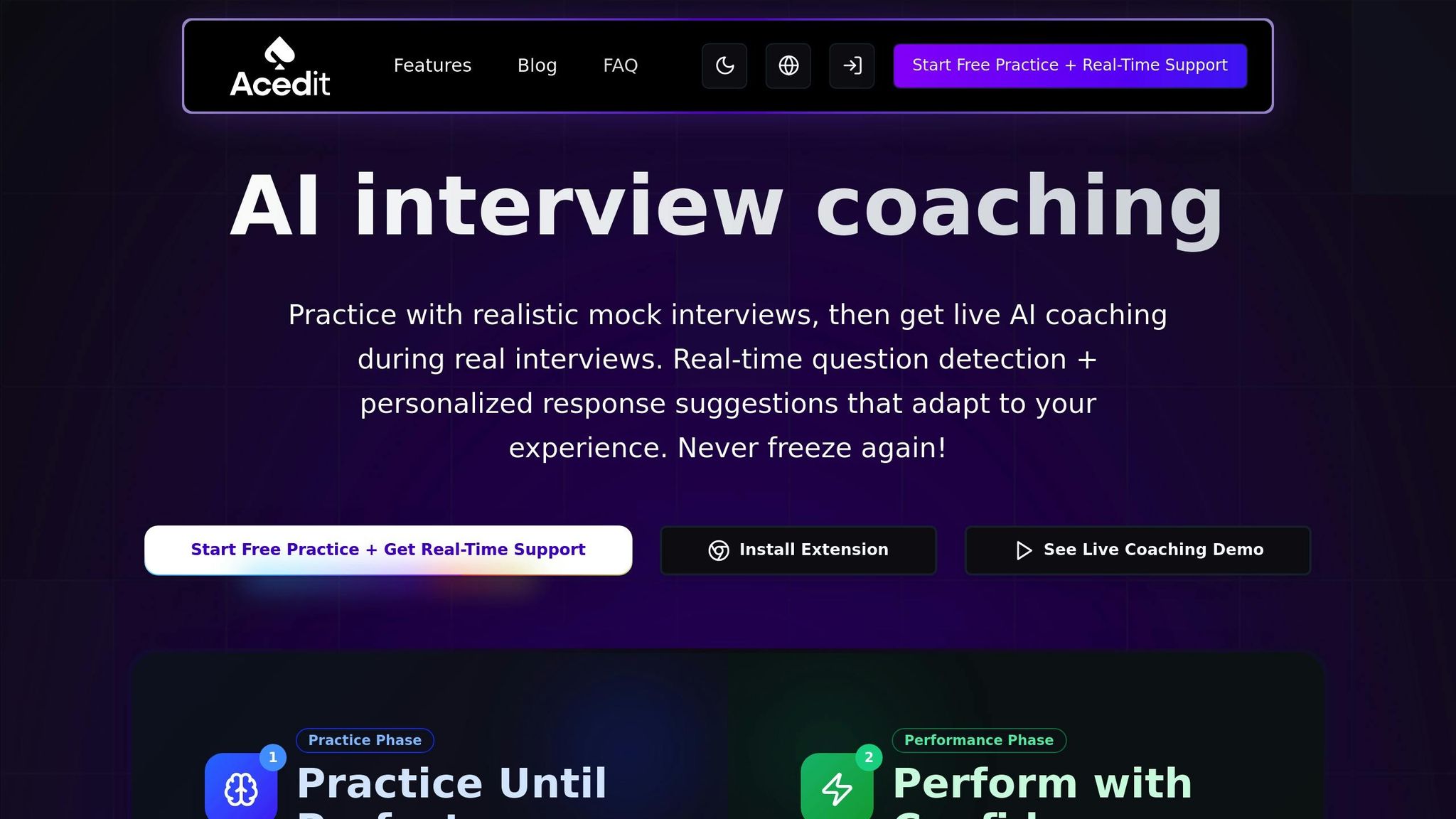
Creating impactful STAR responses with the right emotional balance takes practice, especially in virtual interviews. Acedit helps job seekers hone these skills through AI-driven tools that analyze questions, suggest tailored responses, and provide delivery feedback. The key is to focus on building a genuine connection while adhering to the STAR framework.
The platform tackles common hurdles like organizing experiences clearly, matching emotional tone to different questions, and staying composed under pressure. By analyzing prompts and generating STAR responses that resonate emotionally, Acedit eases the mental strain that often leads to anxiety or rambling - particularly in U.S. job markets where behavioral interviews are the norm. Let’s dive into how Acedit’s real-time tools simplify your response strategy.
Real-Time Question Detection and Response Suggestions
During virtual interviews, Acedit can identify questions on-screen or in text, classifying them as behavioral or situational. It then offers STAR-based suggestions tailored to the specific question in a side panel. For instance, if asked, “Tell me about a time you resolved a conflict on a remote team,” Acedit flags it as a conflict-resolution question and outlines a STAR response. It also layers in emotional elements like empathy (pathos) and reliability (ethos) to highlight teamwork and trust.
These suggestions help balance ethos, pathos, and logos naturally. Acedit prompts you to establish credibility by detailing your role, responsibilities, and measurable impact in the Situation and Task (e.g., team size, deadlines, outcomes). At the same time, it encourages emotional resonance by addressing stakeholder concerns and backing up results with concrete metrics. This approach aligns with U.S. interviewers’ preference for data-supported achievements.
The platform also tags each question with a likely focus - like “technical depth,” “team culture,” or “business outcomes” - and suggests emotional tones to emphasize. For example, it might recommend calm confidence for technical leads, empathy for HR, or ownership and impact for hiring managers. It can even adjust vocabulary to align with the audience, such as emphasizing team morale for HR or cost savings for technical stakeholders, while keeping the STAR narrative intact.
Beyond real-time guidance, Acedit lets you practice responses in simulated environments for even greater preparation.
Simulated Interviews and Emotional Tone Practice
Acedit’s simulated interviews mimic real-world scenarios, presenting video or screen-based questions and analyzing your responses for pacing, tone, and word choice. The platform flags issues like rushed delivery, flat tone, or overly casual language that might not fit professional U.S. contexts. It suggests improvements like slowing down when sharing key metrics, adding empathy in conflict scenarios, or boosting vocal energy when discussing achievements - helping you align your tone with the role and company culture.
For example, Acedit might encourage adding empathetic touches to technical STAR stories, such as acknowledging team frustrations to build trust. It could also transform a simple “met deadlines” Result into a more compelling close by including metrics and emotional context - like noting that timely delivery preserved client trust and secured repeat business. This blend of logos and pathos resonates strongly with U.S. hiring managers.
The simulations allow you to practice different emotional tones while receiving instant feedback, which is especially helpful for candidates feeling nervous or overwhelmed. With video interviews becoming more common, mastering structured techniques like STAR can make your submission stand out. Acedit users have completed over 179 million practice questions and report an average confidence boost of 98%. This practice reinforces the importance of adapting emotional appeals for virtual settings.
Custom STAR Examples and Feedback Integration
Acedit takes personalization a step further by generating STAR examples based on your resume, target role, and industry. By analyzing your resume, the job description, and company background, the platform creates responses tailored to the role’s specific requirements. This feature is available even on the free plan, making it accessible to job seekers at any career stage.
The platform’s AI-powered feedback refines your responses by evaluating clarity, structure, and emotional impact. Premium plans offer advanced AI models for deeper insights and allow you to submit pre-written STAR examples for detailed feedback. Acedit also analyzes your LinkedIn profile to align your interview stories with your professional brand.
As you practice, Acedit helps you focus on the most impactful parts of your STAR responses. For example, it might recommend spending less time on the Situation and more on the actions you took and the results you achieved - elements that interviewers prioritize. It also reminds users to practice responses out loud, ensuring delivery feels natural rather than rehearsed.
For remote roles, Acedit emphasizes skills like self-motivation, communication, and time management when structuring STAR examples. This is crucial as employers increasingly evaluate candidates on their ability to thrive in virtual work settings.
With tiered access options, including a free plan and premium upgrades, Acedit caters to job seekers at all career levels. By combining personalized feedback with structured practice, the platform helps you craft STAR responses that are both engaging and impactful.
Conclusion
Using the STAR method combined with emotional appeals transforms your virtual interview answers into engaging stories that leave a lasting impression on hiring managers. The STAR structure ensures your responses stay organized and focused, while emotional elements like empathy, credibility, and logic help create a genuine connection with interviewers. This approach is especially important in virtual settings, where screen fatigue, technical delays, and limited body language can make it harder to stand out. A well-crafted, emotionally resonant narrative helps you cut through these challenges and keeps the interviewer’s attention.
The good news? This isn’t about innate talent - it’s a skill you can develop. Every STAR story you practice becomes a chance to showcase personal growth, not just deliver a polished performance. Preparing ahead with routines like practicing key STAR examples and checking your tech setup can calm your nerves and help you present yourself with confidence and warmth. The goal isn’t perfection - it’s progress. These habits lay the groundwork for mastering the art of virtual interview storytelling.
With video interviews now a standard part of the hiring process in the U.S., many employers rely on them for at least one stage of recruitment. Putting time into STAR-based practice is a smart investment that can pay dividends across multiple interviews and roles.
That’s where Acedit comes in. This platform makes practice both accessible and effective, offering features like real-time question detection, AI-generated suggestions, and simulated interviews. These tools help you refine your ability to blend the STAR structure with emotional storytelling, showcasing both your achievements and your personal brand. With over 15,000 practice questions completed by users and an average confidence boost of 98%, Acedit turns this combined approach into a reliable skill for when the camera is on.
To build this skill, try recording one STAR response daily. Review your recording for clarity, tone, and overall impact. Share it with a mentor, coach, or peer to get feedback on both your content and emotional delivery. Focus on keeping one strong element (like a clear Result metric) and improving one weaker area (like emotional timing or tone). This step-by-step process helps you develop confidence and ensures your STAR stories feel authentic rather than overly rehearsed.
When wrapping up your interview, finish with a brief, positive summary that ties your experiences to the team’s needs. This allows you to highlight both your accomplishments and your personality. By combining structured practice with the right tools, you’ll approach every virtual interview ready to share stories that highlight not just what you’ve done, but who you are as a professional.
FAQs
How can I use emotional appeals effectively in STAR responses during a virtual interview?
To make your STAR responses more engaging during a virtual interview, focus on building a connection with the interviewer by weaving in authenticity and empathy. When discussing the Situation or Task, bring attention to the emotional aspects - maybe the challenges your team faced or why the issue held personal importance. This adds a human touch to your narrative, making it more relatable and memorable.
When you move into the Action and Result parts, highlight how your efforts addressed those emotional elements. For instance, share how your approach lifted team spirits or turned around a frustrated customer’s experience. By blending logical problem-solving with genuine emotion, you can create a compelling story that showcases not just your skills but also your ability to connect with others.
How can I tailor my STAR method responses for different industries and interview styles?
To tailor your STAR method responses for different industries and interview styles, start by aligning your examples with the core skills and values that matter most to the role or company. Dive into the job description and research the industry to pinpoint what’s emphasized - whether it’s teamwork, leadership, or technical know-how - and select examples that showcase those strengths.
It’s also important to match your tone and language to the company’s vibe. For instance, stick to formal language for corporate settings, but lean into a more casual, conversational style if you’re interviewing for a role in a creative field. If you’re preparing for virtual interviews, practicing your responses in an online setting can help you polish your delivery. Tools like Acedit are great for this - they offer real-time feedback and personalized coaching to help you stand out.
How can Acedit help me prepare and deliver STAR-based responses during virtual interviews?
Acedit makes interview preparation easier with its real-time question detection and AI-driven response suggestions designed around the STAR method. This approach ensures your answers are well-organized, concise, and leave a lasting impression.
Additionally, features like personalized coaching and interactive interview simulations help you boost your confidence and polish your delivery, giving you the edge you need to shine in virtual interviews.