
Les premières impressions lors des entretiens d'embauche se font en quelques secondes, et trouver le bon équilibre entre la chaleur émotionnelle et la maîtrise professionnelle est essentiel pour se démarquer. Si vous semblez trop formel, vous risquez de paraître distant. Trop émotionnel, et vous pourriez sembler mal préparé. Voici l'objectif : établir une connexion personnelle tout en démontrant confiance et compétence.
Points clés à retenir :
- L'émotion compte : L'engagement authentique, le contact visuel stable et les gestes naturels aident à établir une relation.
- Le professionnalisme est important : Les réponses claires et concises et la maîtrise sous pression signalent votre préparation aux défis du lieu de travail.
- La préparation est essentielle : Recherchez le ton de l'entreprise, pratiquez les réponses en utilisant des cadres comme STAR, et affinez votre langage corporel.
- Les signaux non verbaux dominent : La posture, le contact visuel et les expressions façonnent 93 % de votre impression lors des entretiens.
- Adaptez votre approche : Alignez votre ton et votre énergie sur le rôle et le secteur spécifiques.
En équilibrant ces éléments, vous pouvez laisser une impression durable qui met en évidence à la fois vos compétences et votre personnalité. Le reste de ce guide explore plus en détail comment atteindre cet équilibre avec des conseils pratiques et des exemples.
Comment mieux communiquer dans les entretiens et décrocher une offre d'emploi
Comment l'émotion et la formalité fonctionnent dans les entretiens d'embauche
L'authenticité émotionnelle consiste à rester fidèle à qui vous êtes plutôt que de viser la perfection. Ce sont les gestes naturels, le contact visuel stable et l'engagement authentique qui transforment une session de questions-réponses rigide en une conversation significative. Cette authenticité vous aide à établir une connexion avec votre intervieweur au niveau humain.
La formalité professionnelle, en revanche, est votre capacité à rester maître de vous, concentré et adaptable sous pression. Il s'agit de fixer des limites avec des réponses claires et concises, de gérer les moments inattendus avec calme et de respecter les normes professionnelles. Comme le dit Marlo Lyons :
"Se démarquer en tant que candidat ne consiste pas à être parfait ; il s'agit d'être authentique" [1].
Les employeurs apprécient les deux qualités car elles vont au-delà des compétences techniques. Des études montrent que les candidats qui sont sympathiques, agréables et qui s'engagent dans de petites conversations sont souvent mieux évalués que ceux qui mettent uniquement l'accent sur leurs qualifications [2]. Alors que la formalité établit la crédibilité et démontre votre compétence, l'authenticité et l'enthousiasme mettent en évidence votre potentiel. Trouver le bon équilibre entre ces qualités peut vous aider à paraître à la fois capable et accessible lors d'un entretien.
Ensuite, explorons comment exprimer une émotion authentique dans un cadre professionnel.
Montrer une émotion authentique dans les cadres professionnels
Exprimer l'enthousiasme ne signifie pas abandonner le professionnalisme - il s'agit de laisser votre personnalité naturelle briller. Si vous êtes naturellement extraverti, utilisez votre énergie pour vous engager avec les autres, en gardant vos réponses concentrées et concises. Si vous êtes plus réservé, appuyez-vous sur vos forces comme la maîtrise de soi et l'écoute active pour faire une bonne impression.
L'objectif est d'éviter de paraître rigide ou artificiel. Utilisez des gestes qui vous semblent confortables, maintenez un contact visuel stable et reflétez le langage de l'intervieweur pour montrer l'empathie et la curiosité. Sabina Nawaz, coach PDG mondial, souligne :
"Démontrer la passion n'est pas le seul prédicteur d'un excellent candidat, cependant les responsables du recrutement font régulièrement référence à ce trait dans leurs commentaires d'entretien" [3].
Prenez le cas d'Alex, qui a passé un entretien dans une startup de haute technologie en avril 2019. Malgré son excellent CV, ses excellentes notes et ses projets techniques impressionnants, il n'a pas obtenu le poste. Pourquoi ? Ses intervieweurs ont senti qu'il manquait de passion, le décrivant comme trop silencieux et ne montrant pas l'enthousiasme qu'ils recherchaient [3]. Cet exemple souligne comment un manque d'expression émotionnelle peut parfois éclipser même les plus fortes qualifications.
Des actions simples comme sourire et hocher la tête peuvent créer une énergie positive qui rend les interactions plus authentiques [2]. Refléter le langage corporel positif de votre intervieweur - comme adopter des gestes ou une posture similaires - signale que vous êtes sur la même longueur d'onde. Gardez simplement cela professionnel et évitez de partager des détails trop personnels qui pourraient franchir les limites.
Maintenant que nous avons couvert l'expression émotionnelle, plongeons dans les raisons pour lesquelles la formalité professionnelle est tout aussi importante.
Pourquoi la formalité professionnelle est importante
La formalité professionnelle montre que vous pouvez relever les défis d'un vrai lieu de travail. Qu'il s'agisse d'organiser vos réponses, de rester calme lors d'interruptions ou de respecter la culture de l'entreprise, ces comportements démontrent comment vous performeriez au travail.
Cela vous aide également à éviter les erreurs courantes d'entretien. Les réponses claires et concises évitent les digressions ou les surpartages. Rester concentré vous permet de mettre en évidence des réalisations spécifiques au lieu de parler vaguement. Dans les entretiens virtuels, gérer les perturbations inattendues - comme le bruit de fond ou les problèmes techniques - avec calme et confiance montre l'adaptabilité [1].
Le secret pour équilibrer l'émotion et la formalité est l'auto-conscience. Réfléchissez à votre style de communication naturel et ajustez-le au besoin. Si vous êtes naturellement bavard, pratiquez pour garder vos réponses concises. Si vous êtes plus réservé, travaillez à articuler votre enthousiasme pour le rôle. Les deux styles peuvent fonctionner, tant qu'ils vous semblent authentiques.
Comment se préparer à une communication d'entretien équilibrée
Se préparer à un entretien ne consiste pas seulement à connaître votre CV - il s'agit de trouver le bon équilibre entre être professionnel et montrer votre vrai moi. Cette phase de préparation vous aide à aligner votre style de communication avec les attentes de l'entreprise, à élaborer des réponses percutantes et à vous présenter avec confiance.
Rechercher l'entreprise et les attentes du rôle
Les descriptions de poste contiennent souvent des indices sur le style de communication qu'une entreprise valorise. Par exemple, des termes comme "équipe collaborative" ou "mentorat" suggèrent un environnement qui apprécie l'empathie et le travail d'équipe. En revanche, des phrases comme "structure de rapports stricte" ou "processus lourds d'approbation" pointent vers un lieu de travail plus formel [4].
Allez au-delà des bases. Consultez les profils de médias sociaux de l'entreprise sur des plateformes comme Instagram, Twitter et LinkedIn pour avoir une idée de leur culture et du ton du leadership [4]. Les avis Glassdoor peuvent également fournir des informations - concentrez-vous sur les thèmes récurrents dans les commentaires plutôt que sur les plaintes isolées. Même le processus d'entretien lui-même peut en dire long sur les attentes de l'entreprise en matière de professionnalisme et de communication [4].
Soyez attentif aux signaux d'alerte. Par exemple, "peau épaisse requise" pourrait indiquer une culture de rétroaction difficile, tandis que "travailler dur, s'amuser dur" pourrait suggérer de longues heures et un équilibre travail-vie limité [4]. Pour rester organisé, envisagez de créer une Matrice d'adéquation culturelle. Énumérez vos points non négociables (comme la communication respectueuse) aux côtés des préférences, et utilisez-la pour évaluer si le style de l'entreprise s'aligne avec le vôtre.
Une fois votre recherche terminée, il est temps d'adapter vos réponses d'entretien.
Pratiquez vos réponses aux questions courantes
La préparation consiste à être flexible, pas à mémoriser. Au lieu de réciter votre CV, transformez vos expériences en histoires concises et engageantes qui montrent comment vous avez relevé des défis et livré des résultats [7]. Visez à avoir cinq à sept histoires adaptables prêtes pour les questions sur les conflits, le leadership et la résolution de problèmes.
La Méthode STAR (Situation, Tâche, Action, Résultat) est un excellent moyen de structurer vos réponses. Elle vous aide à expliquer le contexte, votre rôle, les actions que vous avez prises et les résultats - tout en tissant des perspectives personnelles et des leçons apprises [6]. Chaque fois que possible, soutenez vos histoires avec des métriques pour mettre en évidence comment vos efforts ont eu un impact mesurable [7].
Si vous avez besoin d'aide pour pratiquer, des outils comme Acedit peuvent changer la donne. Cette plateforme offre des entretiens simulés avec des questions générées par l'IA spécifiques au rôle et des commentaires en temps réel. Le plan gratuit comprend deux sessions de pratique, tandis que le plan Premium Plus (75 $ une seule fois) vous donne des sessions illimitées pour affiner vos compétences [5]. Ces entretiens simulés peuvent vous aider à équilibrer l'enthousiasme et le professionnalisme sous une pression simulée.
N'oubliez pas - la façon dont vous vous présentez visuellement compte aussi.
Sélectionnez une tenue et une présentation appropriées
Ce que vous portez peut influencer non seulement la façon dont les autres vous perçoivent, mais aussi le niveau de confiance que vous ressentez. La recherche montre que s'habiller de manière appropriée peut augmenter la confiance jusqu'à 23 % et la compétence perçue de 31 % [10].
Suivez la Règle "Un cran au-dessus" - habillez-vous légèrement plus formellement que le code vestimentaire habituel de l'entreprise. Par exemple, si les employés portent des jeans, optez pour un chino et une chemise boutonnée. Consultez les médias sociaux de l'entreprise ou les pages "À propos de nous" pour des photos d'employés afin de jauger leur niveau de formalité habituel [9]. Dans les secteurs traditionnels comme la finance ou le droit, de petites touches comme des chaussettes colorées ou des cravates peuvent ajouter un peu de personnalité à une tenue formelle [8].
Le confort est essentiel. Comme l'explique Marsha Hebert de TopResume :
"Les gens qui se sentent bien rayonnent une énergie positive - ils en débordent. Ils sourient, sont heureux, et savez-vous pourquoi ? Parce qu'ils sont physiquement à l'aise" [9].
Planifiez votre tenue quelques jours avant l'entretien pour tenir compte des ajustements de dernière minute, des réparations ou du nettoyage [11]. Pour les entretiens virtuels, évitez les chemises blanc pur (qui peuvent créer des reflets) et tenez-vous en aux couleurs unies qui ont l'air propres et professionnelles à la caméra [9][10].
Utiliser la communication non verbale pour équilibrer l'émotion et le professionnalisme
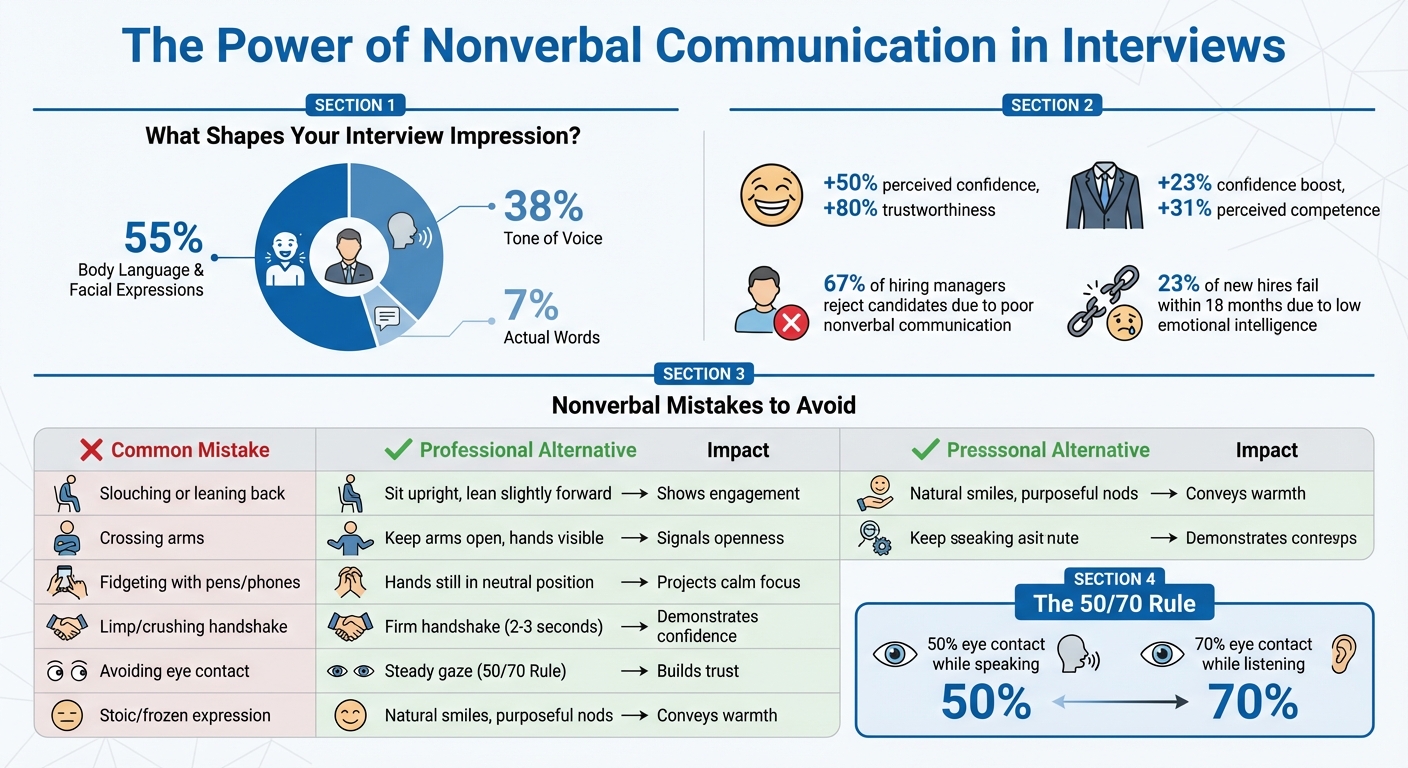
La communication non verbale joue un rôle énorme dans la façon dont les autres vous perçoivent. En fait, la recherche montre que lors d'un entretien, les signaux non verbaux représentent environ 55 % de votre impression globale, tandis que votre ton de voix ajoute 38 %. Cela ne laisse que 7 % pour les paroles réelles que vous prononcez [13]. En maîtrisant votre langage corporel, vos expressions faciales et votre ton vocal, vous pouvez projeter la confiance et l'enthousiasme, créant une impression équilibrée et soignée.
Techniques de langage corporel pour les entretiens
Votre posture en dit long. S'asseoir droit avec les épaules en arrière signale la confiance et la force, tandis que se voûter peut donner l'impression d'une faible énergie ou d'un manque d'intérêt. Se pencher légèrement en avant montre que vous êtes engagé et intéressé. La coach en carrière Eloise Eonnet souligne le pouvoir de la posture :
"Le langage corporel représente 90 % de la façon dont nous sommes perçus. Nous pouvons dire, 'Je suis un excellent candidat pour ce poste,' deux fois et la première fois semble confiante, posée et compétente, et la deuxième fois incertaine, nerveuse et inexpérimentée." [12]
Le contact visuel est un autre élément critique. Suivre la Règle 50/70 - maintenir le contact visuel 50 % du temps en parlant et 70 % en écoutant - aide à établir la confiance et la confiance sans accabler l'autre personne. Gardez vos mains détendues sur la table ou sur vos genoux pour éviter de vous agiter, et utilisez des gestes naturels pour souligner les points clés.
Pour les entretiens virtuels, il est important d'ajuster votre approche. Regardez directement dans l'objectif de la caméra au lieu de l'écran pour imiter le contact visuel, et gardez vos gestes dans le cadre de la caméra. Positionnez votre caméra au niveau des yeux et assurez-vous que vos mouvements semblent naturels.
Utiliser les expressions faciales pour montrer la positivité
Vos expressions faciales sont tout aussi importantes que votre langage corporel. Un sourire authentique, en particulier un sourire de Duchenne (où votre bouche et vos yeux sont engagés), peut augmenter votre confiance perçue de 50 % et vous faire paraître jusqu'à 80 % plus digne de confiance et positif [13]. L'écoute active bénéficie également des signaux faciaux, comme des hochements occasionnels, de légers mouvements de tête ou des sourcils levés, qui montrent l'intérêt et l'engagement. Comme l'explique Monique Sample de l'Université Commonwealth de Virginie :
"Les expressions faciales peuvent être le signal non verbal le plus mal compris. Nos visages racontent plus l'histoire que n'importe quels mots que nous utilisons." [12]
Faites attention à ne pas rester trop stoïque, car cela peut sembler un manque d'intérêt. D'un autre côté, en faire trop avec des sourires excessifs ou des sourires narquois peut sembler insincère [14]. Aussi, faites attention à la tension des lèvres - les lèvres serrées ou rentrées peuvent involontairement signaler le stress ou le désaccord [15].
Erreurs non verbales courantes à éviter
Même les petites erreurs de langage corporel peuvent détourner de votre communication verbale. En fait, 67 % des responsables du recrutement ont rejeté des candidats en raison d'une mauvaise communication non verbale [13]. N'oubliez pas que l'entretien commence dès que vous franchissez la porte. Maintenez une bonne posture, évitez de vous pencher sur votre téléphone dans la salle d'attente et projetez la confiance dès votre première interaction.
Voici un guide rapide des pièges non verbaux courants et de leurs alternatives professionnelles :
| Erreur courante | Alternative professionnelle | Impact |
|---|---|---|
| Se voûter ou se pencher en arrière | S'asseoir droit et se pencher légèrement en avant | Montre l'engagement |
| Croiser les bras | Garder les bras ouverts et les mains visibles | Signale l'ouverture et l'honnêteté |
| S'agiter avec des stylos/téléphones | Garder les mains immobiles dans une position neutre | Projette une concentration calme |
| Poignée de main molle ou écrasante | Offrir une poignée de main ferme (2-3 secondes) | Démontre la confiance |
| Éviter le contact visuel | Utiliser un regard stable (suivre la Règle 50/70) | Établit la confiance et la connexion |
| Expression figée ou gelée | Utiliser des sourires naturels et des hochements intentionnels | Transmet la chaleur et l'enthousiasme |
Évitez les comportements comme cliquer sur des stylos, taper du pied, jouer avec vos cheveux ou vérifier constamment votre montre. Si vous prenez des notes, mettez votre stylo de côté une fois terminé pour éviter les mouvements inutiles.
Le confort compte aussi. Porter des chaussures neuves ou des vêtements serrés peut entraîner de l'inconfort, et l'agitation qui en résulte pourrait être mal interprétée comme de la nervosité [12]. Pratiquer avec des entretiens simulés enregistrés peut vous aider à attraper et corriger des habitudes comme un clignement excessif, des yeux errants ou un manque d'expression [13]. En affinant ces compétences non verbales, vous serez mieux équipé pour vous adapter à n'importe quel cadre d'entretien.
Adapter votre approche à différents rôles et secteurs
Chaque entretien demande un ton émotionnel spécifique. Trouver le bon équilibre entre l'enthousiasme authentique et la maîtrise professionnelle dépend du rôle, du secteur et de la culture de l'entreprise. Savoir comment adapter votre approche garantit que vous semblez être un bon candidat - sans sembler trop rigide ou trop expressif.
Adapter l'expression émotionnelle au niveau du rôle
Pour les rôles de débutant, montrer une excitation visible et une accessibilité est souvent encouragé. Les employeurs à ce niveau s'attendent à une certaine nervosité et apprécient les candidats qui sont désireux d'apprendre. Un peu d'enthousiasme supplémentaire peut jouer en votre faveur lorsque vous commencez tout juste.
Pour les postes seniors ou exécutifs, cependant, les attentes changent. Bien que l'enthousiasme soit toujours valorisé, il doit être associé à une confiance mesurée et à une réflexion stratégique. Comme l'explique Jeanne Tsai, professeure de psychologie à l'Université Stanford :
"La culture américaine dominante associe le bon leadership à être excité et enthousiaste." [17]
Mais tous les rôles ne demandent pas une énergie élevée. Lucy Zhang Bencharit, chercheuse à l'Université Stanford, souligne :
"Dans les environnements de travail, il existe de nombreuses tâches dans lesquelles un employé calme et équilibré peut surpasser un employé excité et passionné." [17]
Ces différences soulignent l'importance d'aligner votre énergie avec les attentes du rôle.
Comprendre les attentes spécifiques à l'industrie
Les industries ont leurs propres normes pour l'expression émotionnelle et le comportement professionnel. Par exemple, les secteurs financier et juridique penchent vers un ton réservé et formel, tandis que les entreprises technologiques valorisent souvent la créativité et une ambiance décontractée. Le secteur de la santé, en revanche, exige du calme et de l'empathie en raison de la nature à enjeux élevés du travail.
| Industrie/Secteur | Formalité attendue | Expression émotionnelle valorisée |
|---|---|---|
| Finance / Droit | Élevée (Formel/Conservateur) | Réservé, Professionnel, Sérieux |
| Tech / Startups | Faible à modérée (Décontracté) | Enthousiaste, Passionné, Créatif |
| Santé | Élevée (Axée sur la précision) | Calme, Équilibré, Empathique |
| Organisations à but non lucratif | Variable | Motivé par la mission, Sincère, Dévoué |
Par exemple, dans une startup technologique en rapide évolution, un ton dynamique et animé pourrait signaler que vous êtes un excellent candidat. En revanche, une attitude stable et composée est plus appropriée pour la finance. Ces nuances sont importantes car les responsables du recrutement citent souvent un "manque de passion" comme raison de rejeter des candidats, même lorsque leurs compétences et leur expérience sont impressionnantes [3].
Trouver des indices culturels par la recherche sur l'entreprise
Rechercher l'entreprise est essentiel pour comprendre sa culture. Des plateformes comme Glassdoor et Fairygodboss fournissent des informations candides sur le processus d'entretien et l'environnement de travail. Vous pouvez également utiliser LinkedIn pour vérifier les antécédents de votre intervieweur, les connexions partagées ou les intérêts communs qui pourraient vous aider à établir une relation.
Faites attention au langage dans les descriptions de poste. Des mots comme "passion", "innovation" ou "perturber" suggèrent que l'entreprise valorise l'enthousiasme à haute énergie. D'un autre côté, des termes comme "précision", "conformité" ou "stabilité" pointent vers une préférence pour un style plus composé et mesuré. Comme l'explique Jeanne Tsai :
"Les gens pensent que leurs intuitions disent quelque chose sur le caractère de l'autre personne, mais nos données suggèrent que les intuitions des gens disent aussi quelque chose sur la culture dont ils viennent eux-mêmes." [17]
Si vous avez besoin d'aide supplémentaire, des outils comme Acedit (https://acedit.ai) offrent des entretiens de pratique simulés par l'IA, vous permettant d'affiner votre style de communication pour correspondre au rôle et à la culture de l'entreprise.
S'améliorer par la pratique et les commentaires
Comprendre comment équilibrer l'émotion et le professionnalisme est une chose - le mettre en pratique, surtout sous pression, est un défi complètement différent. C'est là que la pratique et les commentaires interviennent. Ces outils aident à combler le fossé entre savoir quoi faire et le faire réellement avec confiance. Les entretiens simulés, en particulier, offrent un moyen à faible risque d'affiner votre approche avant que la pression soit réelle.
Utiliser les entretiens simulés pour affiner vos compétences
Les entretiens simulés simulent des cadres d'entretien réels, vous donnant une chance de pratiquer la livraison de réponses naturelles et soignées. Lorsqu'ils sont guidés par un conseiller en carrière, ces sessions peuvent vous aider à aligner votre ton et votre formalité avec ce qui est attendu dans votre secteur. Le format que vous choisissez compte aussi - les domaines créatifs pourraient bénéficier de commentaires informels et dirigés par les pairs, tandis que les rôles d'entreprise demandent souvent des commentaires plus structurés et professionnels.
Des plateformes comme Acedit (https://acedit.ai) vont plus loin en offrant des entretiens simulés illimités qui analysent à la fois la livraison verbale et les signaux non verbaux. Ces outils peuvent évaluer des détails subtils comme les micro-expressions et le contact visuel, vous aidant à affiner votre performance. Selon les rapports des utilisateurs, 78 % des praticiens réguliers obtiennent des offres d'emploi, et les niveaux de confiance augmentent en moyenne de 98 % [18][19]. Acedit génère même des questions personnalisées basées sur votre profil LinkedIn et votre CV, garantissant que votre pratique se rapproche autant que possible de la réalité. Ce type de préparation prépare le terrain pour intégrer des commentaires détaillés, qui sont essentiels pour une amélioration constante.
Utiliser les commentaires pour affiner votre performance
Une fois que vous avez pratiqué l'équilibre entre l'émotion et le professionnalisme, l'étape suivante consiste à utiliser les commentaires pour vous améliorer. Commencez par documenter systématiquement les commentaires après chaque entretien simulé. Notez la date, le nom de l'évaluateur et les observations spécifiques. Concentrez-vous sur seulement 2-3 points actionnables à la fois, comme "faire une pause de 2 secondes avant de répondre aux questions émotionnelles" ou "réduire les mots de remplissage à moins de trois dans une réponse de cinq minutes." Garder cela ciblé vous aide à éviter de vous sentir submergé et rend la progression plus facile à suivre.
Faites attention aux aspects verbaux et non verbaux de votre performance. Cela inclut votre choix de mots, votre rythme et la façon dont vous structurez vos réponses, ainsi que votre posture, vos mouvements des mains et vos expressions faciales. La recherche montre que 89 % des participants voient une amélioration mesurable après seulement trois sessions de pratique lorsqu'ils appliquent les commentaires de manière cohérente [19]. Passez en revue vos notes avant chaque session pour créer une boucle de rétroaction qui s'appuie sur votre progression session après session.
Conclusion
Naviguer l'équilibre entre l'émotion et la formalité dans les entretiens d'embauche consiste à être votre vrai moi tout en maintenant le professionnalisme. Cela commence par comprendre comment vous communiquez naturellement et l'aligner réfléchiment avec le rôle, le secteur et la culture de l'entreprise. Cet équilibre est ce qui vous permet de vous préparer efficacement et de répondre dynamiquement lors de l'entretien.
La préparation est essentielle. Plongez dans les valeurs de l'entreprise, pratiquez vos réponses en utilisant des méthodes comme le cadre STAR, et répétez juste assez pour sembler naturel. Des études montrent que les candidats qui s'engagent dans une pratique d'entretien structurée sont 30 % plus susceptibles de décrocher des offres d'emploi [21]. Cependant, trop de répétition peut vous faire paraître rigide ou trop scénarisé [20]. L'objectif est de trouver un équilibre entre être bien préparé et maintenir un ton conversationnel.
L'adaptabilité est tout aussi importante. Être capable de lire la salle et d'ajuster votre ton, votre langage corporel et votre expression émotionnelle démontre l'intelligence émotionnelle - une qualité que les employeurs apprécient hautement. Fait intéressant, 23 % des nouvelles recrues échouent dans leurs 18 premiers mois en raison d'une faible intelligence émotionnelle [16]. Que vous visiez un rôle dans une startup décontractée ou un environnement d'entreprise formel, aligner votre style de communication avec les attentes du rôle tout en restant fidèle à vous-même est essentiel.
Enfin, pratiquez avec intention. Les entretiens simulés, les commentaires ciblés et la concentration sur quelques domaines spécifiques d'amélioration peuvent faire une grande différence. Des outils comme Acedit (https://acedit.ai) offrent des simulations d'entretien réalistes pour vous aider à affiner à la fois votre communication verbale et non verbale. En combinant une préparation réfléchie avec une volonté de vous adapter, vous aborderez n'importe quel entretien - qu'il soit virtuel ou en personne - avec confiance et authenticité.
FAQ
Comment montrer l'enthousiasme sans sembler non professionnel ?
Lorsque vous passez un entretien pour un rôle, il est important de trouver le bon équilibre entre l'enthousiasme et le professionnalisme. Montrez un intérêt authentique en préparant des questions spécifiques et réfléchies qui reflètent votre connaissance de l'entreprise. Cela met non seulement en évidence votre préparation, mais signale également votre enthousiasme pour l'opportunité.
Faites attention à votre langage corporel et à votre ton - maintenez un contact visuel stable, offrez une poignée de main ferme et parlez avec énergie et clarté. Ces signaux subtils peuvent faire une grande différence dans la façon dont votre enthousiasme est perçu. En même temps, évitez de sembler trop décontracté ou désespéré, car cela pourrait nuire à votre professionnalisme.
Pour affiner votre approche, envisagez de pratiquer avec des simulations d'entretien alimentées par l'IA. Celles-ci peuvent vous aider à polir vos réponses, en vous assurant que vous transmettez la confiance et l'enthousiasme authentique de manière équilibrée et professionnelle.
Quel est le moyen le plus rapide d'adapter mon ton à la culture d'une entreprise ?
Rechercher le style de communication, les valeurs fondamentales et la culture du lieu de travail d'une entreprise avant un entretien peut vous donner un avantage majeur. Cette préparation vous aide à comprendre comment vous présenter d'une manière qui résonne avec l'équipe.
Pendant l'entretien, faites attention au ton, au langage corporel et au comportement général de l'intervieweur. Sont-ils formels et structurés, ou gardent-ils les choses décontractées et conversationnelles ? Utilisez ces observations pour ajuster votre ton et vos réponses, en vous assurant que vous vous alignez sur leur approche.
L'objectif est de trouver un équilibre : rester professionnel tout en reflétant la personnalité et l'atmosphère de l'entreprise. Cela montre que vous êtes adaptable et véritablement intéressé par le fait de devenir partie de leur équipe.
Comment puis-je corriger rapidement le langage corporel nerveux dans les entretiens ?
Pour aborder le langage corporel nerveux lors des entretiens, faites attention aux signaux non verbaux qui transmettent la confiance. Tenez-vous ou asseyez-vous avec une bonne posture, maintenez un contact visuel stable et utilisez des gestes délibérés et significatifs. Répéter ces comportements à l'avance peut réduire les tendances comme s'agiter ou détourner le regard, vous aidant à paraître plus détendu et sûr de vous. Un peu de préparation peut faire beaucoup pour façonner les impressions des autres sur vous.