
AI is transforming how job seekers and employers connect. It quickly analyzes job descriptions, identifies essential skills, and helps candidates tailor their resumes for better results. With 48% of hiring managers using AI to screen resumes, understanding how these tools work is now critical for job seekers. AI evaluates both hard and soft skills, aligns them with job requirements, and improves application success rates by up to 94%. Tools like Acedit go further by offering resume optimization, cover letter generation, and even live interview coaching, all designed to make job applications more effective and efficient.
Key takeaways:
- AI identifies skills using Natural Language Processing (NLP) and models like BERT.
- It prioritizes required skills, maps them to taxonomies like O*NET, and aligns them with resumes using cosine similarity.
- Platforms like Acedit offer tailored features, including skill matching, STAR-based interview prep, and LinkedIn integration, with users reporting 3.1x higher response rates.
AI doesn't just match keywords - it analyzes context, ranks skills by relevance, and adapts to industry trends. With tools like Acedit, job seekers can focus on roles that match their expertise and improve their chances of landing interviews.
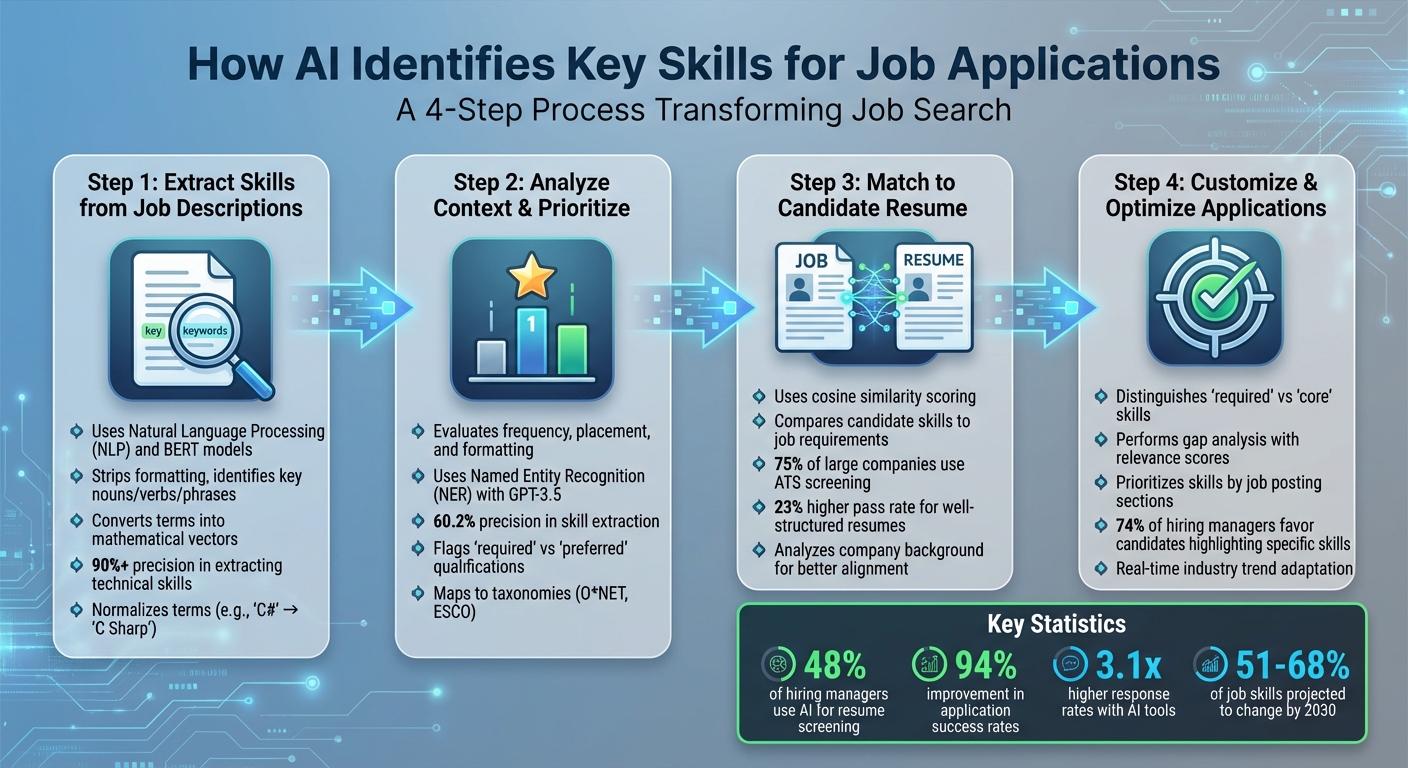
How AI Identifies and Matches Job Skills: 4-Step Process
Build an AI Resume Match Scorer with LangChain & Python | Semantic Similarity Explained
How AI Analyzes Job Descriptions to Find Key Skills
AI relies on Natural Language Processing (NLP) to identify critical skills in job descriptions across various formats like PDFs, DOCX files, and HTML. It strips away unnecessary formatting and stop-words, zeroing in on the nouns, verbs, and phrases that define the role. This process ensures that only the most relevant terms are highlighted.
Technologies such as BERT and GloVe play a key role by converting skill-related terms into mathematical vectors. This allows the system to understand relationships between terms - like recognizing that "Python" and "Flask" belong to the same programming ecosystem. AI also normalizes terms for consistency, so if "C#" appears in a job description, it’s translated to "C Sharp" to maintain uniformity across postings. With training on large datasets, these systems can achieve over 90% precision in grouping and extracting technical skill sets. This capability makes AI highly effective at identifying and organizing job-specific skills.
Keyword Extraction and Context Analysis
AI determines the importance of skills by analyzing factors like frequency, placement within the text, and formatting. Skills that appear prominently - whether in bold, bullet points, or specific sections like "Responsibilities" or "Requirements" - are flagged as essential. Meanwhile, skills found under "Preferred Qualifications" are marked as optional.
Advanced systems, including GPT-3.5, leverage Named Entity Recognition (NER) to label sequences of words as either hard or soft skills. This approach has shown 60.2% precision in skill extraction, surpassing traditional BERT-based models. Once extracted, these skills are mapped to established taxonomies like O*NET or ESCO, ensuring proper classification into categories such as technical, business, or soft skills.
Matching Skills to Job Requirements
After identifying skills, AI compares them to a candidate’s resume to assess relevance. Using cosine similarity, the system scores how closely the candidate’s skills align with the job’s requirements, giving priority to the most relevant matches. Today, 75% of large companies rely on Applicant Tracking Systems (ATS) to screen resumes before they’re reviewed by human recruiters. Resumes with well-structured and clearly defined skill clusters are 23% more likely to pass through these AI-driven systems.
Some platforms go even further by analyzing not just the job description and resume but also the company’s background to enhance the alignment process. For example, Acedit employs this multi-source analysis to improve the accuracy of matching candidates to roles.
AI Methods for Highlighting Candidate Skills
Once AI processes a job description, it transforms unstructured data - like PDFs, DOCX files, and online profiles - into a structured format. This allows for a direct comparison between a candidate’s skills and the job's requirements. The system identifies relevant competencies from various formats, setting the foundation for analyzing both hard and soft skills.
Identifying Hard and Soft Skills
AI takes different approaches when identifying hard versus soft skills. Hard skills, such as "Python", "SQL", or "Data Analysis", are often detected through straightforward keyword matching and mapped to established taxonomies like O*NET. To ensure accuracy, AI normalizes synonymous terms, treating them as equivalent.
Soft skills, on the other hand, require a more nuanced approach. Instead of relying solely on keywords, AI evaluates the context and action-oriented language within a candidate's profile. For instance, a statement like "led a cross-functional team to boost output by 15%" suggests leadership. The system also considers career progression - such as promotions or industry transitions - to infer traits like adaptability or leadership. Advanced AI can even recognize the STAR method (Situation, Task, Action, Result) in descriptions of past experiences to assess problem-solving abilities. This distinction is critical, as research shows that about 70% of hiring decisions are influenced by soft skills, while 30% depend on hard skills.
With this information, AI tailors applications by emphasizing the most relevant skills for each specific role.
Customizing Applications for Specific Roles
AI fine-tunes applications by prioritizing skills based on the job posting. It distinguishes between explicitly "required" skills listed in the description and "core" skills that are fundamental to the role but may not be explicitly mentioned. Skills outlined in sections like "Responsibilities" or "Requirements" are given higher priority than those under "Preferred Qualifications."
Modern AI tools also perform gap analysis, comparing a candidate’s extracted skills to the job description and generating a relevance score. For example, in December 2023, LinkedIn AI Tech Lead Ji Yan and his team introduced a multitask learning framework that improved differentiation between required and core skills. This resulted in a 0.87% increase in qualified applications and a 0.24% rise in predicted confirmed hires. Customization is crucial, as 74% of hiring managers are significantly more likely to consider candidates who effectively highlight the specific skills mentioned in the job description.
sbb-itb-20a3bee
How Machine Learning Prioritizes Skills by Industry
Machine learning takes skill prioritization to the next level by analyzing real-time industry data, offering insights into which skills matter most in a rapidly evolving job market.
Training Models with Industry Data
To understand shifting skill demands, machine learning models analyze massive datasets, including job postings from platforms like Indeed and Cornerstone. These models track trends over time, identifying emerging skills crucial to specific industries. For instance, by 2025, 78% of Information and Communication Technology (ICT) roles required AI technical expertise. This highlights just how quickly industry demands can evolve.
These systems rely on verified skills intelligence to assess workforce capabilities in real time. They also use standardized definitions from industry-led AI Skills Glossaries, ensuring consistency across education, business, and policy sectors. A practical example of this is the U.S. Defense Finance and Accounting Service (DFAS), which adopted Workera's skills intelligence platform in September 2025. The results? An 85% improvement in continuous learning scores and a 1.7× boost in learning velocity.
The data underscores significant demand shifts. Specialized AI skills are seeing explosive growth: AI security surged by 298%, foundation model adaptation by 267%, and responsible AI by 256%. Even broader areas like AI Governance and AI Ethics saw increases of 150% and 125%, respectively. These trends highlight the importance of dynamic ranking systems that adapt to the market's ever-changing needs.
Ranking Skills for Maximum Impact
Once trained with industry data, models rank skills based on explicit signals and inferred indicators. Explicit signals include direct matches between a candidate's listed skills and those required in job postings. When explicit data is limited, models turn to inferred signals, using Economic Graph data to deduce skills from job titles, company history, and other professional attributes.
In April 2022, LinkedIn introduced its "Skills Match" feature, spearheaded by Engineering Manager Zhujun (Allison) Chen, alongside Ping Liu and Xiaochen Hou. The team used Graph Neural Networks (GNN) to analyze professional relationships and set a "strong" skill match threshold, capturing about 10% of all applications. As Chen explained:
The skills needed for jobs globally is projected to change by 51% by 2030 (since 2016), and the rise of generative AI will accelerate this change to 68%.
The system also incorporates network signals, such as professional connections and interactions, to predict application success. This approach is particularly valuable for underrepresented groups who may lack traditional indicators for skill prediction. Additionally, models rank skills across dimensions like theoretical knowledge, problem-solving ability, and physical execution. Between August 2023 and July 2024, Indeed Hiring Lab used GPT-4o to evaluate over 2,800 work skills and found that 53.8% require "essential" or "high" physical execution, making them less likely to be replaced by AI.
The ranking process is updated daily, ensuring that skill prioritization stays in sync with the latest market trends.
Acedit's AI-Powered Skill Highlighting Features
Acedit uses advanced AI-driven techniques to transform how candidates highlight their skills for job applications and interviews. By combining resume analysis, job description matching, and real-time coaching, the platform ensures users can focus on the qualifications that matter most.
Tailored Resume and Cover Letter Optimization
Acedit’s AI takes job description analysis to the next level, helping users fine-tune their resumes and cover letters for maximum relevance. By scanning uploaded resumes and LinkedIn profiles, the platform identifies core skills, key accomplishments, and career milestones . It then compares this data against job descriptions to pinpoint required qualifications and even hints about the company’s values. Through its Smart Job Requirement Matching feature, Acedit aligns a candidate’s background with the specific needs of each job posting.
The results speak for themselves: users report a 3.1x higher response rate from employers, a 94% improvement in application outcomes, and 89% of users prefer AI-generated cover letters. By integrating LinkedIn, Acedit achieves 96% accuracy in representing professional experience and generates 3.5x more relevant interview answers. To get the most out of these tools, users are encouraged to link their LinkedIn profiles and personalize the AI-generated cover letters with their own details.
Real-Time Skill Coaching for Interviews
Acedit’s real-time coaching tools integrate seamlessly with platforms like Zoom, Microsoft Teams, and Google Meet. During interviews, the AI recognizes questions as they’re asked and provides tailored response suggestions on the spot . This feature has boosted user confidence by 94% and improved the quality of responses by 88%.
Sophia Lang, a satisfied user, shared her experience:
Assisted with preparing me and then on the day, the live prompts during the interview helped me nail it.
For premium users, the platform also allows preloaded STAR (Situation, Task, Action, Result) examples, enabling the AI to generate highly personalized answers. It offers targeted advice for technical interviews, behavioral questions, and even tricky, unexpected queries . Among those using the simulation and coaching features, 78% successfully land job offers.
Plan Comparison for Skill-Focused Features
Acedit offers flexible plans to cater to different needs, from basic features to comprehensive, unlimited access.
| Plan | Key Skill Features | Usage Limits |
|---|---|---|
| Free | Basic skill matching for Q&A and cover letters, LinkedIn integration, STAR examples | 4 Q&A per job, 2 practice interviews, 2 cover letters |
| Premium ($45 one-time) | Unlimited skill-optimized Q&A and cover letters, advanced AI tools, custom STAR examples | 3 AI-assisted interviews, 6 practice interviews |
| Premium Plus ($75 one-time) | Full, unlimited access to all features, advanced AI tools | Unlimited everything |
Every plan includes LinkedIn profile integration and support for custom STAR examples, ensuring all users benefit from skill-focused features. With a one-time payment model, Acedit eliminates recurring fees, making it an attractive option for budget-conscious job seekers.
Conclusion
AI has reshaped the way job seekers approach skill identification and prioritization, making the process more efficient and precise. With tools that leverage natural language processing to extract skills, assign relevance scores on a 0–100 scale, and highlight potential gaps, preparing applications has become far less time-consuming. Instead of poring over numerous job descriptions, candidates can now use AI to zero in on the exact hard and soft skills to showcase - and pinpoint areas where they might need to improve.
But this isn't just about matching keywords. AI-powered platforms go a step further by helping candidates assess their current skill set and figure out what to focus on learning next. These tools also emphasize high-impact skills that can be developed quickly, boosting both efficiency and confidence.
Taking this a step further, platforms like Acedit bring these innovations together in one place. Acedit combines skill extraction, resume optimization, cover letter creation, and even live interview coaching. Its LinkedIn integration ensures your profile fully represents your capabilities, while the one-time payment model - starting at $0 with the Free Plan - makes advanced AI tools accessible without ongoing costs. By streamlining everything from skill identification to real-time coaching, Acedit represents a new standard in job search tools.
FAQs
How does AI identify the most important skills for a job application?
AI uses natural language processing (NLP) to scan job descriptions and resumes for skill-related terms. Then, with the help of machine learning models, it evaluates factors such as how often a skill appears, its relevance to the job, and its overall demand in the industry.
This method highlights the most important skills for a specific role, allowing job seekers to customize their applications more effectively. Tools like Acedit take it a step further by offering AI-driven features to fine-tune resumes, craft tailored cover letters, and prepare for interviews. This makes it easier to confidently present the right skills for the job.
How does AI use Natural Language Processing (NLP) to identify key skills for job applications?
Natural Language Processing (NLP) allows AI to break down and interpret text from resumes, job descriptions, and even interview conversations. It analyzes sentences, pinpoints important details like job titles or certifications, and matches synonyms to standardized skill categories. This creates a clear, structured profile of a candidate’s abilities.
Using this data, tools such as Acedit can match a candidate’s skills with the requirements of a job posting. They can spotlight the most relevant qualifications, craft tailored interview questions, or even generate AI-powered cover letters. During interviews, NLP can step in with real-time feedback, recognizing questions and offering contextually relevant suggestions for responses. By turning raw text into actionable insights, NLP streamlines the hiring process, making it faster and more personalized.
How can AI tools like Acedit help job seekers improve their chances of success?
AI tools like Acedit can give job seekers a serious boost by simplifying some of the most challenging parts of the application process. For starters, it dives into job postings to pinpoint the key hard and soft skills employers are looking for. Using this information, it creates targeted keyword lists that can be seamlessly worked into résumés and cover letters. This not only makes documents more appealing to Applicant Tracking Systems (ATS) but also ensures they’re tailored for the specific role. On top of that, Acedit crafts personalized cover letters that match the company’s tone and highlight relevant accomplishments, saving users a ton of time and effort.
But that’s not all. Acedit also steps up when it comes to interview prep. It offers interactive mock sessions with real-time coaching, providing tailored question prompts, AI-generated response suggestions, and instant feedback. This helps candidates fine-tune their answers and build confidence. Even during live interviews, the tool discreetly detects questions and provides context-aware suggestions, helping users stay calm and deliver strong, well-thought-out responses. By combining polished application materials with well-prepared interview skills, Acedit equips job seekers to shine in today’s competitive job market.