
AI is transforming how companies evaluate job candidates by focusing on skills instead of traditional resumes and interview methods. Real-time skill assessments use AI to create personalized tests that adjust based on your performance. These tools provide instant feedback, helping you improve during the process and boosting confidence.
Key benefits include:
- Faster hiring: Companies report a 36% reduction in time-to-hire.
- Better results: Quality-of-hire metrics improve by up to 92%.
- Improved confidence: 94% of users feel more confident after using these tools.
Behind the scenes, technologies like machine learning, natural language processing (NLP), and multimodal analysis power these assessments. They evaluate technical skills, communication, and reasoning in milliseconds, making interviews more efficient and fair. Platforms like Acedit also offer real-time coaching and AI interview simulation, helping job seekers prepare effectively.
AI-driven assessments are reshaping hiring by focusing on what candidates can do, making the process faster, more accurate, and less stressful for everyone involved.
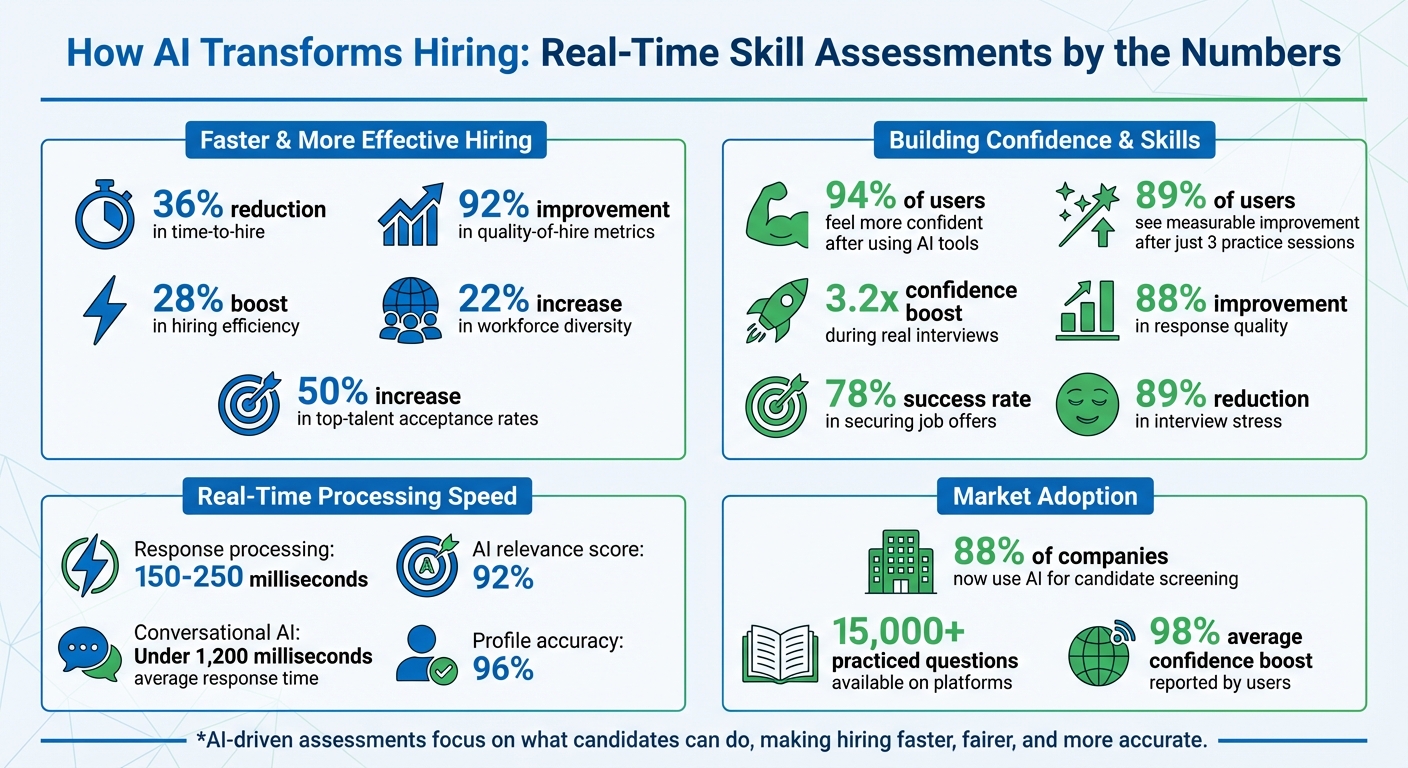
AI-Powered Skill Assessments: Key Statistics and Benefits
The Power of AI in Video Skill Assessment - Talented Learning Show Podcast 87
sbb-itb-20a3bee
What Are Real-Time Skill Assessments?
Real-time skill assessments are powered by AI to create dynamic, personalized tests that adapt to how you perform in the moment. Unlike traditional exams where everyone faces the same set of questions, these assessments analyze your responses as you go. If you're breezing through, the questions ramp up in difficulty. If you're struggling, they adjust to pinpoint your skill level more accurately.
These systems rely on models like Item Response Theory (IRT), the Rasch Model, and Bayesian inference to evaluate your accuracy, speed, and reasoning depth. Based on this data, they select the next most relevant question to keep the assessment tailored to you. This approach ensures you receive immediate, customized feedback.
One standout feature is the feedback loop. Using Natural Language Processing (NLP), these tools analyze your verbal and written inputs to provide personalized answer suggestions and structured hints almost instantly. Some platforms even use specialized AI agents to focus on different areas - one might evaluate coding tasks while another reviews behavioral responses. Essentially, these assessments don’t just measure your skills; they guide you through the process like a coach.
How AI Adjusts Questions Based on Performance
AI adapts questions in real-time by analyzing various performance metrics, creating a highly personalized experience.
Abhishek Verma from Dobr.AI explains that adaptive technical interviews "move beyond pre-set or 'one-size-fits-all' question banks... leveraging AI models like Item Response Theory (IRT) and adaptive branching logic to analyze each candidate's previous answers".
The system doesn't just check if you got an answer right or wrong. It also evaluates how quickly you completed the task, the quality of your code, and the depth of your reasoning.
This tailored approach has a measurable impact. Companies using adaptive question banks report up to a 50% increase in top-talent acceptance rates. Additionally, personalized interview flows can increase candidate completion rates by as much as 30%. For candidates, this means the process feels less draining and gives a more accurate representation of their abilities.
How Real-Time Feedback Works
Real-time feedback takes the experience a step further by analyzing your performance instantly and helping you improve on the spot. Instead of waiting for results, you get immediate insights into how you're doing. NLP systems convert your speech to text, identify the intent behind questions (e.g., technical, behavioral, or system design), and flag when your responses become unclear or off-track.
According to Beyz AI, "A real-time AI interview assistant simply bridges the gap between 'I know it' and 'I can say it clearly under pressure'".
This feedback isn't just about scoring - it’s about guiding you. By using frameworks like STAR (Situation, Task, Action, Result), the system helps you refine your answers in real-time. This immediate coaching prevents repeated mistakes and boosts confidence. Users have reported an 88% improvement in response quality and an 89% reduction in stress.
These tools don’t just evaluate; they empower candidates by highlighting their skills and helping them improve in the moment.
Technologies Behind AI-Based Skill Assessments
AI-based skill assessments rely on a combination of machine learning, natural language processing (NLP), and multimodal analysis to provide tailored evaluations. These systems are far from one-size-fits-all. Instead, they use multiple technologies, each designed to handle specific tasks, such as adjusting question difficulty or analyzing communication under pressure. Let’s break down the core technologies that make these assessments both adaptive and detailed.
Machine Learning for Personalized Evaluation
Machine learning serves as the backbone of personalized assessments. These algorithms analyze performance metrics like accuracy, speed, and depth of reasoning. Using this data, the system adjusts question difficulty in real-time, often guided by psychometric models. This ensures that each question is relevant to your skill level, pulling from adaptive question banks.
Some systems go even further with multi-agent routing. Here’s how it works: lightweight classifiers identify the intent behind a question - whether it’s behavioral, technical, or related to system design - and route your responses to specialized agents. For example, a STAR agent might evaluate how you narrate a behavioral scenario using the STAR method, while a Coding Reasoning agent focuses on your logical problem-solving. Impressively, these systems process responses in just 150–250 milliseconds, keeping the interaction seamless.
The impact of these systems is clear. Companies using AI-driven assessments report a 36% reduction in time-to-hire and up to a 92% improvement in quality-of-hire metrics. They’ve also seen a 28% boost in hiring efficiency and a 22% increase in workforce diversity. But machine learning is just one piece of the puzzle.
Natural Language Processing and Conversational AI
NLP is the technology that enables conversational assessments. It translates speech into text in real-time, identifies question intent, and generates meaningful follow-ups. However, NLP doesn’t stop at understanding what you say - it also evaluates how you say it. Factors like tone, pace, and clarity are analyzed to assess soft skills.
According to Kian Katanforoosh, Founder and CEO of Workera, "Conversational assessments change the type of signal we collect. By talking through a problem, the person reveals their approach, reasoning, and blind spots".
Workera’s "Talk" feature is a practical example of NLP in action. Introduced in 2026, it conducts skill-based challenges in multiple languages, including English, Spanish, French, and German, with response times averaging under 1,200 milliseconds. Beyond scoring, it provides tailored learning recommendations based on your conversation.
NLP also powers dialogic feedback, allowing you to ask questions, clarify mistakes, and refine your answers. This interactive approach turns assessments into opportunities for growth, making them more than just a static test.
Multimodal Analysis for Complete Skill Tracking
Multimodal analysis ties everything together by integrating data from various sources - text, audio, video, and even behavioral signals like typing patterns. This creates a 360-degree view of your abilities. For example, while NLP evaluates your verbal communication, computer vision might analyze facial expressions and body language during a video interview. Meanwhile, machine learning assesses the technical accuracy of your work.
How AI Powers Job Preparation Tools Like Acedit
AI technologies that adaptively adjust assessment questions are also transforming job preparation tools in various ways. Acedit leverages these advancements to leverage AI for your job search through tailored coaching and practice sessions, designed to align with their specific backgrounds and target roles.
Personalized Interview Simulations
Acedit taps into natural language processing (NLP) and machine learning to analyze details from your resume, LinkedIn profile, and job descriptions. Using this data, it creates interview scenarios that mimic real-world questions for your desired position. What sets it apart is its ability to adapt follow-up questions based on your responses, closely replicating how actual interviews unfold. Plus, you receive instant feedback, making the learning process far more effective than traditional methods.
The platform’s impact is clear: 89% of users see measurable improvement after just three practice sessions, and confidence levels during real interviews increase by 3.2x. Regular users have a 78% success rate in securing job offers, with the platform supporting over 15,000 practiced questions and reporting a 98% average confidence boost among its community.
These simulations don’t just sharpen your skills - they prepare you for dynamic, real-time coaching during actual interviews.
Real-Time Coaching During Interviews
Acedit’s Chrome extension takes things further by providing real-time support during live interviews. Using conversational AI and speech-to-text technology, it transcribes questions instantly and generates tailored responses on the spot. This feature works discreetly during browser-based video calls on platforms like Zoom, Microsoft Teams, and Google Meet. The AI doesn’t offer generic answers; it cross-references job requirements, practiced skills, and LinkedIn data to deliver responses with a 92% relevance score.
The results? Users report up to a 3.2x confidence boost, with 94% noticing improved response quality and a 76% increase in overall interview success rates. It’s like having a safety net for those moments when nerves take over or unexpected questions arise.
Skill Synchronization Across Platforms
Acedit also ensures your professional story stays consistent across platforms. By integrating directly with LinkedIn via API, it analyzes your career history, achievements, and skills. This synchronization guarantees that your interview responses and AI-generated content align seamlessly with your professional brand. The system uses deep profile analysis to identify key skills and accomplishments, tailoring responses to match specific job requirements in real time.
This approach achieves 96% accuracy in representing your experience and generates responses that are 3.5x more relevant. When your answers reference actual projects and achievements from your LinkedIn profile, they carry more weight. Unsurprisingly, 91% of users prefer responses linked to their LinkedIn data, and 88% find this feature improves their use of professional achievements during interviews.
Benefits of Real-Time Skill Assessments for Job Seekers
Unbiased and Objective Evaluation
AI-driven assessments take the guesswork out of hiring by replacing subjective judgments with standardized, performance-based evaluations. Instead of relying on a recruiter’s intuition or first impressions, these systems assess candidates on equal footing. Whether it’s solving coding problems, navigating scenario-based challenges, or showcasing soft skills, every applicant is measured against the same criteria. For instance, companies using AI-driven assessments have reported a 22% increase in hiring diversity compared to traditional approaches.
As Metaview highlights:
"The result is a level playing field where candidates are judged on merit, rather than which interviewer they're paired with".
This approach is especially important when you consider that hiring mistakes can cost businesses up to 30% of an employee’s first-year salary. By focusing on real-world skills instead of resumes or interviewer biases, AI ensures a fairer and more consistent evaluation process.
Faster Preparation and Time Savings
AI doesn’t just improve evaluations - it also speeds up your interview preparation. Real-time feedback pinpoints your weaknesses instantly, cutting out the need to revisit material you’ve already mastered. This means you can focus your energy where it’s needed most. Tools like Acedit take it a step further by transforming basic resume bullet points into STAR-formatted stories, organizing your experiences into a "story bank", and offering unlimited practice sessions whenever you need them.
The results speak for themselves: 88% of users report improved response quality with AI-driven suggestions, and 94% feel fully prepared for interviews after using these tools. By combining immediate feedback with personalized guidance, AI makes preparation faster, smarter, and more effective.
Building Confidence Through Practice
Streamlined preparation naturally leads to greater confidence. AI-powered platforms provide a safe space to practice realistic interview scenarios, helping you build “muscle memory” for high-pressure conversations. This preparation significantly reduces stress - 89% of users report feeling less anxious about interviews after practicing with AI tools.
Even during live interviews, AI can quietly assist with browser-based video calls, offering a safety net for unexpected questions or moments of uncertainty. Users have reported a 3.5x boost in confidence during simulated interviews, and 76% credit AI assistance for their success in real interviews. With platforms like Acedit offering access to over 15,000 practice questions, job seekers can refine their skills and gain the repetition needed to excel when it counts the most.
Conclusion
AI-driven real-time skill assessments are redefining how job seekers tackle interviews. By moving beyond static question banks to dynamic systems that adapt based on your performance, these tools provide a tailored learning experience. They don’t just measure your abilities - they guide and coach you, helping you focus on areas where you need improvement while reinforcing your strengths. This shift in approach enhances preparation and delivers measurable results.
Feedback from users highlights significant boosts in confidence and improved interview outcomes. Acedit stands out as a prime example of how these tools are making a difference in the competitive job market.
One of the standout features of these platforms is their ability to make high-quality interview preparation accessible to everyone. Whether you’re practicing in the middle of the night or navigating a tricky question during a live interview, AI-powered tools are available 24/7. Unlike traditional coaching, they eliminate the barriers of cost and scheduling, offering reliable support whenever you need it. This accessibility reflects a broader shift in the industry toward prioritizing skills-based hiring.
The momentum behind skills-first hiring is undeniable - more than 88% of companies now use AI in some capacity for candidate screening. Tigran Sloyan, CEO of CodeSignal, emphasizes that AI skill assessments are driving innovation and fostering long-term success. Job seekers who integrate these tools into their preparation today will be better equipped to navigate an ever-changing job market.
Incorporating adaptive AI into interview prep changes the game. In a job market that demands not only technical expertise but also the ability to present it under pressure, platforms like Acedit turn interview stress into confidence and competence. These tools are paving the way for a new standard in job readiness.
FAQs
How does an AI assessment decide what question comes next?
An AI assessment crafts the next question by evaluating your answers, background, and the job description. This approach enables it to create customized, on-the-spot follow-up questions that closely resemble real interview dynamics. The process offers a tailored experience, helping job seekers get ready for actual interview situations.
Can AI skill assessments be biased, and how is fairness checked?
AI skill assessments can sometimes reflect biases, often stemming from underrepresented groups in the training data or the influence of biased patterns within datasets. This can result in outcomes that aren't fair or balanced during evaluations.
To address this, organizations take steps like incorporating diverse training datasets, implementing fairness-focused algorithms, and maintaining consistent monitoring practices. Ensuring transparency and accountability plays a key role in reducing these biases and striving for more equitable results in real-time skill assessments.
Is using Acedit during a live interview allowed?
Yes, you can use Acedit during a live interview. Its real-time AI assistance works quietly in the background, ensuring it remains undetectable to interviewers. The tool is specifically created to support candidates during online interviews without drawing any attention.