
AI is transforming how we prepare for job interviews. By 2025, most companies are using AI to screen resumes and create tailored interview questions, making the hiring process longer and more complex. Candidates now rely on AI-powered tools for preparation, which improve performance, reduce stress, and build confidence. These tools simulate interviews, provide real-time feedback, and personalize practice sessions based on job roles and skills.
Key stats:
- 83% of companies use AI for resume screening (up from 48% in 2023).
- 76% plan to use AI to generate interview questions.
- Candidates using AI tools report higher performance ratings and less anxiety.
- Tools like Acedit offer features like mock interviews, real-time coaching, and tailored feedback.
AI tools are reshaping interview prep by focusing on critical thinking, collaboration with AI, and personalized learning. Job seekers who embrace these tools are better equipped to navigate the changing recruitment landscape.
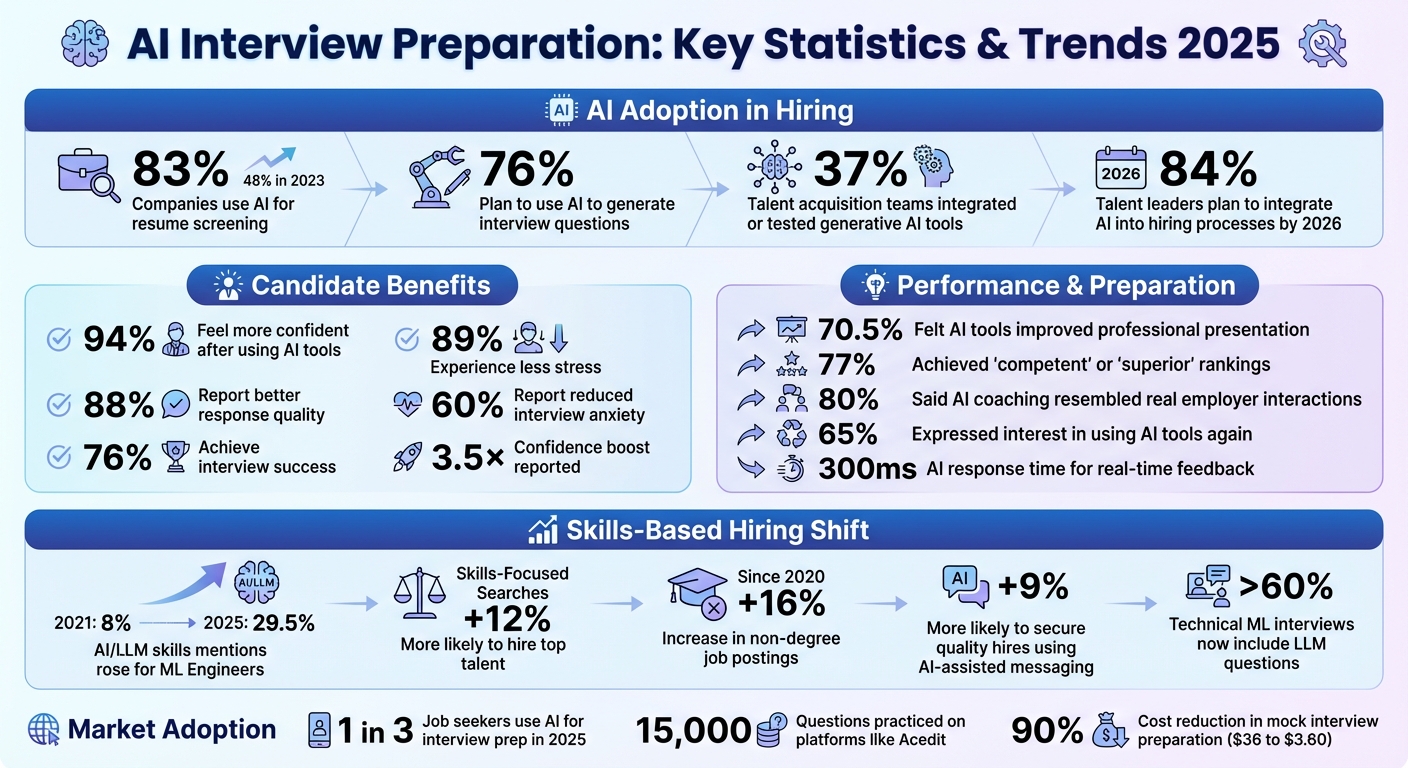
AI Interview Preparation Statistics and Trends 2025
Best AI Tools for Interview Preparations in 2025 - Be Job Ready with AI
Research Findings on AI Interview Preparation Tools
Studies from 2025 highlight how AI-powered tools are reshaping interview preparation. Candidates using generative AI tools showed higher performance ratings compared to those who prepared without AI assistance, thanks to personalized content that reinforced job-specific skills.
The benefits go beyond performance scores. A survey found that 70.5% of students felt these tools improved their professional presentation, while 77% achieved "competent" or "superior" rankings in their preparation materials. Additionally, 60% of job seekers reported reduced interview anxiety due to the nonjudgmental environment these tools provide.
Interestingly, AI training also improved users' confidence in interacting with technology, especially among those initially hesitant to embrace it. This suggests that AI tools can cater to a broad range of users, making interview preparation more accessible for everyone.
Real-Time Interview Coaching with AI
One standout feature of AI tools is real-time coaching. In June 2025, researchers Nathalia Gomez and Tiffany D. Do from Drexel University studied how a GPT-4o-powered AI system supported 20 computer science students during mock technical interviews. The system provided real-time feedback, asking clarifying questions and offering hints, which 80% of participants said closely resembled real employer interactions.
With a lightning-fast 300-millisecond response time, the AI maintained a natural conversational flow. This instant feedback helped candidates articulate their thought processes, bridging communication gaps. Notably, 65% of students expressed interest in using the tool again for future practice.
Personalized Q&A Generation Results
AI tools have moved beyond generic questions, offering tailored interview questions and answers based on a candidate’s unique background. For example, Machine Learning Engineers might practice with questions about RAG pipelines, while Data Scientists focus on A/B testing and bias detection.
This shift aligns with the growing emphasis on AI and LLM-related skills in hiring. For instance, mentions of AI/LLM skills in interviews for Machine Learning Engineers rose from 8% in 2021 to 29.5% in 2025. However, recruiters are also using deeper follow-up questions to detect "AI-parroting", where candidates provide rehearsed answers without genuine understanding.
Navio Kwok, Leadership Adviser at Russell Reynolds Associates, commented:
In one recent study, candidates who used such tools to prepare received higher overall interview performance ratings compared with those who were unassisted by GenAI.
Behavioral Interview Preparation with AI
AI tools are also enhancing preparation for behavioral interviews, which remain a critical part of the hiring process. Using STAR-based techniques (Situation, Task, Action, Result), these tools guide candidates toward crafting effective responses. A 2025 study by the University of Colorado Boulder involving 663 Amazon MTurk participants found that "Why/Why Not" Chain-of-Thought prompting provided actionable feedback while maintaining low offensiveness ratings.
Modern AI systems deliver nearly instant feedback on aspects like readability, credibility, and job relevance. Candidates often use these tools repeatedly, creating a self-correcting learning loop. Advanced multimodal systems even analyze speech and non-verbal cues in real time, offering comprehensive coaching.
For instance, researchers at Maharaja Surajmal Institute developed an AI tool in June 2025 that uses Gemini AI and Next.js to record mock interviews via webcam and microphone. The tool provides detailed feedback, including ratings and keyword suggestions to improve responses.
User feedback highlights some skepticism. Participants rated AI-generated feedback as moderately understandable and transparent (scores ranged from 1.72 to 2.12 on a 5-point scale). Overall effectiveness for actionable training was rated moderate to high, with scores reaching 2.23. However, trust in these tools remained cautious, with ratings between 1.74 and 1.91.
AI Interview Preparation Trends in 2025
The way we prepare for interviews has transformed significantly in 2025, thanks to advancements in AI tools and changes in hiring practices. These trends are reshaping how candidates get ready for the job market.
AI Integration with Professional Platforms
In 2025, AI interview tools started tapping into professional platforms like LinkedIn to create tailored preparation experiences. By this year, 37% of talent acquisition teams had integrated or tested generative AI tools. Tools like Acedit now analyze LinkedIn profiles to spot skill gaps and generate practice questions that align with a candidate's verified experience. This approach has proven effective - companies using AI-assisted messaging on platforms like LinkedIn are 9% more likely to secure quality hires. The rise of skills-based hiring has further fueled this trend. For example, organizations conducting skills-focused searches on LinkedIn are 12% more likely to hire top talent, and non-degree job postings have increased by 16% since 2020.
Real-Time and Adaptive Learning Systems
AI tools in 2025 moved beyond static question banks, offering dynamic, personalized learning environments. These systems adapt to each candidate’s performance during practice sessions. Using advanced natural language processing (NLP), they evaluate not just the content of responses but also how well candidates articulate their thoughts. If a candidate struggles with certain question types, the system provides similar challenges until they improve. On the other hand, when they excel, the difficulty level increases to push their skills further. Amanda Richardson, CEO of CoderPad, highlighted this evolution:
The death of algorithmic take-homes - replaced by project-based ones.
This shift is evident in hiring trends, with mentions of AI and LLM skills for Machine Learning Engineers jumping from 8% in 2021 to 29.5% in 2025. These adaptive tools also extend into simulation environments, where candidates can practice in scenarios that mimic real-world interviews, boosting their confidence.
Confidence Building Through AI Simulations
AI-powered simulations have become a game-changer for reducing interview stress. These tools create lifelike interview settings where candidates can practice responses and get instant feedback. Multimodal systems now analyze factors like body language, tone of voice, and even eye movements, offering a complete picture of a candidate's presentation skills. With in-person interviews making a partial return, simulation tools have added features like video recording and analysis to help candidates prepare for face-to-face interactions with greater ease and authenticity.
sbb-itb-20a3bee
Acedit: AI Interview Practice Tool Overview
Acedit is a Chrome extension powered by AI, designed to help users prepare for interviews in real time. It integrates smoothly with popular video conferencing platforms like Zoom, Microsoft Teams, and Google Meet, offering discreet, on-the-spot assistance during interviews. With over 15,000 questions practiced on the platform and a user rating of 4.8/5, Acedit has become a trusted tool for interview preparation [20, 22].
The feedback from users highlights its effectiveness: 94% feel more confident, 88% report better response quality, 76% achieve interview success, and 89% experience less stress during interviews. As Ethan Brown put it:
The AI Interview Copilot gave me the confidence I needed to tackle tough questions, and it helped me land a dream job in consultation.
Acedit Features
Acedit tailors its suggestions by analyzing your resume, job description, and company details. Its real-time question detection system offers instant AI-generated advice, and premium users can include customized STAR (Situation, Task, Action, Result) examples for more structured responses. It also integrates with LinkedIn to ensure answers align with your professional profile.
The tool's AI-simulated mock interviews adapt to your experience level and the job you're targeting, helping you build "muscle memory" for real situations. In fact, 94% of users report feeling well-prepared after practicing, with many experiencing a 3.5× confidence boost. Acedit also assists with creating cover letters tailored to your resume, writing style, and LinkedIn profile - all while safeguarding your data with industry-standard security measures. As Sophia Lang shared:
Assisted with preparing me and then on the day, the live prompts during the interview helped me nail it.
Acedit Free Plan
The free plan is a great way to get started without requiring a credit card. It includes real-time question detection, basic AI response suggestions, LinkedIn integration, and the ability to add custom STAR examples [21, 22].
| Feature | Free Plan ($0) | Description | Limitations |
|---|---|---|---|
| AI-Generated Practice Q&A | 4 per job listing | Tailored practice questions | Limited to 4 questions per listing |
| AI-Simulated Interviews | 2 sessions | Mock interviews based on job descriptions | Limited to 2 sessions |
| AI Cover Letter Generation | 2 letters | Personalized based on your profile | Maximum of 2 letters |
| AI-Assisted Live Interviews | Included | Real-time coaching during interviews | Limited usage |
For those needing more extensive preparation, premium plans unlock additional features and unlimited access.
Acedit Premium and Premium Plus Plans
Acedit offers two premium options with one-time payments for lifetime access. The Premium plan costs $45 and includes unlimited Q&A generation, six AI-simulated interviews, unlimited cover letter creation, and three AI-assisted live interviews [21, 22]. The Premium Plus plan, priced at $75 but currently available at a 40% discount, removes all restrictions and provides unlimited access to every feature [21, 22]. Both plans feature enhanced AI capabilities, full LinkedIn integration, and unlimited storage for custom STAR examples. Among premium users, 88% feel comfortable using AI suggestions during real interviews after practicing with these advanced tools [21, 22].
| Plan Name | Price | Key Features | Best For |
|---|---|---|---|
| Premium | $45 (One-Time) | Unlimited Q&A, 6 simulations, unlimited cover letters, 3 live interview sessions | Job seekers targeting specific roles |
| Premium Plus | $75 (One-Time) | Unlimited Q&A, simulations, cover letters, and live interview support | Active job seekers attending frequent interviews |
These features illustrate the evolving role of AI in interview preparation and what users can expect as the technology continues to advance.
AI Interview Practice: What to Expect in 2026
By 2026, AI interview tools will focus less on simple answer accuracy and more on how well you explain your reasoning. As Santosh Rout from Interview Node aptly notes:
In 2026, every ML interview is a reasoning test disguised as a coding question.
These platforms will dig deeper into your thought process during "think-aloud" sessions, assessing how clearly and logically you handle ambiguity in real time. Beyond reasoning, advanced AI will also analyze delivery cues. For instance, natural language understanding technology will pick up on vocal stress patterns during practice, helping you refine your confidence and composure. It will also generate dynamic follow-up questions based on your responses, mimicking how recruiters test your depth of expertise. A hiring manager at Meta AI explains:
We're less interested in whether you know a sorting algorithm and more in how you'd decide which algorithm fits a production constraint.
Virtual reality will play a growing role in interview prep, creating realistic office and panel settings. Back in November 2024, an AI-driven platform combining GPT-4 and ADA 2 embeddings slashed preparation costs by 90% - from $36 to just $3.60 for three mock sessions. By 2026, these VR tools will include photorealistic avatars and biosensors to measure and provide feedback on anxiety levels, offering candidates deeper insights into their stress management.
Personalization will also take center stage. These tools will adapt simulations based on your career history and the specific company you're targeting. With 84% of talent leaders planning to integrate AI into hiring processes by 2026, preparation platforms will deliver highly tailored experiences. Additionally, over 60% of technical interviews in machine learning now include questions on language model behavior and prompt design. As a senior recruiter at Anthropic points out:
The AI interviewer doesn't care about your pedigree. It cares about how you think, how you learn, and how you explain ambiguity.
Candidates will also need to show they can collaborate effectively with AI systems. Instead of relying on rote memorization, preparation tools will train you to work alongside these systems, defend your choices, and explain trade-offs. With 52% of leaders planning to integrate autonomous AI agents into their teams by 2026, this collaboration will be a key skill. And as in-person interview elements make a comeback to ensure authenticity, showcasing genuine insight will remain crucial for standing out.
Conclusion
AI-driven interview preparation is reshaping how job seekers approach the hiring process in 2025. Gone are the days of relying solely on generic study guides - now, data-driven, personalized simulations allow candidates to practice with tools that reflect the technology used in modern hiring systems. Research shows that these AI tools not only improve performance but also help reduce the stress associated with interviews.
Platforms like Acedit offer real-time coaching and customized question-and-answer practice, helping candidates build confidence through realistic simulations. Instead of promoting memorized responses, these tools focus on strengthening job-relevant skills and knowledge while also analyzing non-verbal communication like tone and body language. With one in three job seekers already leveraging AI for interview prep in 2025, using these tools is quickly becoming a must for staying competitive in today’s automated hiring landscape.
The real trick lies in finding balance. AI tools are excellent for structuring your thoughts and refining your approach, but it’s critical to pair these insights with your personal experiences and stories. This combination ensures your responses resonate with both automated systems and human recruiters. As interviews increasingly focus on evaluating problem-solving and teamwork abilities rather than just factual knowledge, platforms that adapt to your career path and target employers can provide a distinct advantage.
No matter your industry, AI-powered tools can help you understand what employers value and how to effectively showcase your expertise. Try Acedit’s Free plan to experience AI-driven practice firsthand, or consider upgrading for access to unlimited features. Preparing with AI today could lead to stronger interview performance and better career opportunities tomorrow.
FAQs
Are AI interview prep tools considered cheating?
Whether using AI interview prep tools is considered cheating largely hinges on how they're used and the intent behind them. Some argue that relying on AI to generate answers or scrape questions during an actual interview gives candidates an unfair edge. On the flip side, many companies are fine with candidates using these tools for practice or improving their skills before the interview.
Ultimately, it comes down to being transparent and following the organization's policies. Misusing AI tools can skew the evaluation process and may come across as trying to manipulate the system.
How can I use AI help without sounding rehearsed?
To keep your responses from sounding overly rehearsed when using AI tools, focus on practicing with personalized feedback and engaging in dynamic simulations. For example, platforms like Acedit can analyze your tone and clarity, providing actionable suggestions to enhance your delivery. These tools also assist in sharpening storytelling techniques, such as using the STAR framework, and can create customized questions based on your resume and the job description. The key is to use these tools as preparation aids rather than scripts, helping your answers come across as natural and self-assured.
Can AI tools help with my anxiety and confidence?
AI tools can play a big role in tackling interview anxiety and building confidence. Many of these tools offer features like personalized coaching, real-time feedback, and simulated interview sessions to help users feel more prepared. For example, platforms like Acedit use cutting-edge technology to assess communication skills and confidence levels, providing customized recommendations for improvement. By practicing regularly with these tools, users can lower their stress, improve their performance, and develop self-assurance - all within a safe and supportive setting.