
AI is transforming job alerts, making them smarter and more personalized. Instead of relying on outdated keyword-based searches, today’s systems use advanced AI like Large Language Models (LLMs) to understand the intent behind your search. This means better matches, fewer irrelevant notifications, and more time saved for job seekers and recruiters alike.
Key Takeaways:
- Precision Matching: AI identifies roles based on skills and goals, not just job titles.
- Real-Time Updates: Systems adjust instantly to your preferences and behavior.
- Efficiency: Automated tools save up to 70% of time spent on tasks like resume tailoring.
- Higher Success Rates: Applying within 24 hours of a posting increases response likelihood by 2.5×.
AI-powered job alerts are reshaping how people find jobs, improving both accuracy and efficiency while reducing the hassle of irrelevant matches.
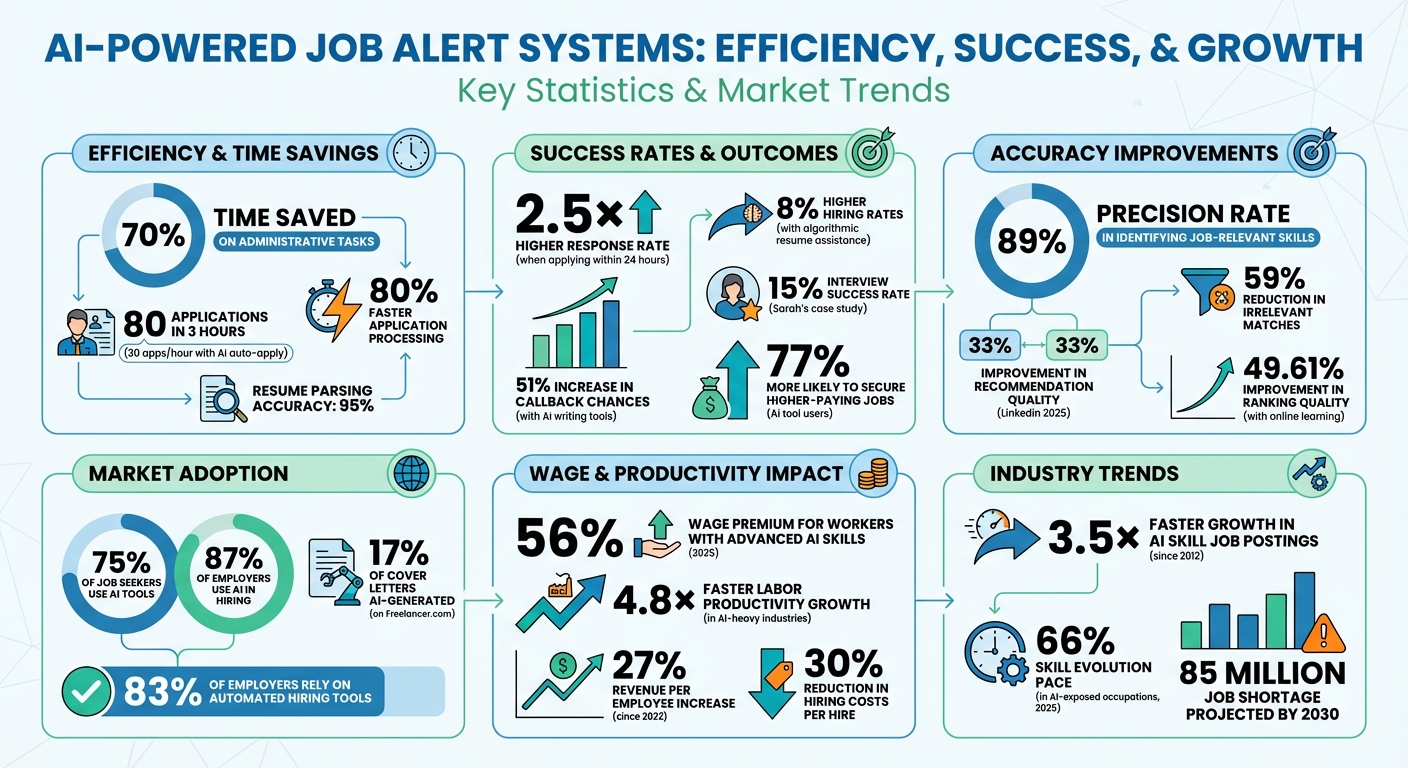
AI Job Alerts Impact: Key Statistics on Efficiency, Success Rates, and Market Trends
Masterclass on Automating Job Search with AI- Karthick Raju
sbb-itb-20a3bee
How AI Improves Accuracy in Job Alerts
AI has transformed job alerts, making them more precise and tailored to individual skills and preferences.
Skill-Based Filtering and Personalization
AI systems now go beyond merely scanning job titles - they analyze your experience in depth. Using tools like NLP frameworks such as BERT and Spacy, these platforms extract technical qualifications, years of experience, and career-related keywords from resumes, even when formatted differently. These models have achieved an 89% precision rate in identifying job-relevant skills and experiences.
LinkedIn has taken this a step further with its "Generalized Additive Mixed Model" approach. This system creates personalized profiles that adapt to changing user preferences. In August 2025, LinkedIn introduced a unified query understanding framework powered by the Qwen2.5-1.5B model, consolidating multiple legacy systems into a single LLM-based service. This upgrade led to a 33% improvement in recommendation quality and a 59% reduction in irrelevant matches.
"A single (global) machine learned model can be sub-optimal to capture unique idiosyncrasies... we individually adjust this single global model for each member and job." – Konstantin Salomatin, AI Software Engineer, LinkedIn
These personalized profiles are only as good as the data they rely on, which is why real-time updates are essential. By continuously refreshing data, these systems adapt to changes in your job search behavior, keeping recommendations relevant.
Better Relevance Through Real-Time Algorithms
AI models need constant updating to stay accurate. Without fresh data, their performance can drop by 50% in just three weeks. To counter this, platforms use daily automated retraining pipelines, ensuring updates occur within minutes.
Over 50% of job seekers revisit their search within 10 minutes of their last session. Real-time systems adjust dynamically based on your interactions. For instance, if you save a marketing position or skip several software engineering roles, the algorithm learns from these actions. In a trial with Sweden's largest job board, 59 million personalized recommendations increased employment rates by 0.6% over six months. Additionally, when a system recommends a specific job, it boosts the likelihood of you being hired there by 5%.
These advancements in accuracy directly enhance efficiency, which we'll delve into next.
Efficiency Gains from AI-Driven Job Alert Systems
AI doesn't just improve job match accuracy - it also saves a ton of time, completely reshaping how people approach their job searches. These efficiency gains make the process smoother and far less time-consuming.
Time-Saving Automation
AI takes over the repetitive parts of job hunting by scanning platforms like LinkedIn, Indeed, and Glassdoor. It filters job listings based on your preferences - such as title, location, salary, and experience - and assigns each one a "fit score." This score helps you quickly identify the opportunities worth your attention.
The time saved is impressive. Tasks that once took hours now happen in minutes, or even seconds. For example, customizing resumes and writing cover letters manually can take 30 to 60 minutes per application. With AI, fully automated systems can handle this in seconds, and hybrid systems that include human review typically finish within 24 hours. In fact, users of AI tracking tools report saving 70% of their time on administrative tasks.
Take Sarah, a mid-level product manager in 2024, as an example. Using Resumly's auto-apply feature, she submitted 80 applications in just three hours - about 30 applications per hour. This effort led to 12 interview requests within 48 hours, giving her a 15% success rate. Features like real-time notifications via dashboards or WhatsApp also mean you don’t have to keep refreshing your email for updates.
Higher Response Rates and Success Rates
This speed advantage directly boosts your chances of getting noticed. Applying within 24 hours of a job posting increases your likelihood of receiving a response by 2.5 times. AI alerts ensure you’re notified as soon as relevant positions are posted, giving you a head start.
AI also improves the quality of applications, making them more effective. For instance, AI writing tools can increase callback chances by 51%, and algorithmic assistance on resumes has been shown to raise hiring rates by 8%. Currently, 75% of job seekers use AI tools, and those who do are 77% more likely to secure higher-paying jobs.
Freelancer.com’s "AI Bid Writer", launched in April 2023, is a great example of this. The tool automatically generates tailored cover letters, and within months, 17% of all cover letters on the platform were written with its help. These AI-crafted letters improved tailoring by 1.36 standard deviations and increased callback rates by 3.56 percentage points. Another major benefit: AI helps navigate Applicant Tracking Systems (ATS), which can reject up to 60% of resumes due to formatting or missing keywords.
"Filling out applications is easy for AI. Matching is hard." – Dan Vykhopen, Founder, Massive
The Technology Behind AI Job Alert Systems
AI-powered job alert systems rely on cutting-edge technologies to deliver personalized job recommendations. These systems learn user preferences, interpret context, and predict which opportunities are most relevant. Let’s break down the key technologies that make this possible.
Machine Learning for Personalization
Machine learning (ML) drives the personalization of job alerts by analyzing user behavior. It works in two main stages:
- Retrieval Layer: This filters millions of job postings, narrowing them down to a smaller, relevant pool based on your profile.
- Ranking Layer: Advanced ML models then score and rank these jobs specifically for you.
A standout technique here is Embedding-Based Retrieval (EBR), which converts both job descriptions and user profiles into mathematical vectors. Jobs that are closer in vector space (measured by cosine similarity) offer better matches, even when keywords don’t overlap.
For example, LinkedIn’s "Learning to Retrieve" system uses EBR and GPU-based search to handle data from over 65 million weekly active job seekers. This system balances user preferences with recruiter needs by analyzing hiring data. Similarly, a 2023 study on Sweden’s largest job board showed that ML-driven recommendations increased employment rates by 0.6% within six months.
The impact of real-time learning is also significant. Implementing online learning features led to a 49.61% improvement in ranking quality, with real-time signals accounting for 7 of the top 10 factors driving model performance. Given that more than 50% of job seekers resume their searches within 10 minutes, real-time processing is crucial.
"The technique we leverage to train the targeting to get smarter is called 'online learning,' which is learning that happens in real time as our members use the product." – Ben McCann, Entrepreneur and Investor, LinkedIn
While ML personalizes recommendations, NLP ensures these systems understand the language of job descriptions and resumes.
Natural Language Processing (NLP) for Job Descriptions
NLP allows AI systems to grasp the deeper meaning behind job descriptions and resumes, going beyond simple keyword matching. For instance, it recognizes that "software engineer" and "backend developer" often describe similar roles.
The process begins with resume parsing, which extracts structured data from free-form text. This involves tasks like tokenization, entity recognition, and normalization. Modern systems employ tools like BERT to convert job descriptions into high-dimensional vectors, ranking matches through cosine similarity.
A practical example comes from TechHire.io, which implemented a BERT-based semantic search engine and a spaCy-powered resume parser in late 2022. This resulted in a 45% improvement in application relevance and reduced the average time-to-fill for positions from 48 days to 32 days. Employer satisfaction scores also rose dramatically, from 3.2 to 4.6 out of 5.
"Natural Language Processing (NLP) is reshaping the recruiting landscape. Modern job boards no longer rely on simple keyword matching; they employ sophisticated language models to understand intent, context, and even sentiment." – Resumly
Beyond language comprehension, predictive analytics adds another layer of refinement by forecasting emerging trends and user preferences.
Predictive Analytics for Emerging Job Trends
Predictive analytics helps these systems anticipate which roles you’re most likely to pursue. By analyzing user engagement data, these models calculate the likelihood of actions like profile views, recruiter messages, or interview invitations.
Modern platforms use real-time data pipelines like Apache Samza and Kafka, enabling updates to predictive models within minutes. These systems retrain daily to stay aligned with market dynamics.
For instance, LinkedIn’s "Qualified Applicant" (QA) AI model predicts recruiter actions and powers features like "Quality Match", "Top Applicant", and "Recruiter." This model improved evaluation metrics (AUC) by 27% and boosted recruiter interaction rates significantly. Interestingly, 30% of positive recruiter actions occur within a day of an application being submitted, emphasizing the importance of timely recommendations.
Research from 2023 also highlighted the value of recommending jobs in related fields that users might not have considered. These suggestions proved particularly effective for unemployed or less-educated job seekers, increasing the likelihood of employment by 5%.
"Individual job searches and job postings are transient, and... personalized models will go stale if not updated regularly." – Konstantin Salomatin, AI Software Engineer, LinkedIn
Research Findings and Case Studies
Recent studies highlight how AI is reshaping recruitment and job matching, with insights from PwC's analysis of nearly one billion job postings across six continents showcasing the depth of this transformation.
PwC AI Jobs Barometer
The PwC 2025 Global AI Jobs Barometer reveals that AI is driving rapid changes in skill demands. For occupations exposed to AI, the pace of skill evolution jumped from 25% in 2024 to 66% in 2025. This fast-paced shift means job alert systems need to frequently update their algorithms to stay relevant.
Industries heavily influenced by AI, like financial services and IT, are seeing significant productivity gains. Labor productivity in these sectors grew 4.8× faster compared to others, while revenue per employee surged 27% since 2022. For job seekers, the advantages are clear: workers with advanced AI skills earned a 56% wage premium in 2025, more than doubling the 25% premium from the previous year. Specific professions also benefited, with database designers and administrators earning 53% more, lawyers 49% more, and financial analysts 33% more than peers without AI expertise.
"AI is making workers more valuable, with wages rising twice as quickly in those industries most exposed to AI compared to those least exposed."
– PwC 2025 Global AI Jobs Barometer
Demand for AI expertise is skyrocketing. Job postings requiring specialist AI skills have grown 3.5× faster since 2012. In the U.S. tech and telecom sectors, job listings were nearly 10× more likely to mention AI skills in 2024 compared to a decade earlier. These shifts signal a profound transformation in workforce dynamics.
Workforce Trends and Projections
The rise of "agentic AI" - autonomous systems capable of managing complex tasks - is revolutionizing recruitment processes. Among organizations using AI agents, 66% report increased productivity, prompting 88% of executives to plan higher AI-related budgets in the next year. This shift underscores the growing importance of AI-powered job alerts.
Employers are increasingly prioritizing skills over traditional job titles, focusing on areas like machine learning and prompt engineering. Carol Stubbings, Global Markets and Tax & Legal Services Leader at PwC UK, captures the broader implications:
"AI is transforming the labour market globally and presents good news for a global economy hindered by deep economic challenges... the findings highlight optimism around AI with the technology representing an opportunity for economic development, job-creation, and the creation of new industries entirely."
Interestingly, data shows that AI exposure correlates with stable workforce numbers, even as companies achieve higher revenues without expanding their headcounts. Wage growth in AI-heavy industries is also accelerating, with salaries rising 16.7% compared to just 7.9% in less AI-exposed sectors. These trends emphasize the importance of precise, AI-driven job alerts in aligning candidates with roles that meet the evolving demands of the job market.
How Job Seekers Can Use AI-Powered Tools
AI-powered tools are transforming the way job seekers approach the hiring process, offering support at every stage - from crafting applications to acing interviews. These tools go beyond basic alerts, equipping candidates with resources to stand out in a competitive job market.
Integrated Job Search Preparation
Modern AI platforms do more than just help you write resumes - they can tailor your entire application to match specific job postings. By analyzing job descriptions, these tools align your skills with the exact language employers want to see, making your application feel more targeted and relevant.
For instance, Acedit takes this a step further. It not only crafts personalized cover letters but also generates interview questions and answers based on your LinkedIn profile and the job's requirements. This end-to-end approach ensures that your application is cohesive and positions you as a strong candidate.
But here’s a critical point: while AI can assist in creating polished materials, hiring managers are quick to spot resumes that feel entirely AI-generated - sometimes in under 20 seconds. While 52% of hiring managers are open to AI for tasks like proofreading or drafting, they expect the final product to reflect genuine effort. Mike Peditto, a Tech Agency Director of Talent, warns that poorly executed AI usage can hurt your chances.
By leveraging these tools effectively, you can refine your application materials and set the stage for a confident interview performance.
Building Confidence Through AI Simulations
AI doesn’t just help with applications - it can also prepare you for the nerve-wracking interview process. AI-driven interview simulations offer a safe space to practice, helping you refine your responses and reduce anxiety.
Take Acedit again as an example. Its simulation feature generates personalized interview questions in real time, based on your background and the job description. With unlimited practice sessions available in its Premium Plus plan, you can rehearse everything from behavioral questions to technical scenarios. This repetition builds confidence and sharpens your ability to handle high-pressure situations.
What makes these simulations even more effective is the feedback they provide. Using data-driven insights, the platform highlights areas where you can improve. By practicing with questions tailored to your target role, you can anticipate likely questions and prepare structured responses using methods like the STAR framework (Situation, Task, Action, Result).
The impact of these tools is notable - job seekers who use specialized AI services report being 80% more likely to land a job compared to those relying on traditional methods. With AI assisting every step of the way, from application to interview prep, candidates are better equipped to navigate the hiring process with precision and confidence.
Future Trends in AI-Driven Job Alerts
AI-driven job alerts are evolving quickly, with ethical concerns and stricter regulations playing a major role in shaping the future of these systems.
Ethical Integration of AI in Recruitment
One of the biggest challenges for AI in job alert systems is addressing bias. Algorithms trained on historical hiring data can unintentionally replicate discrimination patterns. As Ian Hulme, Director of Assurance at the UK's Information Commissioner's Office (ICO), puts it:
"AI can bring real benefits to the hiring process, but it also introduces new risks that may cause harm to jobseekers if it is not used lawfully and fairly."
An ICO audit on AI hiring practices resulted in nearly 300 recommendations aimed at safeguarding job seekers' rights. To ensure fairness, companies are now focusing on transparency by conducting bias audits and impact assessments.
Another ethical priority is data minimization. AI systems should only collect what's necessary for matching candidates to roles and avoid inferring sensitive traits like ethnicity or gender from data such as names or zip codes. Liz Shuler, President of the AFL-CIO, warns:
"AI systems rob workers of opportunities they're qualified for based on criteria as arbitrary as names, zip codes, or even how often they smile."
Accessibility is also a critical concern. AI tools should not exclude candidates based on age, disability, or socio-economic status. Instead, they must offer reasonable adjustments to ensure all job seekers have an equal chance.
These ethical considerations are paving the way for stricter regulatory oversight.
Regulatory Impacts on AI Job Alerts
Regulations are now catching up with the rapid advancements in AI hiring tools. What were once voluntary guidelines are becoming enforceable laws. States are introducing rules that require algorithmic accountability, including annual bias audits and detailed documentation.
The term "Automated Decision Systems" (ADS) now broadly covers technologies that screen, rank, or recommend candidates - even those used to target specific audiences for job postings. Employers must notify applicants about how AI tools are used, explain the logic behind them, and inform candidates of their rights to opt out or request human review. As the California Civil Rights Council emphasizes:
"Innovation must serve fairness and equity, not undermine it. An AI tool's efficiency, while powerful, cannot replace human oversight, judgment, and analysis."
Employers cannot shift responsibility to vendors. Even if a third-party platform introduces bias, employers remain accountable for discriminatory outcomes. This was evident in cases like Mobley v. Workday, where courts examined whether software providers could be treated as agents of employers.
The focus is shifting from intent to impact. If an AI system unintentionally creates a disparate impact on protected groups, it may still be considered a civil rights violation. With about 83% of employers now relying on automated hiring tools, compliance is no longer optional. Companies are expected to conduct regular bias audits, maintain an inventory of all AI tools, update vendor contracts for transparency, and assign human oversight to review AI-generated decisions.
These developments, driven by ethical concerns and regulatory changes, are reshaping AI job alert systems to better meet the needs of job seekers.
Conclusion
AI is transforming the way job seekers connect with roles that truly align with their skills and aspirations. By incorporating context and analyzing industry trends, these systems go beyond simple keyword searches. Instead, they use semantic analysis to assess competencies and map out career paths effectively. Today, 87% of employers worldwide rely on AI for at least one part of their hiring process, cutting hiring costs by an average of 30% per hire.
With advancements in AI-powered screening, application processing is now 80% faster, and parsing accuracy has reached an impressive 95%. This means job seekers can expect quicker responses, which significantly improves their overall experience.
"AI is like oxygen. It's everywhere, and it's essential to filling open roles with incredible talent and retaining them for the long haul." – Mahe Bayireddi, CEO and Co-founder of Phenom
These advancements are driving a shift toward skills-first hiring, where candidates are evaluated on their abilities and potential, rather than just their job titles. This shift is crucial as the world faces a projected shortage of 85 million jobs by 2030 due to widening skills gaps. AI tools help bridge this gap by identifying transferable skills and uncovering opportunities candidates might not have considered.
Job seekers can now benefit from tools like Acedit, which streamline every step of the job search. From generating practice interview questions and conducting simulations to crafting tailored cover letters and integrating with LinkedIn profiles, these tools empower candidates to present themselves confidently. By automating tasks like resume customization and keyword optimization, job seekers can focus on networking and showcasing their fit for a company.
Looking ahead, job alerts will combine automation with transparency, giving candidates insights into why they receive certain matches. With this level of clarity, they can fine-tune their profiles for better results.
"AI is no longer just a tool used by recruiters and large companies; it's a powerful resource everyday job seekers can use to their advantage." – Jordan Willetts, Recruiting & Staffing Services Director at Cherry Bekaert
FAQs
How do AI job alerts understand my intent beyond keywords?
AI job alert systems take advantage of advanced natural language processing (NLP) and large language models (LLMs) to go beyond simple keyword matching. They analyze your profile - everything from your skills and preferences to your behavior - to understand the context behind your job search. Over time, these systems learn from your interactions, fine-tuning recommendations to make them more tailored and precise. The result? Alerts that align closely with your changing career goals.
How can I get more accurate AI job matches?
To get better job matches using AI, make sure your profile and resume are detailed and tailored to the roles you're targeting. Align your skills and experiences closely with the language used in job descriptions. Additionally, provide feedback on the recommendations you receive - this helps refine future suggestions. Many AI tools also analyze your preferences and activity over time, so using them consistently can improve their accuracy.
How do AI job alerts avoid bias and protect my data?
AI-driven job alerts aim to create a more equitable and precise hiring process. These systems rely on algorithms that prioritize job-related qualifications while disregarding factors such as age, gender, or ethnicity. By conducting frequent bias testing and audits, they help reduce the risk of discrimination and ensure compliance with anti-discrimination laws. Additionally, strict privacy protocols are in place to safeguard personal information, ensuring secure data handling and transparency in how that data is used. This approach makes job searches not only fairer but also safer for individuals.