
Portfolios are your professional story in action. They show proof of your skills, build trust, and help you stand out in a crowded market. Unlike resumes, portfolios demonstrate your expertise with real projects, case studies, and measurable results. Here's why they matter:
- Showcase your work: Highlight your best projects in a way that reflects your unique style and skills.
- Build credibility: Use case studies, testimonials, and metrics to prove your impact.
- Increase visibility: Connect your portfolio to LinkedIn and other platforms to create a consistent online presence.
- Drive opportunities: A strong portfolio attracts clients, employers, and repeat business.
To create a great portfolio, focus on quality over quantity, design it to match your professional brand, and keep it updated with your latest work. Tools like Google Analytics can help track its performance, while AI tools like Acedit ensure consistency across platforms. A portfolio isn't just a collection of work - it's a tool that grows with your career.
6 tips to make your portfolio stand out
Why Portfolios Matter for Personal Branding
A portfolio is more than just a collection of work - it's a tool that shapes how others perceive your professional identity. By showcasing real-world projects and case studies, it offers concrete proof of your skills and expertise, creating a powerful narrative about who you are and what you bring to the table.
Showcasing Your Identity
Your portfolio puts you in charge of your story. Using a custom domain lets you personalize everything - from the design and typography to interactive elements - ensuring it reflects your unique style and abilities. This level of customization makes your work stand out and highlights what sets you apart.
Different professions call for different approaches. For instance, UX designers might include detailed case studies that demonstrate their problem-solving skills, while game designers could focus on wireframes that showcase their technical expertise. The format you choose should emphasize the strengths that matter most in your field. As Sergie Magdalin, Chief Experience Officer at Webflow, notes:
As someone who looks at designer applicants daily, checking out a portfolio is one of the first things I do. I can get a sense of that person's experience very quickly based on the project mocks they provide and how they present their information.
Building Trust and Credibility
A portfolio isn’t just about showing off your work - it’s about building trust. By including detailed case studies and client testimonials, you can explain the "why" and "how" behind each project, which adds depth and credibility. Specific metrics, like "increased conversions by 20%", provide measurable proof of your impact. Together, these elements strengthen your reputation and make your expertise undeniable.
Increasing Visibility and Professionalism
A well-crafted portfolio does more than showcase your work - it positions you as a leader in your field. It serves as a centralized hub for your professional brand, linking to your LinkedIn profile, social media, and other online content to ensure a consistent and unified presence. By creating multiple touchpoints for potential clients, your portfolio reinforces your brand across every interaction.
It also opens doors by hosting articles, case studies, and insights that establish you as a trusted expert. Incorporating industry-specific keywords into headings and meta tags can improve your search visibility, making it easier for the right people to find you.
How to Build a Portfolio That Reflects Your Brand
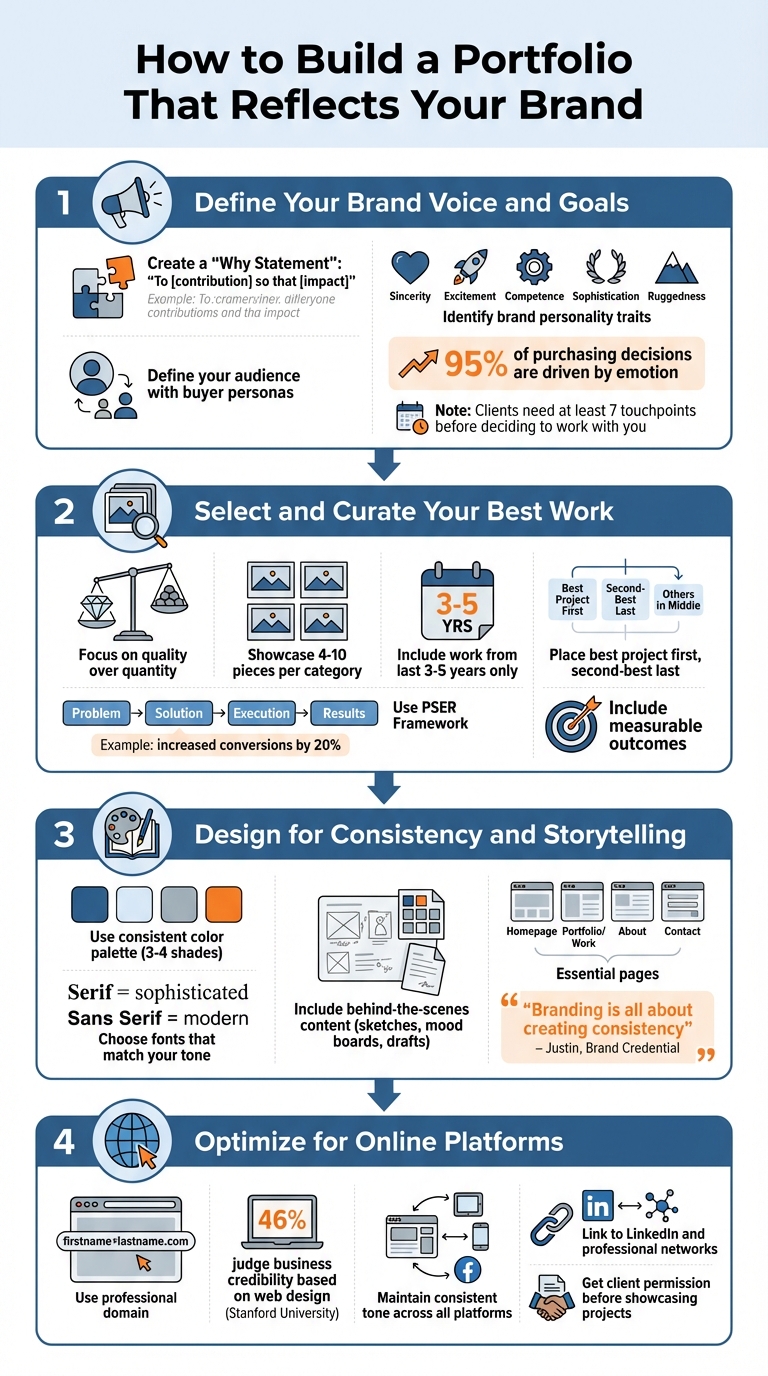
4-Step Guide to Building a Portfolio That Strengthens Your Personal Brand
A strong portfolio starts with a clear sense of purpose. Before showcasing your work, take the time to define why you do what you do. As Simon Sinek puts it: "Very few people or companies can clearly articulate WHY they do WHAT they do. People don't buy WHAT you do, they buy WHY you do it". This idea resonates because nearly 95% of purchasing decisions are driven by emotion rather than logic. Your purpose will guide every decision, from selecting projects to refining design details.
Define Your Brand Voice and Goals
Start by crafting a "Why Statement" using this template: "To [contribution] so that [impact]." This simple sentence should reflect the positive change you aim to create. For instance, instead of saying, "I design websites", you could say, "To create intuitive digital experiences so that small businesses can connect with their customers effortlessly."
Next, identify your brand personality by gathering feedback from peers. Ask them to describe you using a few adjectives. Your brand voice might align with traits like sincerity, excitement, competence, sophistication, or ruggedness. Decide whether your tone should be conversational or more formal, depending on your target audience. Consistency is key - make sure your tone carries across your portfolio's "About" section, social media, and project descriptions.
It’s also important to define your audience. Research their demographics, behaviors, motivations, and challenges to create "buyer personas." Keep in mind that a potential client may need several interactions with your brand before deciding to work with you - research suggests at least seven touchpoints.
Once your brand voice is clear, you can move on to selecting work that aligns with your message.
Select and Curate Your Best Work
Your portfolio should highlight quality over quantity. Avoid including weaker projects that could distract from your strongest pieces. Stick to work completed in the last three to five years to ensure your skills appear current. For design portfolios, aim to showcase 4 to 10 pieces per category, as advertising and marketing professionals often prefer concise collections.
Focus on projects that resonate with your target clients. For example, if you're aiming for a career in fashion, prioritize fashion-related work over unrelated projects. As the Format Team explains:
By showing your preference or skill towards a particular type of work, you'll attract the right clients to further your career in the right direction.
Each project should demonstrate how you solve practical business problems, not just your technical expertise. Use the PSER Framework - Problem, Solution, Execution, Results - to structure your case studies. Be sure to include the project's objective, your role, the tools you used, and measurable outcomes. Data like percentage increases in traffic or sales figures can make a strong impression.
Place your best project first to grab attention and your second-best last to leave a lasting impression. If you have more than 10 top-tier projects, feature the best on your main page and archive the rest.
Design for Consistency and Storytelling
Your portfolio's design should reflect your brand identity at every turn. Stick to a consistent color palette of three or four shades, and choose fonts that match your tone. For instance, Serif fonts like Times New Roman suggest sophistication, while Sans Serif fonts like Helvetica feel modern and straightforward.
As Justin from Brand Credential points out:
Branding is all about creating consistency and making your various marketing assets and channels immediately recognizable as your own.
Give potential clients a glimpse into your creative process by including behind-the-scenes content like sketches, mood boards, or early drafts. Present each project as a concise case study, and consider sharing personal values or hobbies to make your brand more relatable.
A well-rounded portfolio typically includes a Homepage, a Portfolio/Work page, an About page, and a Contact page.
Optimize for Online Platforms
Once your portfolio is cohesive, focus on how it performs online. A seamless digital presentation is crucial. For personal branding, domain names like "firstname+lastname.com" or "firstname.com" are ideal for maintaining professionalism. According to a Stanford University study, nearly half of respondents (46%) judge a business's credibility based on web design.
Ensure your portfolio's tone and design remain consistent across all online platforms. Link it to your LinkedIn profile and other professional networks to create multiple touchpoints for potential clients.
For job seekers, tools like Acedit (https://acedit.ai) can help maintain consistency by integrating LinkedIn profiles and generating content that aligns with your brand voice. Always get permission from past clients or employers before showcasing their projects publicly. For technical roles, ensure any featured code is functional and demonstrates a variety of tools.
sbb-itb-20a3bee
Connecting Your Portfolio with Your Online Presence
Linking your portfolio to professional platforms like LinkedIn can open multiple doors to potential clients and employers. With 78% of recruiters researching candidates online, your portfolio serves as a crucial digital gateway. A consistent online brand can boost candidate recall by 2.5 times. Let’s explore how to integrate LinkedIn and AI tools to ensure your brand message stays consistent and impactful.
Linking Your Portfolio to LinkedIn and Social Media
LinkedIn provides several key opportunities to showcase your portfolio effectively. Start by adding your portfolio link to your headline, which appears in search results and immediately directs viewers to your work. Use the "Featured" section to highlight your best projects - this is prime real estate for grabbing attention. Nearly half of hiring managers say portfolios help streamline the shortlisting process.
In the "About" section, write in a conversational, first-person tone, ending with a call-to-action like: "Explore my portfolio for detailed case studies: [URL]". Under the "Experience" section, include project-specific links for each relevant role. For example, you could add: "View full project details at [Specific Project URL]". This method ensures your LinkedIn profile acts as a clear guide leading directly to the evidence of your expertise.
To maintain a seamless brand image, use the same headshot, consistent job titles, and relevant keywords across all platforms. For example, Sarah, a UI/UX designer, saw her response rate jump from 3% to 10% after creating a Behance portfolio with a custom URL (sarah.design/portfolio) and integrating it into her LinkedIn headline and "Featured" section. Within two weeks, she received three interview invitations and landed a contract with a startup. Keep in mind, 71% of hiring managers flag mismatched information across profiles as a "red flag".
For even greater consistency, consider using AI tools designed to streamline your professional narrative.
Using AI Tools Like Acedit for Brand Consistency
To enhance your polished online presence, AI tools like Acedit can help ensure your messaging stays aligned across platforms. Acedit’s LinkedIn integration (https://acedit.ai) syncs your professional narrative, saving you time while maintaining consistency. This is critical, as hiring managers typically spend only six seconds scanning a candidate’s online profile.
These tools can create custom headlines and "About" sections tailored to each platform while reflecting your portfolio's key themes. By using identical job titles and keywords across profiles, you reinforce your professional image. Including your portfolio link in a well-optimized profile can increase interview invitations by up to 30%. Regularly audit your portfolio - every quarter is a good rule of thumb - to ensure links and achievements stay up to date.
Tracking and Improving Your Portfolio's Impact
A portfolio isn't just a static collection of your work - it’s a dynamic tool that can shape your personal brand and professional opportunities. To maximize its potential, it’s essential to measure its performance and refine it over time. By tracking key metrics and incorporating feedback, you can ensure your portfolio remains impactful and relevant.
Monitoring Engagement Metrics
To gauge how well your portfolio performs, connect it to tools like Google Analytics and Google Search Console. These platforms help you monitor metrics such as conversion goals, unique visitor counts, and returning visitor rates. For example, metrics like "Time on Site" and "Pages per Visit" can reveal whether your content holds attention. If visitors spend less than 30 seconds on a featured project, it could mean the content is too dense or unclear.
Track conversion signals like contact form submissions, direct email inquiries, and newsletter sign-ups to measure the professional opportunities your portfolio generates. Additionally, analyze referral traffic from platforms such as LinkedIn or Instagram to see which channels drive the most engagement. Setting specific goals, like increasing organic traffic by 20% over six months, can turn abstract objectives into actionable targets.
"Understanding which KPIs are most important for your website can help track the progress and ensure that a portfolio website is on track to meet your goals." - Pixpa Editorial Team
Remember, SEO improvements often take four to six months to show results. If a project page has a high bounce rate, consider revising its design or content to better engage your audience. Pair these quantitative insights with qualitative feedback for a more complete understanding of your portfolio's impact.
Gathering Feedback and Making Changes
While metrics offer a numerical view of your portfolio's performance, qualitative feedback provides deeper insights. Avoid asking vague questions like "What do you think?" Instead, ask targeted ones such as, "Does this portfolio clearly showcase my expertise?" Seek input from hiring managers, recruiters, peers, or others in your industry. Use methods like user observation, remote screen recordings, or targeted surveys to gather meaningful feedback.
A great example comes from Senior UX Designer Fangru Wu, who in June 2020 used Reddit feedback and Google Analytics to identify weaknesses in her portfolio. She learned that her "Identity" case study wasn’t retaining visitor attention - 70% of users returned to the homepage after viewing just one project. Based on this, she reorganized her case studies to highlight shippable experiences, used concise text for better readability, and added descriptive thumbnails to improve navigation.
"Before you ask for feedback about your UX portfolio you need to have a clear objective - and it cannot be 'see what people think of my portfolio.'" - Sarah Doody, Founder, Career Strategy Lab
To assess how memorable your portfolio is, ask reviewers what they recall after viewing a project for 30–60 seconds. Share drafts early in the process to avoid over-investing in designs that might not work. Combining analytics with feedback ensures your portfolio evolves effectively.
Adapting to Career Growth and Market Trends
Regular updates are key to keeping your portfolio relevant. Aim to review it monthly, replacing older projects with fresh, high-quality work. A curated selection of seven to 10 samples, ideally no more than five years old, keeps your portfolio sharp and focused.
Take advantage of client offboarding moments to enhance your portfolio. Capture screenshots, record walkthroughs, and request testimonials while the project is still fresh. Use this baseline data to measure the impact of portfolio updates. Including permission for case studies in client contracts can also simplify showcasing your work.
Looking ahead, showcasing "AI-readiness" is becoming increasingly important, and there are many ways to use AI in your job search. For example, you might include a note like, "Used AI to generate 30 headline options and refined two for A/B testing".
"A portfolio is an ongoing project that's never really finished." - Webflow
Highlighting results with clear, quantified data - such as "increased organic traffic by 60%" or "achieved four featured snippets" - can significantly boost your professional credibility.
"SEO wins take time. Be patient and persistent in your efforts, and you'll see gradual improvements in your portfolio website's visibility and performance." - Henry Purchase, SEO Expert, Squarespace
Conclusion
Your portfolio is the cornerstone of your personal brand. It builds trust by providing tangible proof of your skills, communicates your professional identity, and acts as a networking tool that's available anytime. Whether you're a freelancer, entrepreneur, or job seeker, a well-designed portfolio turns vague resume claims into solid evidence of your abilities.
"Psychologically, portfolios create trust through transparency. When someone can see examples of your work, they experience reduced uncertainty about your capabilities." - Wix Blog
Take action today: select 3–10 standout projects that showcase measurable results, craft a concise two-sentence brand statement highlighting who you are and the problems you solve, and align your online profiles to present a cohesive message. Research shows that candidates with consistent branding are 2.5× more likely to leave a lasting impression after interviews. This approach transforms general claims into clear, measurable achievements.
To strengthen your brand message, consider using AI tools for interview preparation like Acedit. These tools can help align your story across resumes, cover letters, and LinkedIn profiles, avoiding inconsistencies that 71% of hiring managers notice. Features like AI-driven Q&A and LinkedIn integration ensure your personal brand is consistently reinforced across all platforms.
"Your digital portfolio is not a static resume - it's your evolving brand in motion." - Upulakshie Kodithuwakku, Senior SEO Specialist
Make it a habit to update your portfolio quarterly with new projects, results, and testimonials. By documenting your work as it happens, your portfolio will grow alongside your career. Start building or refining yours today - your next opportunity is out there, waiting to find you.
FAQs
How can I create a portfolio that highlights my unique skills and personal brand?
To build a portfolio that genuinely highlights your skills and personal brand, focus on emphasizing what makes you stand out. Start with a strong brand statement that clearly communicates your unique qualities - whether that's your specialized expertise, creative approach, or problem-solving abilities.
Weave in elements of your personal story, values, and the unique perspective you bring to your work. Include projects that not only showcase your skills but also align with your professional goals and reflect your personality. A polished, cohesive design and a well-thought-out presentation will help your portfolio leave a lasting impression while staying true to who you are.
How can I effectively showcase my portfolio on LinkedIn and other platforms?
To make your portfolio stand out on LinkedIn and other platforms, start by adding it to the Featured section on LinkedIn. This is a great spot to showcase standout projects, media, or links that highlight your skills and accomplishments. You can also weave portfolio examples into your Experience and About sections to give more depth and context to your expertise.
Don’t forget to include direct links to your portfolio within your profile’s contact info or in posts to make it easily accessible. Keep your portfolio fresh by regularly updating it to reflect your personal brand and career goals. These steps work together to build a cohesive online presence that grabs the attention of potential clients or employers.
How often should I refresh my portfolio to keep it relevant and effective?
To keep your portfolio fresh and effective, make it a habit to update it regularly. A solid approach is to review it at least once a year or whenever you wrap up a major project. This way, your portfolio highlights your latest skills, accomplishments, and professional development.
Consistent updates not only ensure you're ready for new opportunities but also demonstrate your dedication to maintaining a polished personal brand. A current portfolio makes it simple for potential clients or employers to understand the value you offer.