
When applying for jobs online, your resume often goes through an AI-powered Applicant Tracking System (ATS) before reaching a recruiter. These systems evaluate resumes based on skills alignment, experience relevance, and keyword usage. To succeed, you need to:
- Match keywords: Use exact terms from the job description (e.g., "Python", "P&L management").
- Embed skills strategically: Include key skills in your title, summary, and work experience sections.
- Quantify achievements: Use numbers to highlight results (e.g., "Increased sales by 25%").
- Keep formatting simple: Avoid tables or graphics that can confuse the system.
Modern ATS tools also use semantic analysis to infer skills from context, so focus on clear, action-oriented language. By aligning your resume with ATS criteria, you can boost your chances of landing an interview by up to 40%.
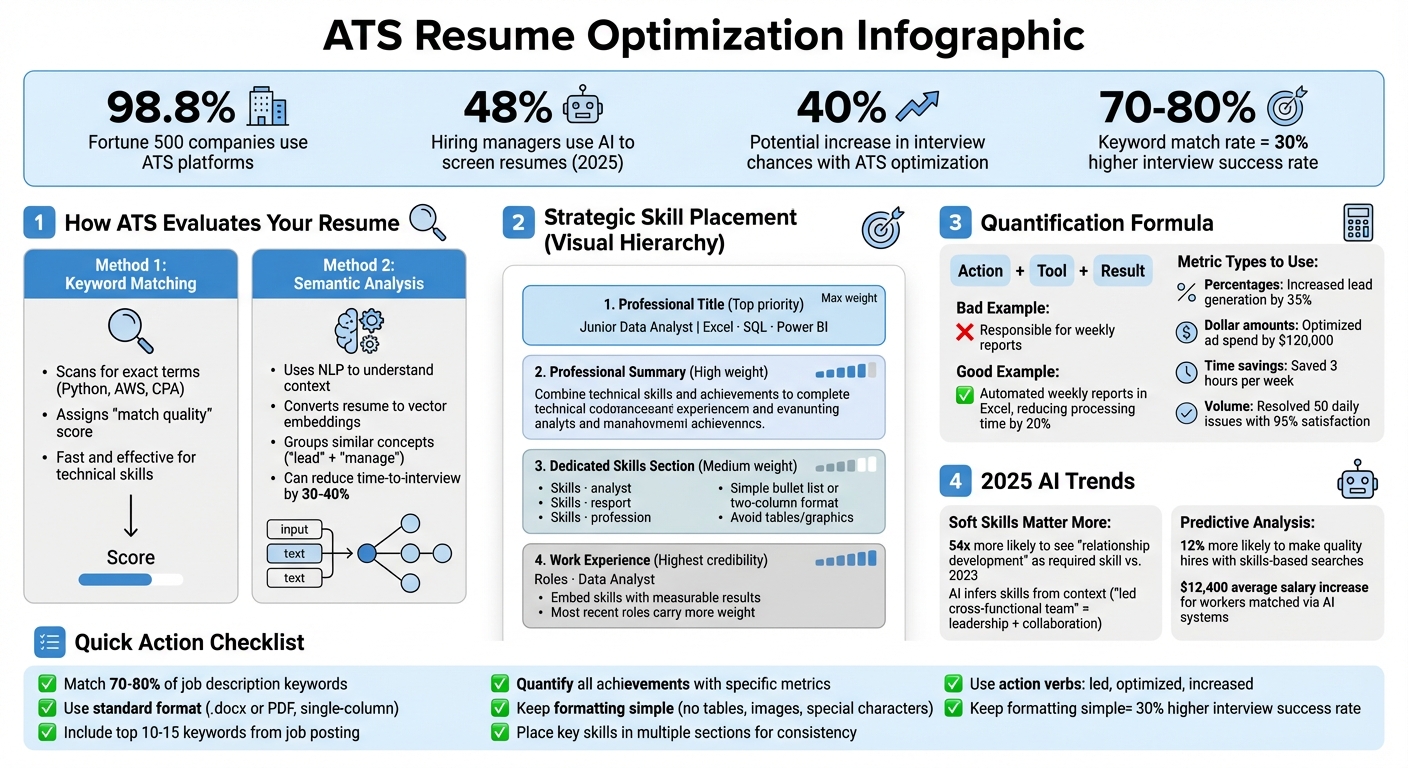
ATS Resume Optimization: Key Strategies to Pass AI Screening
How to Optimize your Resume for Applicant Tracking Systems (2024)
How AI Evaluates Skills in ATS Systems
AI doesn’t just skim your resume for individual words - it uses two key methods to determine if your skills align with what employers need. The first is straightforward keyword matching, and the second leverages advanced natural language processing (NLP) to grasp the context and meaning behind your experience. Let’s break down how these approaches work together to assess your qualifications.
Keyword Matching and Exact Skill Identification
Applicant Tracking Systems (ATS) often rely on exact matches for tools, certifications, and technologies mentioned in job postings. For example, if a job lists "Python", "AWS", or "CPA", the system scans your resume for those exact terms. This method remains a go-to for many companies because it’s fast and effective - 98.8% of Fortune 500 companies incorporate ATS platforms with this functionality.
These systems assign a "match quality" score, a numeric value based on how many required terms appear in your resume. In competitive job markets, boosting this score is crucial. To improve your match rate, use the exact language from the job description. For instance, if the job lists "P&L management", avoid rephrasing it as "budget oversight." Include both abbreviations and full terms, such as "Certified Public Accountant (CPA)", to ensure nothing is overlooked. Additionally, steer clear of complex formatting like tables or text boxes, as these can confuse the ATS and cause it to miss important details.
While keyword matching is effective, modern systems also analyze the context of your skills through semantic analysis.
Semantic Analysis for Contextual Understanding
Advanced ATS systems take things a step further by using semantic analysis powered by NLP. This approach allows the system to interpret the meaning behind your experience rather than just scanning for exact terms. For example, even if you don’t explicitly list "Python", the system might infer your proficiency based on broader terms like "Data Science" or related technical skills.
Here’s how it works: the system converts your resume into vector embeddings, grouping similar concepts together. Words like "lead" and "manage" are placed near each other in this virtual space, enabling the AI to recognize your qualifications even if you use slightly different terminology than what’s in the job posting.
Semantic analysis also evaluates the relevance of your skills. Generic terms like "team player" carry little weight unless paired with concrete achievements, such as "led a 5-person team to deliver a $2M project". Using attention mechanisms, the AI prioritizes impactful words and phrases, rewarding resumes that feature strong action verbs and measurable results. By aligning your resume with how these systems interpret content, you could reduce your time-to-interview by as much as 30–40%.
Optimizing Skill Placement for ATS
Where you position your skills on a resume can be just as important as the skills themselves. ATS (Applicant Tracking Systems) scan the entire document, not just the designated skills section, and assign varying levels of importance to different areas. Knowing how this hierarchy works can significantly boost your chances of ranking higher.
Where to Place Skills in Your Resume
Start with your professional title. Including 3–5 key technical skills directly beneath your name (e.g., "Junior Data Analyst | Excel · SQL · Power BI") signals to the ATS that these are your core strengths. This section is one of the first areas scanned by both algorithms and recruiters.
Next, integrate your skills into your professional summary. Use this space to craft a concise narrative that combines your technical expertise with measurable achievements. This section carries considerable weight because it establishes the context for the rest of your resume. After that, include a dedicated skills section - use a simple bullet list or a two-column format, steering clear of tables or graphics. Stick with standard headings like "Skills", "Work Experience", and "Education" to ensure the ATS parses your content correctly.
The final and most crucial step is embedding your key skills within your work experience. As Alba Hornero, Co-founder of CandyCV, puts it:
"If a skill never appears in a task or achievement, it feels inflated or made up".
For example, instead of merely listing "Google Analytics", write something like, "Optimized ad spend by $120,000 using Google Analytics." This approach not only improves keyword recognition but also demonstrates how and when you applied those skills, making them more credible.
How ATS Weighs Skills by Relevance and Recency
In addition to placement, ATS systems prioritize skills based on how recently they were used. Skills highlighted in your most recent roles carry more weight than those mentioned in older positions. For instance, if you used Python extensively three years ago but don’t reference it in your current role, the system may consider it less relevant. To avoid this, emphasize key skills in your latest roles, even if they’ve been mentioned earlier.
Consistency is key. If a skill isn’t backed up by examples in your work experience, it could hurt your ranking. Resumes with a 70–80% keyword match to the job description are 30% more likely to lead to interviews. To maximize your score, make sure your skills are reinforced across multiple sections and supported by tangible evidence.
sbb-itb-20a3bee
Measurable Skills and Quantified Achievements
Numbers transform vague responsibilities into clear, impactful results. Modern ATS systems don't just look for keywords - they analyze action verbs like led, designed, or optimized to assess your contributions. When these verbs are paired with specific metrics, your application scores higher. It’s no longer about simply listing duties; it’s about proving your performance with concrete evidence.
Here’s the difference: writing “Responsible for weekly reports” doesn’t tell the system - or a recruiter - much about your abilities. On the other hand, saying “Automated weekly reports in Excel, reducing processing time by 20%” tells a complete story. It highlights the tool you used (Excel), the task you completed (automation), and the measurable outcome (20% time savings). This approach strengthens what recruiters call the "Credibility Ratio", turning generic statements into actionable achievements that showcase your potential to deliver results.
Using Numbers to Prove Your Skills
Quantifying your achievements is powerful, but the type of metric you use matters. Different metrics highlight different strengths:
- Percentages: Showcase growth or improvement, like “Increased lead generation by 35% year-over-year.”
- Dollar amounts: Highlight financial impact, such as “Optimized ad spend by $120,000, achieving a 22% reduction in cost-per-acquisition.”
- Time savings: Demonstrate efficiency, e.g., “Saved 3 hours of manual work per week.”
- Volume metrics: Illustrate scale, like “Resolved an average of 50 daily billing issues with a 95% satisfaction rate” [1, 19].
To structure your achievements effectively, use the Action + Tool + Result formula. Start with a strong action verb, specify the tool or skill you used, and end with a measurable outcome. This format not only improves keyword recognition but also provides clear evidence of how you’ve applied your skills in practical situations.
Matching Your Metrics to Job Requirements
To maximize impact, align your quantified achievements with the job description. If the posting emphasizes goals like “reducing churn” or “increasing lead generation,” use those exact phrases in your resume, backed by numbers. Pull key terms directly from the listing and integrate them into your bullet points. This tailored approach increases keyword matches and boosts your chances of landing an interview.
When direct metrics are harder to identify, quantify the scale of your work instead. For example, say “Managed SQL databases with 500,000+ entries” or “Oversaw a portfolio of 50+ clients” [26, 27]. You can also estimate broader impact: calculate time saved per meeting, multiply it by the number of attendees and weeks in a year, and present the total organizational savings. Even in roles where traditional metrics are less obvious, this method provides tangible evidence of your contributions.
New AI Trends in ATS Skill Ranking for 2025
The hiring process is undergoing a major transformation. Building on tools like keyword matching and semantic analysis, AI is changing how resumes are evaluated. As of 2025, 48% of hiring managers use AI to screen resumes, and 73% of talent acquisition professionals believe AI will fundamentally reshape hiring practices. The biggest shift? Moving beyond simple keyword searches to a more comprehensive evaluation of resumes. Madeline Laurano, Chief Analyst at Aptitude Research, sums it up well:
"The AI providers take a skills-based approach... We're not using keywords on a resume. We want to be able to create more of a holistic picture and a full view of the individual, so we're inferring skills."
This shift means your resume needs to tell a cohesive story. For instance, describing how you "led a cross-functional team to deliver a product launch" allows AI to infer skills like leadership, collaboration, and project management. This approach doesn't just focus on technical expertise - it also highlights the growing importance of soft skills in the hiring process.
How AI Evaluates Soft Skills
In 2025, soft skills are a key factor in hiring decisions. While AI efficiently handles technical skill screening, recruiters are placing more emphasis on human-focused abilities. Compared to 2023, employers are now 54 times more likely to list "relationship development" as a required skill. Modern ATS systems analyze descriptive phrases to identify communication and interpersonal strengths. For example, statements like "facilitated stakeholder alignment across five departments" or "mentored junior team members through complex technical challenges" provide the context AI needs to assess your soft skills.
Predictive Analysis for Job Fit
AI isn't just identifying skills anymore - it’s predicting how well you’ll fit into a role. Machine learning models now analyze inferred competencies to forecast your success before you even step into an interview. Tools like LinkedIn’s Hiring Assistant can even compare candidates to top-performing employees. As Hari Srinivasan, Vice President of Product at LinkedIn, explains:
"A recruiter can even point the assistant to a current employee and ask it to find similar candidates."
This process, known as lookalike modeling, identifies skill overlaps and connections. For instance, having project management experience might suggest familiarity with Agile methods or resource planning. By combining measurable achievements with inferred abilities, these AI systems evaluate your potential just as effectively as they assess traditional keywords.
The impact is clear: companies using skills-based searches are 12% more likely to make quality hires, and workers without bachelor’s degrees who are matched through these AI systems see an average salary increase of 25% - around $12,400 annually. Many platforms now include "Job Match" tools, offering instant feedback on how well your qualifications align with a role before you even apply.
Conclusion: Main Points for ATS Skill Optimization
Getting through AI screening systems boils down to a few essential strategies. For starters, aim for a 70–80% keyword match to increase your chances of landing an interview - resumes in this range enjoy a 30% higher success rate. Identify the top 10–15 keywords from the job posting and incorporate them naturally into your bullet points.
Your resume's structure is just as critical as its content. Place your Professional Summary and Core Skills at the top, as these sections carry the most weight in AI evaluations. Stick to standard formats like .docx or PDF with single-column layouts, and steer clear of tables, images, or special characters that could confuse the system. As Nathan Soto from Resume Genius explains:
"Unfortunately, the more boring it looks to the human eye, that's what the ATS craves".
Quantifiable achievements are another key element. AI systems prioritize resumes that back up skills with measurable results. Use specific metrics, such as percentage increases or dollar amounts, to make your accomplishments stand out. Action verbs like "led", "optimized," and "increased" also carry significant weight. If your previous job title is unconventional, consider adding a standard industry title in parentheses to help the AI map your experience effectively.
Additionally, modern AI tools analyze context, so make sure your resume tells a cohesive story. Leveraging AI-driven optimization tools can improve your ranking score by up to 40%, giving you a notable advantage in competitive job markets. Remember, your resume should strike a balance - it needs to perform well with both AI systems and human reviewers.
For real-time, AI-powered insights that can refine your resume and showcase your skills effectively, consider tools like Acedit (https://acedit.ai). They can help you implement these strategies and stand out in the hiring process.
FAQs
How can I optimize my resume to meet ATS keyword requirements?
To make sure your resume works well with ATS (Applicant Tracking System) keyword requirements, start by pulling key terms directly from the job description. Look for specific skills, tools, or certifications mentioned in the listing. Then, weave these keywords naturally into your resume, focusing on high-visibility areas like your summary, job titles, and bullet-point achievements. Using the exact wording from the job posting can boost your resume's relevance.
Keep your resume's format simple to ensure it passes through ATS without issues. Avoid using graphics, tables, or text boxes, and stick to standard fonts like Arial or Times New Roman. Save the file as a .docx or PDF for compatibility. Where possible, quantify your achievements with measurable results (e.g., "Boosted sales by 20%") to make your resume both keyword-rich and easy to read. Double-check for typos and avoid overloading your resume with keywords, as that can hurt your chances.
If you want extra help, tools like Acedit can pull keywords from job descriptions and guide you on where to place them, streamlining the process and saving time.
How does AI evaluate and rank skills in ATS systems?
Modern applicant tracking systems (ATS) rely on AI to evaluate résumés by pinpointing keywords and skills that align with the job description. These systems then rank candidates based on how closely their qualifications match the role’s needs. This AI-driven method prioritizes relevance, helping employers quickly identify the most suitable applicants.
Although semantic analysis - which involves interpreting the meaning and context of words - likely contributes to recognizing skills and their connections, its specific role in ATS evaluations isn’t widely documented. That said, the growing emphasis on skill-based hiring showcases how AI continues to evolve in assessing candidates' qualifications.
How do I use numbers to highlight achievements on my resume for better ATS results?
To ensure your resume grabs attention and works seamlessly with ATS systems, focus on highlighting your achievements with measurable data. Start by outlining your main responsibilities and pinpointing metrics that reflect your contributions - like increases in revenue, cost reductions, or time saved. Use U.S.-specific formats such as dollars ($), percentages (%), or hours to make your results crystal clear.
When crafting bullet points, combine strong action verbs like "Increased", "Reduced," or "Generated" with specific numbers right at the start of the sentence. For instance: "Increased monthly sales by $50,000 (10%) through targeted outreach efforts." Adding context can make your impact even more evident. For example: "Reduced ticket resolution time from 48 hours to 32 hours, achieving a 33% improvement."
If you need extra guidance, tools like Acedit can help refine your phrasing, match metrics to ATS-friendly keywords, and ensure consistency throughout your resume. By emphasizing concrete results and keeping a polished tone, you'll create a resume that resonates with both recruiters and AI systems.