
Your personal brand is more than just an online profile - it's your professional identity and how you’re perceived in your industry. Aligning it with your career goals isn’t optional anymore, especially when 85% of recruiters check online profiles and 95% rely on LinkedIn during hiring. Here’s a quick breakdown of the five steps to shape your brand for success:
- Define Career Goals: Be clear about your target role and industry. Narrow your focus and create a concise career positioning statement.
- Craft Your Brand Story: Highlight your skills, values, and achievements. Use specific examples and tailor your story for different platforms.
- Audit Your Digital Presence: Search your name online, update your profiles, and remove outdated or irrelevant content.
- Showcase Expertise: Share content, post insights, and engage with industry professionals to establish credibility.
- Track and Adjust: Regularly review your online presence, monitor metrics like profile views, and refine your brand to stay aligned with your goals.
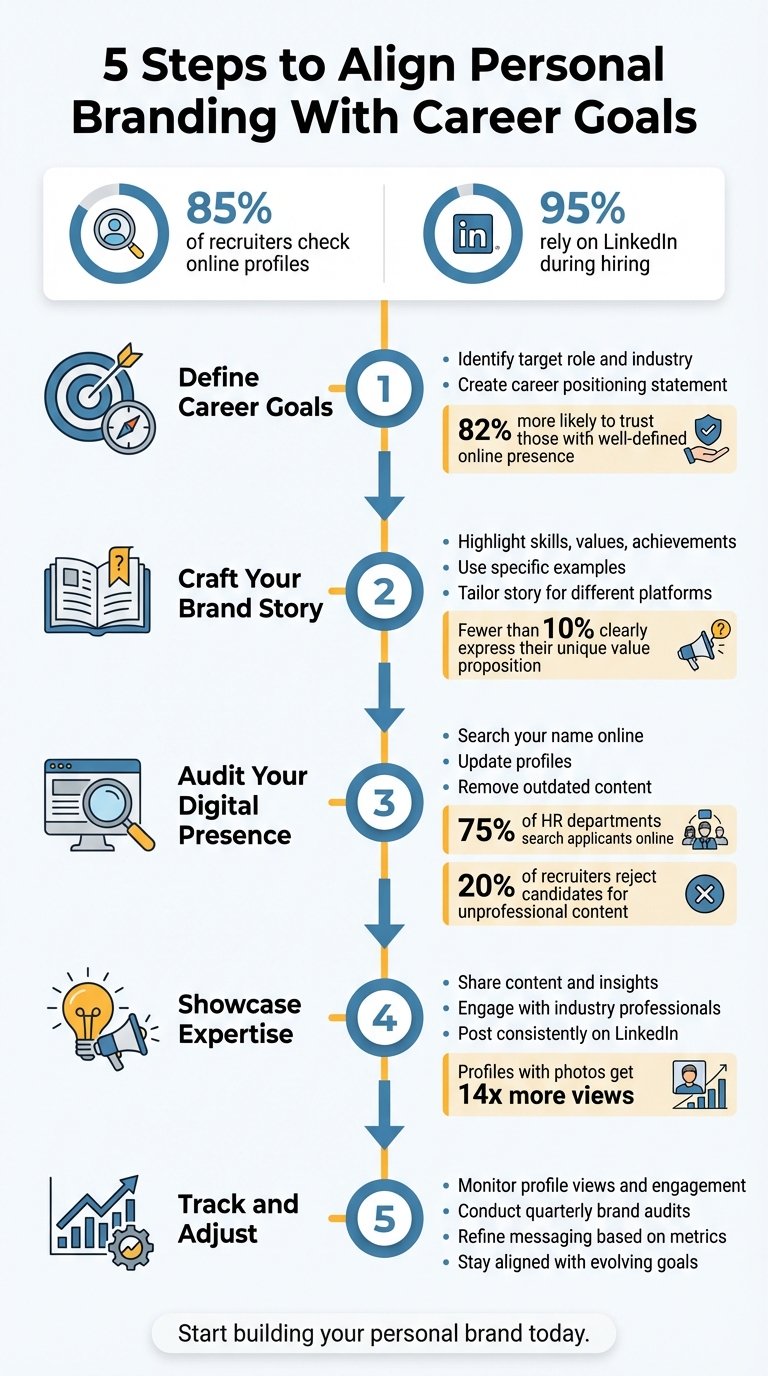
5 Steps to Align Personal Branding With Career Goals
Optimize Your Personal Brand and LinkedIn for Career Growth
Step 1: Define Your Career Direction and Goals
Start by setting clear career goals to solidify your personal brand. Without a specific target, your brand risks becoming a scattered mix of skills and experiences that fail to connect with your audience. As Bill Gates famously said, "My success, part of it certainly, is that I have focused in on a few things". The same principle applies to shaping your career path.
Identify Your Target Role and Industry
Begin with a focused skills assessment - highlight your core technical abilities and natural strengths. Then, think about the types of projects that genuinely excite you and align with market demands. The sweet spot lies where your skills meet the needs of potential employers.
Zero in on a specific niche rather than trying to appeal to everyone. Susan Chritton, a personal branding expert and author, explains it perfectly:
One of the biggest mistakes personal branders make is trying to appeal to everyone. Think about the game of darts: you have to aim in order to hit the board.
For instance, instead of positioning yourself as a broad "marketing professional", narrow it down to something like "B2B SaaS growth marketer." Research backs this up - 82% of people are more likely to trust individuals with a well-defined online presence than those without.
To refine your focus, outline the characteristics of your ideal employer: company size, primary challenges, and the role level you’re aiming for. Ask yourself energizing questions, like: "What challenges excite me the most?" or "Which tasks energize me versus drain me?". These insights will help you pinpoint your ideal role with clarity.
Once you’ve identified your niche, the next step is crafting a career positioning statement to guide your branding efforts.
Write a Career Positioning Statement
After narrowing your focus, create a one-to-three-sentence career positioning statement that serves as your professional compass. Tyler Norman, Sr. Program Manager at Scholastic Inc., emphasizes:
Branding is an intentional effort to convey information about yourself, including your skills and unique value proposition.
Your statement should include three key elements: what you do, who you serve, and what makes you stand out.
Here’s a simple template to get started: "I am a [Role/Expertise] who wants to [Goal/Value Delivery] at [Target Organization Type]". For example: "I am a data analyst specializing in healthcare analytics who wants to help hospital systems reduce operational costs through predictive modeling." Keep it short, focused, and infused with a touch of personality to make it memorable. This statement will become the foundation for your personal brand, shaping everything from your LinkedIn headline to your interview responses.
Step 2: Build Your Personal Brand Story and Value Proposition
Once you've clarified your career goals, it's time to create a brand story that highlights what makes you stand out. Surprisingly, fewer than 10% of professionals clearly express their unique value proposition. A compelling brand story can help you rise above the competition in today’s crowded job market.
Identify Your Brand Themes and Back Them Up
Start by breaking your personal brand into four key categories: Competence (your technical skills and experience), Values (the principles that guide your work), Goals (your future aspirations), and Identity (the traits that make you stand out). This structure helps you move beyond generic labels like "dedicated professional" and instead focus on specific, memorable themes, such as "a data-driven strategist committed to optimizing efficiency."
To pinpoint your strongest themes, ask trusted colleagues or mentors: "What three or four adjectives best describe my value?". Their feedback might reveal strengths you hadn’t considered. Personal branding expert Meg Guiseppi explains it best:
"Your personal brand is your reputation - the perception of you held by the external world".
Once you’ve identified your themes, back them up with tangible examples. For instance, if you claim leadership skills, include quantifiable achievements to prove it.
Next, conduct a SWOT analysis - assessing your Strengths, Weaknesses, Opportunities, and Threats - to see how your personal brand stacks up against others in your target industry. Keep in mind that 85% of recruiters are influenced by a candidate’s online reputation when making hiring decisions. This underscores the importance of pairing your themes with measurable results.
With your key themes and evidence in place, you’re ready to adapt your story for different platforms.
Tailor Your Story to Each Platform
While your core value proposition remains the same, how you present it should vary depending on the platform. For LinkedIn, craft a headline that goes beyond your job title and incorporates relevant keywords. A good formula is: "[Job Title] helping [Target Audience] achieve [Specific Result]." For example, "SEO Specialist Helping E-commerce Brands Reach 5-Digit Traffic Numbers". Use the "About" section to share a narrative that highlights challenges you’ve overcome and what drives you, rather than just listing job duties.
On resumes and job applications, shift the focus from responsibilities to achievements. Use numbers to quantify your impact, like "streamlined processes to reduce project timelines by 30%". During interviews, share the reasoning behind your career decisions to leave a lasting impression.
Consistency is key. Maintain a uniform tone, language, and visual style across all touchpoints - from your email signature to your personal website. A professional headshot on LinkedIn can increase profile views by 14 times, and completing your headline and current position can increase connection requests five-fold. Regularly audit your online presence by searching your name in private browsing mode to see what recruiters see. Adjust privacy settings on personal social media accounts to ensure a polished, professional image.
Step 3: Review and Update Your Digital Presence
Now that your brand story is clearly defined, it’s time to take a closer look at your online profiles. This step is all about auditing your digital footprint and updating it to align with your career goals.
Review Your Digital Presence
Start by searching your name in incognito mode to see how your digital presence appears to others. If your name is common, include qualifiers like your job title to narrow the results.
Jill Avery, a Professor at Harvard Business School, emphasizes the importance of this step:
"This is a systematic assessment of your brand as it exists now, to determine how well or poorly your current brand supports your vision and sense of self."
Evaluate your “brand equity” by looking at three key areas: credentials (education and certifications), network (testimonials and endorsements), and visual identity (your professional style) . Then, sort your findings into two categories: positive brand signals that highlight your value and negative brand signals that may undermine the career image you’re aiming for.
Why does this matter? Because the stakes are high. Research shows that 75% of HR departments are required to search job applicants online, and 20% of recruiters have rejected candidates after discovering unprofessional content on social media . To safeguard your professional image, deactivate outdated accounts (like Myspace) and set personal profiles to private. This ensures that only professional and relevant content is visible .
Once you’ve completed this audit, you’ll be in a strong position to refine your profiles to reflect your career aspirations.
Update Profiles to Match Career Goals
Using the insights from your audit, update your profiles to clearly communicate your career focus. On LinkedIn - where 95% of recruiters search for candidates - your headline should highlight the role you’re targeting, not just your current job. For instance, instead of "Graphic Designer", try something like "Data-Informed Graphic Designer" to signal your career direction. Career Coach Karen Arrington advises:
"The goal is to grab the attention of hiring managers. What is it that you want them to know? What is your value-add? What can you offer?"
Incorporate keywords related to your target role into your summary, headline, and experience sections . Use the "About" section to craft a compelling narrative that showcases your achievements, core skills, and future goals, rather than simply listing job duties. A professional photo is also key - profiles with one are 14 times more likely to get views . Keep in mind that recruiters often spend less than 10 seconds deciding if a profile is worth exploring further.
Activate the "Open to Work" feature to signal your job availability , and request recommendations from former colleagues or managers to highlight your leadership skills and work ethic. Finally, make sure your contact details - including your voicemail greeting - reflect the polished, professional image you’re projecting online.
If you’re looking for additional tools to streamline this process, consider Acedit (https://acedit.ai). This AI-powered Chrome extension integrates with LinkedIn and provides real-time insights to help you align your digital presence with your career objectives.
sbb-itb-20a3bee
Step 4: Demonstrate Expertise Through Content and Engagement
With your profiles polished and aligned to your career goals, it’s time to show what you bring to the table. This step shifts your personal brand from a static resume to a living, breathing story. By combining thoughtful content creation with meaningful engagement, you can position yourself as a go-to expert in your field.
Share Content That Aligns With Your Target Role
One of the most effective ways to establish your expertise is by sharing your knowledge. Research highlights that the content you put out online plays a huge role in shaping how others perceive you professionally. Instead of just listing your qualifications, actively showcase your insights and experiences.
"The best way to establish yourself as an expert is to share your knowledge." - Hiration
Start by creating posts that dig into specific professional challenges you’ve tackled or new skills you’ve recently picked up. These stories don’t just highlight your abilities - they show your growth and problem-solving mindset. When you share articles or insights, add your personal take to show your unique perspective.
Focus your efforts on LinkedIn. Your posts don’t need to be long or overly polished. What matters most is that they’re consistent and relevant to the role you’re targeting. For example, a quick post about a lesson you learned during a project or your thoughts on a new trend can go a long way in building your credibility and expanding your reach.
Once you’ve crafted compelling content, take it a step further by actively engaging with others in your industry.
Build Connections With Industry Professionals
Your content can open doors to meaningful conversations and connections. Don’t just stop at creating posts - use them as a way to interact with your professional network. Commenting on industry posts is far more impactful than simply hitting the "like" button. When you comment, aim to contribute something valuable, like a fresh perspective, a thoughtful question, or an example from your own experience.
When reaching out to connect with others, make it personal. Engage with their content before sending a connection request or asking for a referral. This approach helps build genuine relationships instead of transactional ones. Joining LinkedIn groups or other online communities can also be a great way to interact directly with decision-makers and industry leaders.
Step 5: Monitor, Measure, and Adjust Your Personal Brand
Once you've fine-tuned your expertise and put your best foot forward, the next step is to ensure your personal brand keeps pace with your career journey. With your strategy in place and your online presence established, regular monitoring becomes essential. Why? Because as your career grows and markets shift, your brand needs to stay relevant.
Keep an Eye on Key Metrics
Metrics are like a progress report for your personal brand. For starters, track your LinkedIn profile views. A steady rise in views is a good sign that your content and engagement are striking a chord. On top of that, pay attention to recruiter messages and interview invitations - they're clear indicators that opportunities are finding you. Considering that 85% of recruiters check a candidate's online presence before making decisions and 95% rely on LinkedIn to scout talent, these numbers carry weight.
Another metric worth noting? Comments on your posts. While likes are nice, comments show that people are truly engaging with your ideas. If your content isn't sparking conversations, it might be time to refine your messaging or sharpen your focus to better connect with your target audience. Use these insights as a guide when conducting regular brand checkups.
Conduct Regular Brand Audits
Set aside time every three months to review your personal brand. As your goals shift and new skills come into play, certain parts of your story may need a refresh. During each audit, do a quick search of your name in incognito mode to see what recruiters or potential employers see. This is your chance to update your LinkedIn headline, tweak your "About" section, and ensure your resume reflects your current ambitions.
Keeping your brand fresh doesn’t mean chasing perfection - it’s about staying relevant. An outdated online presence can work against you, creating missed opportunities. And if you're not actively shaping your narrative, recruiters will form their own impressions without your input. Tools like Acedit can help by offering real-time feedback and updates, making it easier to keep your digital footprint aligned with your evolving career path.
Conclusion
Building a personal brand that aligns with your career goals is not a one-time task - it’s an ongoing effort that can lead to greater visibility, new opportunities, and long-term success. By following the five steps outlined earlier - defining your career direction, crafting your brand story, refining your digital presence, showcasing your expertise, and tracking your progress - you can create a professional identity that stands out to recruiters and hiring managers.
Here’s something to consider: 85% of recruiters review online profiles, and 95% turn to LinkedIn during their hiring process. These numbers highlight how your online presence is constantly under review. In a competitive job market, where the unemployment rate was 4.2% as of August 2024, standing out takes more than just a polished resume.
To build trust and credibility, ensure your messaging is consistent across platforms like LinkedIn, your resume, and other online interactions. A well-aligned personal brand doesn’t just help you land your next job - it also makes you resilient in the face of market shifts, keeping you on the radar of recruiters even during tough times.
If you’re ready to refine your brand, start with some actionable steps. Run a quick audit by searching your name in a private browser to see how you appear online. Update your LinkedIn headline to reflect your expertise and career goals. Share posts about industry trends, adding your own insights, and keep an eye on your profile views to gauge engagement. Tools like Acedit can help simplify this process by optimizing your LinkedIn profile, generating custom cover letters, and even preparing you for interviews - all designed to keep your brand in sync with your aspirations.
Your career story is yours to shape. By setting clear goals, telling your story effectively, maintaining a polished digital presence, staying engaged, and reviewing your progress regularly, you can take charge of your narrative. Start today, and let your personal brand become the key that unlocks the opportunities you’ve been striving for.
FAQs
How can I define career goals that align with my personal brand?
To shape career goals that sync with your personal brand, start by taking a deep dive into your core values, strengths, and past successes. Reflect on the roles or projects where you felt most accomplished - what skills or qualities made those moments stand out? If you're unsure, ask trusted colleagues or mentors for their perspective. Tools like personality or strengths assessments can also help reveal patterns and highlight areas where you excel.
Once you've pinpointed these key elements, turn them into clear, time-bound career goals that reflect both your aspirations and what makes you stand out. For instance, you might aim to step into a data analytics role by mid-2026 or lead a cross-functional team within 18 months. To tie these goals to your personal brand, create a sharp, concise personal brand statement and weave it into your professional profiles - your LinkedIn, résumé, and portfolio should all tell the same story. Tools like Acedit can help polish your online presence, ensuring it communicates a consistent and engaging narrative that supports your objectives.
Make it a habit to revisit your goals, refresh your brand materials, and gather feedback regularly. This will help keep your personal brand aligned with your evolving career path.
How can I effectively showcase my expertise online?
To build your online presence and showcase your expertise, start with a polished LinkedIn profile that aligns with your career aspirations. Use a headline that clearly defines your professional identity, and craft a summary that highlights your skills, achievements, and measurable results. Add rich media, like project samples or presentations, to make your profile visually engaging and memorable. Stay active by sharing content regularly - whether it’s industry insights or examples of problem-solving - to demonstrate your knowledge and keep your profile dynamic.
Take advantage of AI tools like Acedit to fine-tune your digital presence. These tools can help you refine your LinkedIn profile, craft personalized posts, and manage your online reputation, ensuring your professional image remains consistent. A unified tone and style across all platforms make it easier for recruiters and peers to recognize and remember your personal brand.
Extend your reach by contributing blog posts, showcasing work on platforms like GitHub or Behance, or engaging in webinars and forums. These activities not only serve as proof of your expertise but also help you connect with like-minded professionals and potential employers. A thoughtful and consistent approach ensures your online presence reflects the value you bring to any professional setting.
How often should I review and update my online presence to stay competitive?
It's wise to periodically review and refresh your online presence to ensure it aligns with your career objectives and remains up-to-date. While there’s no hard-and-fast rule, many experts suggest revisiting your profiles every 3 to 6 months, or whenever you hit a major career milestone - like landing a new job, completing a significant project, or earning a certification.
Keeping your profiles updated with your latest skills, accomplishments, and goals not only makes you look polished but also helps you stand out to potential employers or collaborators.