
The STAR method is a structured approach to answering behavioral interview questions, helping you showcase your skills and achievements effectively. It stands for Situation, Task, Action, and Result. This method is especially useful for career transitions, as it allows you to connect past experiences to new roles by highlighting transferable skills like problem-solving, leadership, and teamwork.
Mock interviews are key to refining your STAR responses, ensuring clear, concise, and impactful answers. Tools like Acedit can help you practice and polish your delivery with tailored feedback and simulations. Here's how to use the STAR method effectively:
- Situation: Set the stage with relevant context.
- Task: Define the challenge or responsibility.
- Action: Focus on what you did, emphasizing key skills.
- Result: Share measurable outcomes or lessons learned.
Building STAR Stories for Career Transitions
Selecting Relevant Past Experiences
To start, take a close look at the job description for the role you’re pursuing. Identify 3–5 key skills or qualities that are mentioned repeatedly - things like problem-solving, teamwork, or technical know-how. These will be the foundation of the stories you craft.
Next, think about your past experiences, both professional and personal, and identify tasks or achievements that demonstrate those skills. Even small projects can be relevant if they align with the role. Career coach Marlo Lyons emphasizes this point:
"If you are in sales and want to move into marketing, all STAR format stories must be about your marketing work experience, even if it is only 1% of your current job or previous experience."
It’s also smart to research the company’s values and recent accomplishments. This way, you can shape your stories to reflect how you’d fit into their culture. Once you’ve gathered these insights, you’ll be ready to create a set of STAR stories tailored to the role.
Creating 3-5 STAR Stories
Compile a list of 3–5 stories that showcase your skills and can be adapted to answer different behavioral interview questions. Each story should connect to the core skills or qualities from the job description.
Use the STAR-T framework to structure your stories. Start with the Situation and Task to set the stage, then focus on the Actions you took, and wrap up with the Result. Finally, add a Takeaway to link your experience to the role you’re aiming for. Marlo Lyons suggests this approach:
"I always recommend adding a T at the end for Takeaways to connect the dots between your past experience and the job you're hoping to land."
Whenever possible, include numbers or metrics to show the impact of your work, a key part of an interview success formula that builds rapport. Practice delivering each story so it’s clear and concise, aiming for a one-to-two-minute response that feels natural.
Using Acedit to Refine Your Stories
Once you’ve drafted your STAR stories, Acedit can help you polish them for maximum impact. Its Custom STAR Examples feature uses your LinkedIn profile and the job description to create personalized STAR responses that highlight your most relevant skills.
You can also use AI-driven interview simulations to practice your delivery. These simulations help you fine-tune your timing and clarity, ensuring your stories hit all the right notes. With the Premium Plus plan, you can run unlimited practice sessions to perfect your delivery.
For virtual interviews, keep a quick-reference list of your key skills and experiences near your camera to stay on track. Acedit’s real-time coaching feature can even provide live prompts during interviews, helping you address all the critical aspects of the job description in your answers.
sbb-itb-20a3bee
Use the STAR Interview Method to Land Your Next Job
How to Structure STAR Answers Step-by-Step
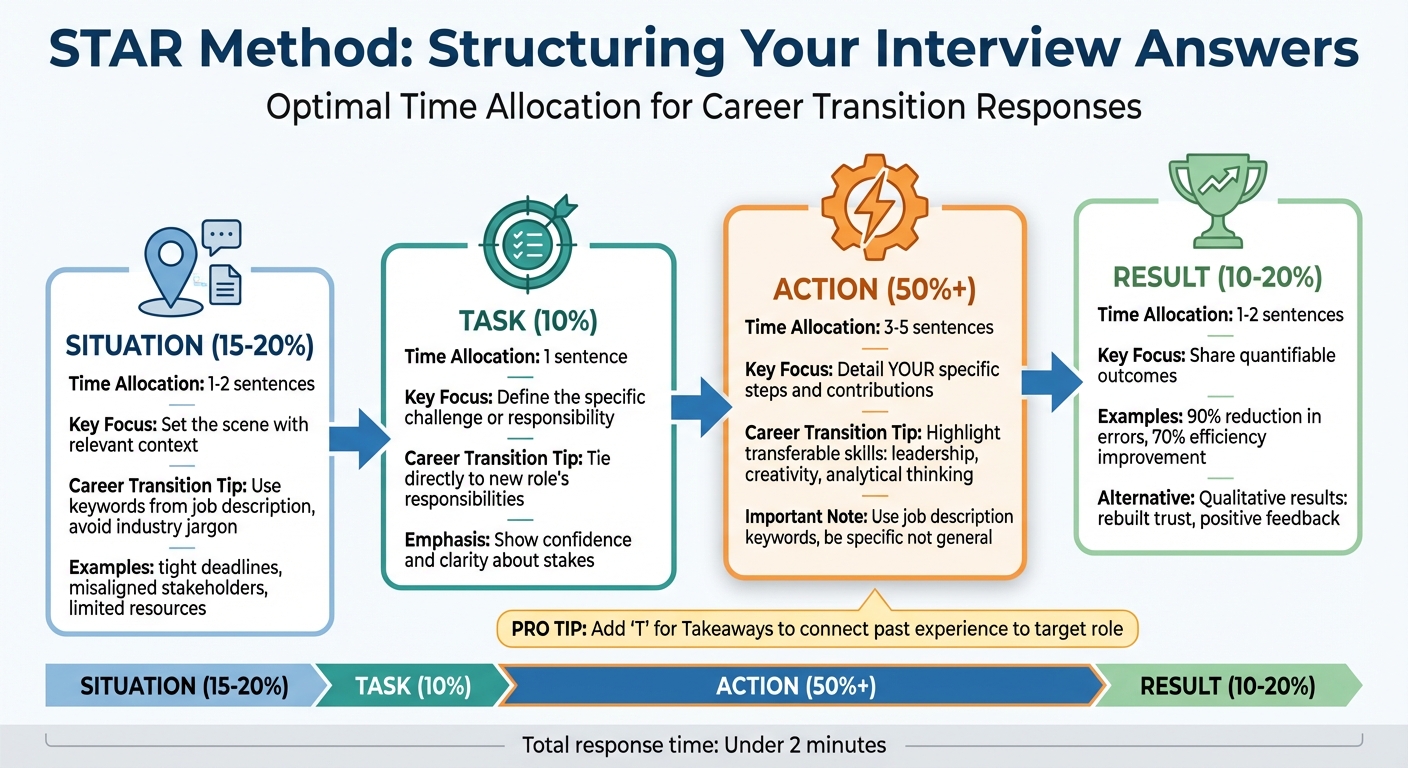
STAR Method Framework for Career Transition Interviews
Situation: Describe the Context
Keep the Situation concise - about 15% to 20% of your total response, which usually means one to two sentences. Focus on setting the scene with only the most relevant details. Mention things like the project name, team size, or the specific challenge you encountered, but avoid unnecessary details that could distract from the main point.
If you're transitioning careers, choose examples that reflect challenges similar to those faced by the company you're interviewing with. Research the organization and use keywords from the job description to frame your context effectively. Instead of relying on industry-specific jargon, describe challenges that resonate universally, like "tight deadlines", "misaligned stakeholders", or "limited resources". This approach helps the interviewer connect your experience to their needs. Once you've set the context, clearly outline the specific challenge you were up against.
Task: Explain the Challenge
The Task should take about 10% of your response time - typically just one sentence that defines the specific problem or responsibility you needed to address. Focus on describing the challenge in a way that ties directly to the responsibilities of the role you're applying for. This is your chance to show how your past experience aligns with the needs of the position.
Be confident and clear when explaining the stakes and the scope of your responsibility. This sets the stage for the Action section, where you'll dive into how you approached the problem and applied your skills.
Action: Show Your Transferable Skills
The Action section is the core of your answer, taking up more than 50% of your response. Use 3–5 sentences to detail the steps you took, highlighting both technical abilities and soft skills like leadership, creativity, or empathy. Even if it was a team project, emphasize your individual contributions.
Be specific - avoid general statements like "I usually handle these situations." Instead, describe exactly what you did in this particular instance. Tie your actions to the job description by incorporating keywords like "collaboration" or "analytical thinking" if they are relevant to the role. This level of detail shows how your problem-solving approach and skills are directly applicable to the new position.
Result: Share Measurable Outcomes
The Result section should take up 10% to 20% of your response, usually one to two sentences. Whenever possible, include quantifiable outcomes - numbers, percentages, or dollar figures make your achievements more concrete. For example, you could mention a "90% reduction in data entry errors" or a "70% improvement in task efficiency".
If hard numbers aren't available, focus on qualitative results, such as "rebuilt trust with stakeholders" or "received positive feedback from supervisors". These outcomes still demonstrate the value you bring to the table.
| STAR Component | Time/Length | Focus for Career Transitions |
|---|---|---|
| Situation | 15-20% / 1-2 sentences | Highlight transferable context and align with new job keywords |
| Task | 10% / 1 sentence | Define the challenge in a way that relates to the new role's duties |
| Action | 50%+ / 3-5 sentences | Detail steps taken, emphasizing transferable soft and hard skills |
| Result | 10-20% / 1-2 sentences | Share quantifiable outcomes that prove value to the new employer |
Common Interview Questions for Career Transitions
Top Questions for Role Transitions
When transitioning careers, interviewers often focus on your ability to adapt, your readiness for the role, and how quickly you can contribute. These questions are designed to gauge your commitment and how your past experiences align with the new position. Using the STAR method (Situation, Task, Action, Result) is a great way to structure your answers, especially since it highlights how your transferable skills can be applied effectively.
Here are some common behavioral questions you might encounter, along with tips for crafting strong STAR-based responses:
"Tell me about a time you successfully adapted to a new role or environment."
In your response, go beyond generalities. Share specific actions you took, such as enrolling in courses, seeking mentorship, or engaging in self-study. Wrap up with measurable outcomes, like improved efficiency or achieving key milestones.
"Describe a situation where you had to learn a new technology or process quickly."
Name the exact resource you relied on - whether it was a certification program, a book, or a hands-on project. Explain how you sought feedback and iterated on your approach, demonstrating your adaptability and openness to learning.
"How will your experience from previous roles benefit our company?"
Identify 3-5 key skills from the job description that you’ve previously honed. When discussing your Action, use specific terms like "analytical thinking" or "stakeholder alignment" to show how your expertise directly applies to the role.
"Tell me about a time you used data to make a decision in an area where you were not an expert."
Focus on your problem-solving process. Talk about how you addressed knowledge gaps by consulting experts, conducting research, or applying frameworks from other industries. Highlight your ability to navigate unfamiliar challenges effectively.
"What approaches will you use to fill any skill gaps needed for this new career?"
Rather than simply stating that you’re eager to learn, provide personalized answer suggestions and concrete examples of steps you’ve already taken. For instance, mention specific training programs, certifications, or side projects that have prepared you for the role.
With 53% of employees who quit in 2021 shifting to new careers within a year, interviewers expect concise and impactful answers. Aim to keep your responses under two minutes, dedicating about 60% of that time to the Action phase, where you demonstrate how you tackled challenges or achieved results.
Practicing STAR Answers with Acedit
Acedit's Mock Interview Tools
Acedit’s Chrome extension takes STAR interview prep to the next level with role-specific simulations and instant feedback. By uploading your resume and job description, the AI generates tailored behavioral questions. For example, if you're moving from marketing to sales, you might see a question like, "Tell me about a time you handled a difficult client". During mock interviews, the adaptive AI interviewer adjusts its follow-up questions based on your prior answers, mimicking how real interviewers probe deeper.
The platform also provides real-time coaching to analyze your responses as you type or speak. It ensures about 60% of your answer highlights the Action phase and includes measurable outcomes. For instance, if you mention "improved efficiency", the AI might prompt you to clarify with specifics like "reduced processing time by 30%". This method ensures your transferable skills are front and center - a key reason why 94% of users report feeling ready for actual interviews after practicing with Acedit.
"Being able to prepare for interviews with real-time AI feedback was a game changer and made me feel confident for my interview." - William Johnson
Acedit also integrates with LinkedIn to refine its suggestions based on your professional history. Plus, it works seamlessly with platforms like Zoom, Microsoft Teams, and Google Meet. With over 15,000 questions practiced and a 91% improvement in response quality reported by users, Acedit helps you build the confidence and muscle memory to deliver concise STAR answers in under two minutes. Once you’re ready, you can explore the pricing plans to find the right fit for your preparation needs.
Acedit Pricing Plans for Interview Practice
Acedit’s pricing plans are designed to cater to various levels of interview prep. With three one-time payment options, you can choose the plan that best aligns with your needs.
- The Free Plan ($0) provides 4 Q&A sessions per job listing, 2 mock interviews, and basic STAR examples, making it perfect for trying out the platform.
- The Premium Plan ($45 one-time) offers unlimited Q&A generation and 6 mock interviews, ideal for career transitions where you need to craft and refine multiple STAR stories without over-preparing.
- The Premium Plus Plan ($75 one-time) removes all restrictions, granting unlimited mock interviews and live AI-assisted sessions for those requiring intensive preparation.
| Plan | Price | Mock Interviews | Q&A Generation | Real-Time Coaching | Best For |
|---|---|---|---|---|---|
| Free | $0 | 2 | 4 per job | Basic | Testing features |
| Premium | $45 (One-time) | 6 | Unlimited | Included | Role transitions |
| Premium Plus | $75 (One-time) | Unlimited | Unlimited | Included | Intensive practice |
To keep your practice relevant, make sure to update your job descriptions regularly. If your needs change, you can easily manage your subscription through the Chrome Web Store.
Conclusion
The STAR method offers a practical way for career changers to link their past achievements to the demands of a new role. By putting extra emphasis on the Action and Result phases - these should make up more than half of your response - you showcase your problem-solving abilities and the measurable outcomes of your efforts, rather than just recounting events. This structure is especially helpful for explaining non-linear career paths and ensures hiring managers can fairly evaluate you alongside candidates with more traditional backgrounds.
Mock interviews take STAR preparation from concept to execution. Saying your answers out loud helps you polish your delivery, ensuring your responses feel natural instead of rehearsed. Keeping your answers concise - under two minutes - also helps maintain the interviewer’s attention. Adding a "T" for Takeaways at the end of your response is an excellent way to highlight how your past experiences align with the role you’re targeting, an essential step for career transitions.
"Understanding and applying the STAR interview method can be the deciding factor between landing an offer or continuing your job search." - Marlo Lyons, Career Coach and Author
Acedit's AI-powered mock interviews provide the immediate feedback you need to build confidence quickly. They help you develop 3-5 adaptable stories that highlight transferable skills with specific, quantifiable results. Whether you’re exploring the Free Plan or diving deep with Premium Plus, the goal remains the same: to walk into your interview ready to prove you’re the right fit, even if your resume tells a non-traditional story.
Career transitions demand more than just optimism - they require preparation that demonstrates your ability to succeed. By combining the STAR method with focused mock interview practice, you can turn your past experiences into powerful evidence that you’re ready for the next step.