
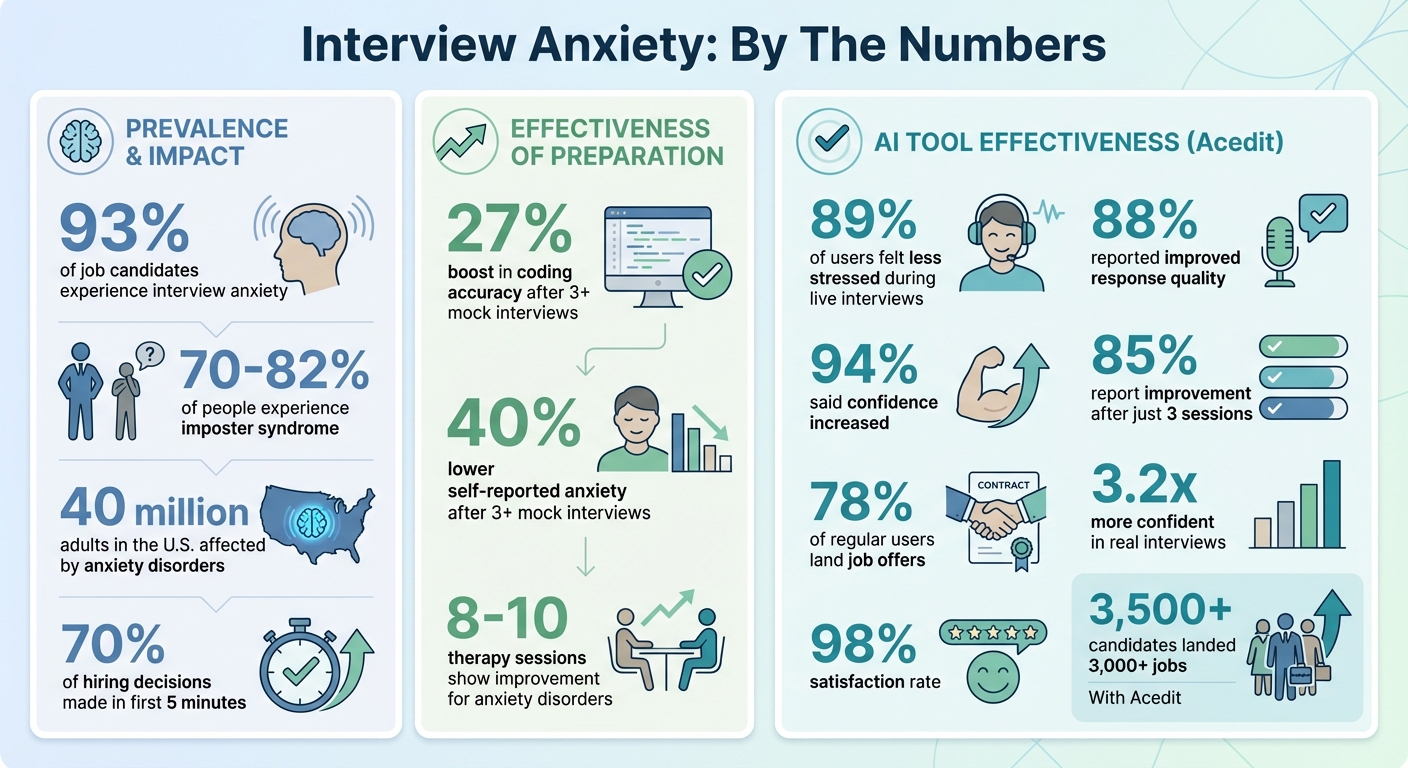
Interview anxiety is common - 93% of job candidates experience it. It’s caused by fear of rejection, uncertainty, perfectionism, and past negative experiences. This guide focuses on practical ways to manage anxiety, including preparation strategies, real-time techniques, and tools like AI-powered mock interviews. Key takeaways include:
- Preparation helps: Research the company, practice with mock interviews, and use the STAR method to structure answers.
- Calm your body and mind: Techniques like 4-7-8 breathing, power posing, and grounding exercises can reduce stress.
- Reframe your mindset: Label anxiety as excitement and focus on your strengths instead of negative self-talk.
- Leverage AI tools: Platforms like Acedit provide live coaching, tailored questions, and response suggestions to build confidence.
Interview Anxiety Statistics and Impact Data
OVERCOMING INTERVIEW ANXIETY! (7 Tips For Reducing Interview Stress, Nerves & ANXIETY!)
sbb-itb-20a3bee
What Causes Interview Anxiety?
Interview anxiety stems from how our brains perceive these situations as threats. This reaction activates survival instincts, which, in the past, helped protect humans from the dangers of social rejection. Back then, group acceptance was critical to survival, so it's no wonder interviews can feel like a life-or-death scenario today.
Fear of Rejection and Uncertainty
Rejection hits hard because humans are wired to seek acceptance. Add to that the uncertainty of not knowing what questions will come up, how the interview will go, or what the hiring team expects, and it’s no surprise anxiety kicks in. When uncertainty looms, your brain treats it as a threat, raising the stakes even higher - especially when you’re banking on the paycheck, trying to prove your worth, or fearing harsh judgment.
"Nerves aren't necessarily bad, they just mean that you really, really want something." – Sinead, Indeed Career Expert
Perfectionism and Imposter Syndrome
Ever feel like you’ve fooled everyone into thinking you’re capable? That’s imposter syndrome, and it’s surprisingly common - affecting 70–82% of people. It creates a nagging fear that you’ll be "exposed" during an interview. Perfectionists often make this worse by setting impossibly high standards. They see any misstep, like stumbling over a question, as a sign of failure rather than a normal part of the process. You might even fixate on one missing qualification in a job description and convince yourself you’re unfit for the role, ignoring all the other skills you bring to the table.
"There's an ongoing fear that's usually experienced by high-achieving individuals that they're going to be 'found out' or unmasked as being incompetent or unable to replicate past successes." – Audrey Ervin, PhD, Clinical Psychologist
Past Negative Experiences
Bad experiences from previous interviews or workplace conflicts can leave lasting scars. Your brain may interpret new interviews as high-pressure situations based on those past setbacks. If you’ve ever blanked out or visibly struggled during an interview, you might become hyper-aware of physical symptoms like a cracking voice or shaky hands. This creates a vicious cycle where focusing on these signs only amplifies your anxiety. Negative self-talk creeps in, convincing you that past failures will inevitably repeat.
Understanding these triggers is a step toward managing interview anxiety. Recognizing how your mind and body react can help you perfect your interview preparation for the challenges ahead.
How to Recognize the Signs and Symptoms
Understanding how interview anxiety manifests in your body and mind is the first step to keeping it under control. You're not alone - 93% of people admit to feeling tense or nervous before a job interview. Spotting these signs early can help you manage them before they escalate.
Physical Symptoms
Your body often sends out clear distress signals when anxiety kicks in. A racing heartbeat is usually one of the first signs, often accompanied by sweaty palms, trembling hands, or nausea. You might notice shallow, rapid breathing or feel tightness in your neck, shoulders, or chest. Other common clues include a dry mouth, dizziness, a clenched jaw, cold hands, or even indigestion.
This physical reaction stems from your brain's "fight, flight, or freeze" response to perceived danger. When you view an interview as a threat, your body releases cortisol and adrenaline, which can leave you feeling tense or aggressive (fight), desperate to back out (flight), or completely stuck (freeze). Instead of resisting these sensations, use them as signals. For instance, sweaty palms or a knot in your stomach can remind you to pause, breathe deeply, and center yourself. Anxiety doesn’t just stop at physical symptoms - it also takes a toll on your mental state.
Emotional and Mental Responses
Anxiety impacts your thoughts just as much as your body. You might experience racing thoughts, moments of blankness, difficulty focusing (often described as brain fog), or a sense of dread. Negative self-talk and endless "what if" scenarios can also take over.
Behavioral signs often include fidgeting, pacing, nail-biting, or speaking too quickly. You might ramble, avoid eye contact, or stumble over your words. If your mind goes blank during an interview, try responding with, "That's a great question, let me take a moment to think about it." This gives you time to regroup. Even simply acknowledging your feelings - saying to yourself, "I feel tense right now" - can help shift your mindset from panic to problem-solving. Recognizing these cues is the first step to tackling interview anxiety head-on.
"Anxiety is a sign that you care about the interview and want to do well. Telling yourself not to have anxiety is actually more likely to make you even more anxious." – Meagan Drillinger, Wellness Writer
Preparation Strategies to Reduce Anxiety
Feeling prepared can do wonders for calming your nerves. When you know what to expect and have practiced your responses, your brain is less likely to perceive the interview as a threat. In fact, research shows that completing at least three mock interviews can boost coding accuracy by 27% and lower self-reported anxiety levels by 40%. Just a few practice sessions can make a noticeable difference, helping you approach the interview with more confidence.
Research and Mock Interviews
Start by digging into the company’s mission, values, and recent projects. Take a close look at the job description, paying attention to key qualifications and keywords. This helps you tailor your answers and reduces the uncertainty that can fuel anxiety.
Mock interviews are your best friend here. Whether you practice with a friend, career services, or even record yourself, these sessions can help you spot nervous habits like avoiding eye contact or overusing filler words. The more you rehearse, the less likely your body is to trigger that fight-or-flight response when it’s time for the real thing. As Formation.dev puts it: "The more we do something, the less scary it gets".
Use the STAR method (Situation, Task, Action, Result) to organize your answers to behavioral questions and answers. This structure keeps you on track and prevents rambling if anxiety kicks in. It’s also a good idea to prepare for moments when you might blank out. Phrases like, "That’s a great question, let me think about that for a moment", can buy you time to gather your thoughts without losing your composure. You can also use AI-powered response suggestions to refine your delivery. Once you’ve nailed down your responses, incorporate visualization and body language techniques to lock in your confidence.
Visualization and Power Posing
Mental rehearsal can be surprisingly effective. Spend 2–5 minutes daily imagining yourself in the interview: making eye contact, responding calmly, and ending with a firm handshake. This practice helps create a mental roadmap, making the actual experience feel less intimidating. Oprah Winfrey famously said, "Visualization is the most powerful mind exercise you can do".
On the day of the interview, try a power pose - stand tall with your hands on your hips for two minutes. This simple posture opens up your chest and can help reduce stress. Pair it with box breathing (inhale, hold, exhale, and hold for four seconds each) for 5–10 minutes beforehand to center your thoughts. These small but effective techniques shift your body from a state of panic to one of readiness.
Behavioral Techniques for Managing Anxiety
Once you're familiar with the physical and mental signs of anxiety, it's time to focus on practical strategies to manage them in the moment. Even with preparation, it's natural for your body to slip into fight-or-flight mode during high-pressure situations like an interview. These real-time techniques work alongside your pre-interview preparation to help you stay composed when it counts. Combining these with proven interview strategies ensures you are ready for any scenario.
Breathing and Grounding Exercises
Your breathing is a powerful tool for calming your body and mind. Simple breathing exercises can activate your parasympathetic nervous system, which helps reduce your heart rate and clears mental fog. One effective method is the 4-7-8 technique: inhale for 4 seconds, hold your breath for 7 seconds, and exhale slowly for 8 seconds. This can create a deep sense of relaxation. Another option is box breathing, where you inhale, hold, exhale, and pause for 4 seconds each. This technique is even used by Navy SEALs to stay focused under pressure.
You can also try the "sigh of relief" method - take a deep breath with a slight pause at the top, then exhale with a soft sigh. This simple act can help release tension. Additionally, accepting a glass of water during an interview can give you a brief moment (5–10 seconds) to gather your thoughts if you feel flustered.
Once you've calmed your body, you can shift your attention to reframing your mindset for confidence.
Cognitive Reframing
Interestingly, anxiety and excitement feel the same in your body - both come with a racing heart and a surge of adrenaline. Instead of labeling your nerves as anxiety, say to yourself, "I'm excited for this interview." This small shift can help you see the situation as an opportunity rather than a threat.
Another helpful approach is to challenge anxious thoughts. Before the interview, write down your specific worries and ask yourself, "Is there any real evidence for this?" Breaking down your concerns like this can make them feel less overwhelming. Replace negative thoughts like "I'm going to fail" with positive affirmations such as "I am prepared". As Oscar Wilde once said, "Worry is misspent imagination".
Finally, remind yourself that an interview is a two-way conversation. You're not only being evaluated - you’re also assessing if the company is the right fit for you. This perspective can ease the pressure to perform perfectly.
Using AI Tools Like Acedit to Reduce Anxiety
In addition to the techniques mentioned earlier, AI tools can offer a structured way to tackle anxiety by addressing preparation gaps and uncertainty. While methods like breathing exercises help in the moment, AI-powered tools like Acedit help build confidence well before the interview even begins.
Real-Time Coaching and Response Suggestions
Acedit, a Chrome extension powered by AI, supports live Zoom, Microsoft Teams, and Google Meet interviews by detecting questions and generating personalized response suggestions based on your resume and job details. This feature can be a lifesaver when nerves get the better of you.
Research shows that 89% of users felt less stressed, and 88% reported improved response quality during live interviews. Even more impressively, 94% of users said their confidence increased, helping to tackle fears of rejection and uncertainty. As Sophia Lang put it:
"The live prompts during my interview boosted my preparation and confidence".
Acedit also offers mock interviews using the same interface as actual interviews, helping users get comfortable with the technology. Its adaptive questioning mimics real interview scenarios, creating a realistic practice environment. After just three sessions, 89% of users report measurable improvement, and 94% feel ready for the real thing.
This combination of real-time support and realistic practice makes Acedit a powerful tool for easing pre-interview anxiety.
Personalized Q&A and Confidence Building
Generic interview prep often falls short because it doesn’t address individual needs. Acedit takes a different approach by analyzing your LinkedIn profile and resume to generate tailored interview prep questions and STAR (Situation, Task, Action, Result) examples specific to the role you’re targeting. This level of personalization reduces the guesswork about potential questions.
The tool also offers multiple response variations, helping you avoid the pressure of crafting the "perfect" answer. Seeing practical, evidence-based examples can boost your confidence significantly. Users who practice with role-specific simulations report feeling 3.2 times more confident in real interviews, and 78% of regular users land job offers. William Johnson shared his experience:
"Being able to prepare for interviews with real-time AI feedback was a game changer and made me feel confident for my interview".
Acedit’s STAR builder is another helpful feature, offering a clear framework for structuring your answers. This can be a reliable tool to lean on when anxiety strikes during an actual interview.
Acedit Plans Comparison
Acedit provides three pricing options to suit different levels of preparation:
| Feature | Free | Premium | Premium Plus |
|---|---|---|---|
| AI-Assisted Live Interviews | Included (Limited) | Limited to 3 | Unlimited |
| Practice Q&A Generation | 4 per job listing | Unlimited | Unlimited |
| Simulated Practice Interviews | Limited to 2 | Limited to 6 | Unlimited |
| AI Cover Letter Generation | Maximum 2 | Unlimited | Unlimited |
| LinkedIn Profile Integration | Yes | Yes | Yes |
| Custom STAR Examples | Yes | Yes | Yes |
| Advanced AI Response Suggestions | Yes | Yes | Yes |
| Price | $0 | $45 (One-Time) | $75 (One-Time) |
Both paid plans offer lifetime access with a one-time payment. If you’re preparing for multiple interviews or want unlimited practice, the Premium Plus plan removes all restrictions. With over 3,500 candidates landing more than 3,000 jobs and a 98% satisfaction rate, Acedit is a practical choice for reducing interview anxiety and boosting performance. It is one of many ways to use AI in your job search to gain a competitive edge.
Building Long-Term Confidence
Interviewing is a skill that gets better with consistent effort and practice. To maintain confidence over the long haul, schedule 30 minutes every week for focused preparation. Use this time to rehearse answers and update a list of three to five measurable professional achievements. Keeping this list current ensures you’ll always have examples ready, reducing last-minute stress before interviews.
Familiarity with interview scenarios can help reduce anxiety. By recording yourself or using AI-powered mock interviews, you train your brain to view these situations as less intimidating. This approach works similarly to how therapists treat phobias - exposure gradually reduces fear. While short-term techniques can boost confidence before an interview, regular practice builds a solid foundation for resilience. Sometimes, though, professional guidance may be necessary.
When to Seek Professional Support
For many, self-guided strategies are enough, but there are times when expert help becomes crucial. If anxiety consistently affects your ability to communicate clearly, leads you to avoid career opportunities, or disrupts your daily life, consider seeking professional support. Anxiety disorders impact about 40 million adults in the U.S. and are often triggered by work-related stress. Encouragingly, many people see improvement after just 8 to 10 therapy sessions.
Cognitive Behavioral Therapy (CBT) is a common treatment for managing deeper anxiety. It focuses on identifying and changing negative thought patterns that fuel stress. If you find yourself repeatedly making the same mistakes despite preparation, or if you experience physical symptoms like chest pain or a racing heart that don’t subside, therapy can help. For sharpening interview techniques, professional coaching is a great option, but therapy is more appropriate when anxiety leads to significant challenges or panic attacks.
Maintaining Progress After the Interview
Your preparation doesn’t stop once the interview ends. Reflecting on your performance afterward can reinforce what you’ve learned. Reflective journaling is a useful tool for this. Within 24 hours of an interview or practice session, ask yourself three questions: What went well? What could I improve? How did I handle my emotions? This process allows you to track progress and pinpoint areas for growth without dwelling on negativity. If there were moments where you felt thrown off or defensive, make note of them and plan neutral responses for the future.
Incorporating daily habits can also help sustain your confidence. For example, try the 4-7-8 breathing technique: inhale for 4 seconds, hold for 7 seconds, and exhale for 8. Practicing this regularly - not just during stressful moments - can calm your nervous system. Additionally, write down two or three of your strengths each day to reinforce a positive mindset and belief in your abilities. As career expert Ken Blanchard wisely says:
"Feedback is the breakfast of champions".
Conclusion
Interview anxiety is something most job candidates - 93% to be exact - experience. But here's the good news: it’s manageable. The key to overcoming it lies in a mix of preparation, mindset techniques, and leveraging modern tools. Start by researching the company thoroughly and practicing frameworks like the STAR method to steer the conversation into a professional, engaging dialogue. On top of that, techniques such as box breathing or the 5-4-3-2-1 grounding method can help calm your nerves and prevent your mind from freezing under pressure.
Adding technology to your preparation can take things to the next level. Platforms like Acedit offer a judgment-free zone for practicing interviews repeatedly. With features like real-time question detection and AI-generated responses, it helps you build the mental "muscle memory" needed for high-stress scenarios. The platform’s simulations act like exposure therapy, helping you shift your perception of interviews from intimidating to manageable. Unlike practicing with friends, Acedit provides structured, objective feedback on your delivery and content, turning vague practice into measurable improvement.
It’s worth noting that 70% of hiring decisions are made in the first five minutes, so starting strong is crucial. AI-driven tools can help you achieve that early composure. In fact, 85% of users report improvement after just three sessions on Acedit. These aren’t just numbers - they reflect real, actionable strategies that can transform your interview experience when applied consistently.
FAQs
How can AI tools help me prepare for job interviews effectively?
AI tools can play a big role in helping you get ready for interviews by providing customized feedback, practice scenarios, and real-time guidance. They’re like having a personal coach, helping you rehearse answers, adjust your tone, and sharpen your delivery. Plus, practicing repeatedly can help ease those pre-interview jitters.
These tools come packed with features like real-time question detection, customized response suggestions, and interview simulations to create a realistic practice environment. Many also guide you through structured methods, such as STAR (Situation, Task, Action, Result), and offer insights into common questions tailored to your role or industry. Using these tools can help you boost your confidence, polish your performance, and improve your chances of nailing that interview.
What are some quick and effective ways to calm your nerves before an interview?
Feeling a bit jittery before an interview? That’s completely normal! The good news is there are a few simple tricks to help you feel more calm and in control.
Start with deep breathing: breathe in through your nose for four seconds, hold it briefly, and then exhale slowly through your mouth for six seconds. This can do wonders for calming both your body and your mind.
Another helpful trick is the 3-2-1 technique. Look around and name three things you can see, focus on two sounds you can hear, and think of one positive thing about yourself. It’s a great way to ground yourself and shift your attention away from nerves.
Need a confidence boost? Picture yourself acing the interview. You can also try a power pose - stand tall, pull your shoulders back, and place your hands on your hips for a minute. It might feel silly, but it can give you that extra shot of self-assurance you need. Small steps like these can go a long way in helping you feel ready to shine.
Why is it important to understand the causes of interview anxiety?
Understanding what causes interview anxiety is key to tackling it head-on and finding ways to manage it. Common triggers, like the fear of rejection, uncertainty about what questions might come up, or struggling with self-doubt, can all contribute to that sense of unease. Once you pinpoint these triggers, you can take steps to prepare and adjust your perspective.
For example, knowing that anxiety often stems from the brain’s natural "fight-or-flight" response can make those feelings seem less overwhelming. Simple techniques like deep breathing or visualization can help you stay calm and centered. This not only eases the physical tension that stress creates but also boosts your confidence, helping you walk into interviews feeling more prepared and in control.